








The day after the first boats of the Global Samud Flotilla set sail carrying humanitarian aid for Gaza – although those that departed from Barcelona had to return to port due to bad weather – Israel’s far-right minister Itamar Ben-Gvir announced that his government would treat humanitarian activists as terrorists. He also unveiled a plan for their prolonged detention in two high-security prisons, while all vessels involved would be seized.
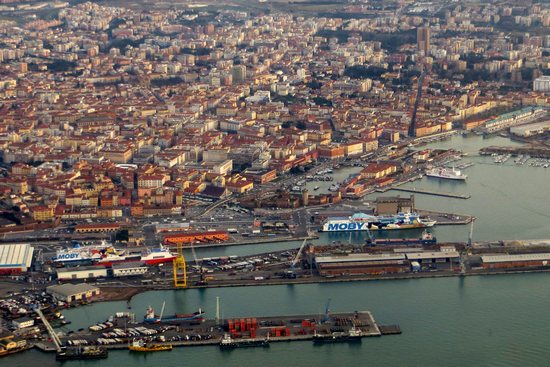
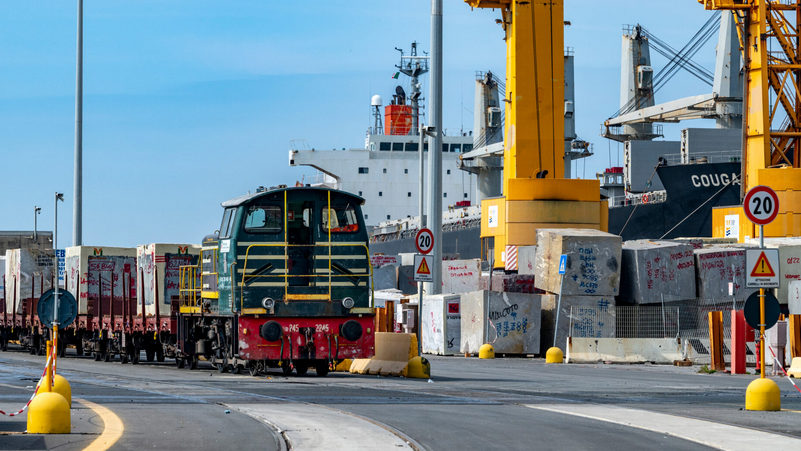
The Genoa dockers were quick to respond. Riccardo Ludino, a representative of Calp, said that if contact with the boats is lost for as little as twenty minutes, all shipments destined for Israel would be halted. From Liguria alone, this represents 13,000 to 14,000 containers. He added that if aid does not reach the people of Gaza, “not even a nail will leave for Israel”. His statement was backed by the grassroots union Usb, which said that the mobilisation would be extended across Europe.
The dockers also announced that on 26 and 27 September Genoa will host a meeting of worker delegates from leading ports around the Mediterranean as well as from Germany and Sweden, to organise an international day of mobilisation against the war. Flai Cgil has also come out in support of the Global Samud Flotilla mission, describing it as “a fundamental act of courage, civic commitment and tangible solidarity with a people who are victims of genocide”.
On 31 August, the International Association of Genocide Scholars, which brings together around five hundred experts on genocide, approved a resolution stating that “Israel’s policies and actions in Gaza meet the legal definition of genocide under Article II of the United Nations Convention on the Prevention and Punishment of the Crime of Genocide (1948)”. The convention defines genocide as acts “committed with intent to destroy, in whole or in part, a national, ethnic, racial or religious group”.
The association further declared that “Israel’s policies and actions in Gaza constitute war crimes and crimes against humanity under the definitions of international humanitarian law and the Rome Statute of the International Criminal Court”, citing “starvation, denial of humanitarian aid, water, fuel and other essentials for survival, sexual and reproductive violence, and the forced displacement of the population”.
Meanwhile, on the media front, Reporters Without Borders and the Avaaz platform – which brings together hundreds of news organisations – have launched a campaign to protect journalists in Gaza and to uphold the right of foreign media to access the territory independently. According to Reporters Without Borders, 220 journalists have been killed by the Israeli army in Gaza in less than 23 months. On the night of 10 August alone, six journalists were killed in a targeted strike on Al-Jazeera correspondent Anas al-Sharif. Less than a week ago, on Monday 25 August, the Israeli army killed five journalists in two consecutive attacks.