






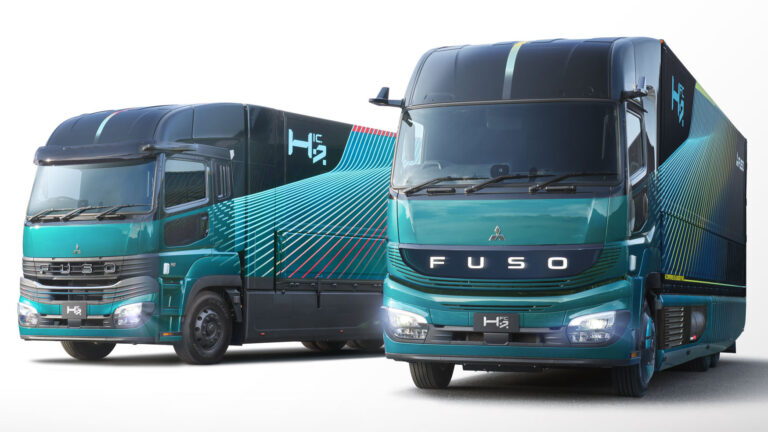
Fuso showcased two industrial vehicle prototypes at the Japan Mobility Show 2025 that outline its hydrogen strategy for long-distance freight transport, a segment where the shift towards carbon neutrality is progressing at a different pace compared with urban distribution. After its experience with the medium-light eCanter, already used for city deliveries and short routes, the manufacturer is now focusing on applications where range, rapid refuelling and payload capacity require technical solutions other than battery-electric systems. During the event, the company stated that hydrogen can serve as a complementary solution to achieve zero emissions for vehicles with a gross weight of up to 25 tonnes.
The two prototypes unveiled at the show, named H2fc and H2ic, represent distinct approaches to the use of hydrogen. The H2fc, designed as an electric vehicle powered by fuel cells, uses liquid hydrogen which, thanks to its higher energy density compared with compressed hydrogen, allows more fuel to be stored in a smaller space and delivers longer ranges, crucial for routes such as Tokyo–Osaka or Fukuoka. The project also removes the traditional technical module positioned behind the cab, familiar from other fuel-cell trucks, thereby preserving space for body configurations identical to those of a diesel truck. This required a re-engineering of the vehicle architecture, with redesigned power supply and thermal management systems.
The choice of liquid hydrogen is combined with the use of sLH2 technology, a refuelling method that keeps the fuel at temperatures below its boiling point to reduce the “boil-off” effect that tends to generate gas that must be vented. Continuous cooling enables more efficient use of the fuel and may simplify the equipment required at refuelling stations, potentially lowering infrastructure costs.
The second prototype, the H2ic, is equipped with an internal combustion engine fuelled by compressed hydrogen at 70 MPa. This solution preserves around 80 per cent of the components of existing diesel vehicles, offering a faster and more cost-effective transition path. The use of compressed hydrogen with lower purity than that required for fuel cells also makes integration with the current refuelling network easier, while still ensuring a significant reduction in carbon dioxide emissions.
Data released by the manufacturer show a clear difference between the two systems. The H2fc electric model stores 80 kilograms of liquid hydrogen in two cryogenic tanks and reaches a range of up to 1,200 kilometres, while the H2ic thermal version uses 58 kilograms of compressed hydrogen distributed across eight type-IV tanks for a range of around 700 kilometres. Both models maintain a gross vehicle weight of 25 tonnes, with the H2fc configured for a full-volume body without internal limitations.
Refuelling times are estimated at around 15 minutes for liquid hydrogen and 25 minutes for compressed hydrogen, with the H2ic featuring two medium-flow refuelling points designed to shorten the process once the standard becomes available. Currently, only the normal-flow protocol is regulated at operational stations.
In terms of driving safety, the electric version introduces a three-dimensional viewing system with bird’s-eye monitoring, while the combustion model adopts Daimler’s camera system and a device offering 270-degree blind-spot coverage. Both incorporate materials with reduced environmental impact inside the cab, consistent with a broader sustainability approach.
From an engineering perspective, the two prototypes are derived from the 2024 Super Great platform, adapted to accommodate new components. The electric version integrates a fuel-cell module, a high-voltage electrical architecture, thermal management systems and liquid-hydrogen storage, as well as electrified auxiliary devices. The combustion variant features Daimler’s internal combustion engine, compressed-hydrogen storage, dedicated safety measures and a real-time control interface for system parameters.
The H2fc project required extensive validation work due to the absence in Japan of a defined regulatory framework for the use of liquid hydrogen in industrial vehicles. Re-engineering the fuel-cell system, originally designed for high-pressure compressed hydrogen, involved creating a specific supply circuit and removing components typical of 70 MPa systems. Verification activities include propulsion simulations to estimate range, tests on fuel-cell systems to assess compatibility with the new architecture, and ongoing trials on cryogenic tanks. For the H2ic, Fuso reports that it already meets the Unr134 national-unified requirements thanks to tests conducted with the Jari institute.
The hydrogen technology initiative aligns with Japan’s national strategy, which foresees a growing role for this energy carrier in transport and industry. However, the main constraint remains infrastructure availability, particularly for liquid hydrogen, which requires dedicated facilities. For this reason, Fuso plans to launch a pilot programme with the construction of specific stations, a phase considered essential to assess system behaviour under real operating conditions and define the next steps in development.