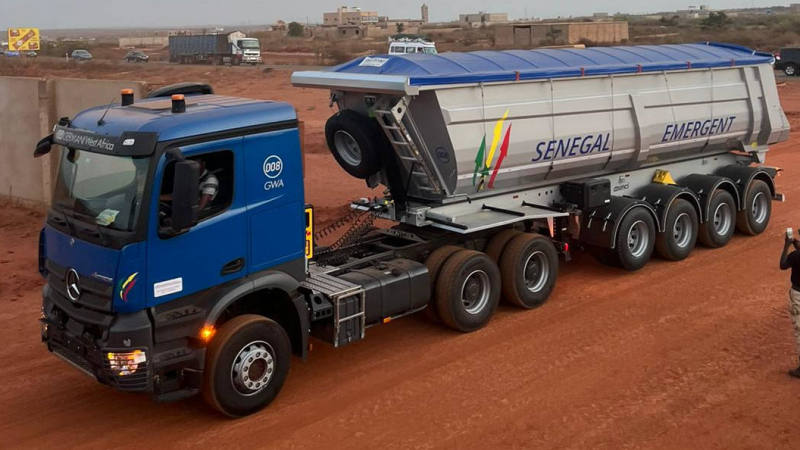







Electric lorries will continue to benefit from the exemption from the Swiss heavy vehicle charge (Ttpcp) for another three and a half years. However, from 2029 onwards, they will be required to pay the toll. This decision, taken by the Federal Council on 28 May 2026, brings the measure forward by two years, with the aim of encouraging a shift from road to rail freight transport. The reform introduces a system of gradually decreasing discounts until 2035 to support the transition to electric vehicles, while simultaneously moving Euro VI vehicles into the second-highest toll category to offset revenue losses caused by the growing number of environmentally friendly vehicles currently exempt from the tax.
According to Swiss authorities, the Ttpcp system, in place since 2001, is reaching its structural limits due to recent technological developments in road freight transport. Today, nearly 90% of heavy goods vehicles operating on Swiss roads fall into the most favourable toll category, significantly undermining the tax's effectiveness in promoting modal shift. As Federal Councillor Albert Rösti explained during the 28 May press conference, this trend is nonetheless positive as it signals ongoing decarbonisation and the increasing use of cleaner vehicles.
The exponential growth of electric trucks poses a particular challenge for infrastructure funding. In 2022, Switzerland had 234 electric lorries exempt from the Ttpcp, a number that rose to over one thousand in 2025. Under the most optimistic scenarios, electric vehicles could make up the entire fleet by 2050, potentially leading to a loss of several billion francs in revenue. The Ttpcp currently generates around 1.8 billion francs annually, two-thirds of which go to the Confederation and one-third to the cantons.
The current Ttpcp tariff system is based on three key factors: the vehicle’s total weight, its emissions category under Euro standards, and the kilometres driven within Switzerland and Liechtenstein. Existing rates are divided into three categories based on environmental class: category I at 3.26 Swiss centimes per tonne-kilometre, category II at 2.82 centimes, and category III (Euro VI) at 2.39 centimes. These rates were increased by 5% on 1 January 2025 to reflect general inflation.
The reform entails a significant overhaul of this system. Euro VI vehicles, currently in the most advantageous category and representing the majority of the fleet, will be moved to the second-highest tariff category. This reclassification will substantially increase costs for such vehicles. For example, a 100-kilometre journey with an 18-tonne Euro VI truck will cost approximately 51 francs, based on the new rate of 2.82 centimes per tonne-kilometre.
From 2029, electric trucks will be subject to the Ttpcp at a base rate of 2.39 centimes per tonne-kilometre, the same as that currently applied to Euro VI vehicles. However, in the first year, they will benefit from a discount of up to 70% on the base rate. This discount will decrease by ten percentage points each year until it reaches 10% in 2035. The structure offers long-term planning certainty for haulage companies, which is crucial for investments in new technologies.
This new framework will apply to all battery-powered and hydrogen fuel cell vehicles, thus recognising the full spectrum of locally emission-free technologies. However, the reform does not include discounts for vehicles powered by biogas, liquefied or compressed natural gas, or synthetic fuels (e-fuels), in order to prevent further erosion of the Ttpcp's effectiveness and to simplify the collection system.
The reform also includes differentiated incentives designed to promote the adoption of cleaner technologies without undermining the competitiveness of the haulage sector. In addition to electric vehicles, newly registered Euro VII diesel trucks will benefit from Ttpcp discounts until 2035, to distinguish them from Euro VI models and encourage fleet renewal. This measure acknowledges the environmental contribution of advanced combustion technologies while preserving a competitive edge for electric propulsion.
One of the most significant innovations in the reform is the introduction of planning certainty mechanisms for the transport industry. The Federal Council will define the criteria for tariff category allocation at least seven years before they come into force. This addresses the needs of transport companies, which require adequate time horizons to plan investments in new technologies and adjust their operational strategies. The consultation process launched in February 2024 highlighted the importance of this aspect, with many sector organisations stressing the need for greater regulatory predictability.
The reform will have varying impacts across the road transport sector, depending on fleet composition and individual company investment strategies. Firms operating mainly Euro VI vehicles will face a significant rise in operating costs, potentially prompting an acceleration in investments in more advanced technologies. This outcome is an intentional objective of the legislation, aimed at encouraging fleet renewal and driving decarbonisation in the sector.
For companies that have already invested or are planning to invest in electric vehicles, the system of gradual discounts provides a temporary competitive advantage, intended to offset the higher acquisition costs associated with this technology. However, the progressive reduction in toll discounts through to 2035 means that, in the medium term, electric vehicles will also be required to contribute fully to transport infrastructure funding.