






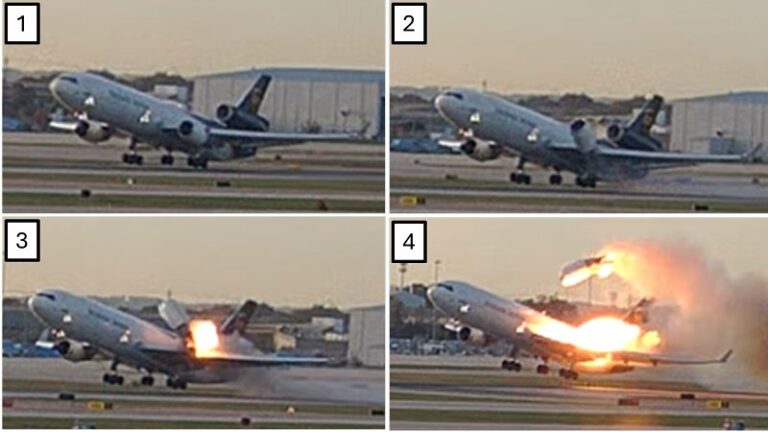
The indefinite grounding of the entire MD-11F cargo fleet is curbing the operational capacity of FedEx and UPS during a period of rising volumes, affecting intercontinental air networks and the most time-sensitive express services. The measure was introduced after the 7 November 2025 accident in Louisville, when a UPS MD-11F crashed moments after take-off, killing fourteen people, including crew members and people on the ground. The extended suspension is expected to weigh on transport operations in the run-up to Christmas, though it is not expected, according to industry operators, to have a direct impact on product availability in retail outlets.
Data cited by US analysts show that the MD-11 accounted for around 9% of the UPS fleet and 4% of FedEx’s active aircraft. Despite the relatively limited share, the role of this widebody type on long-haul operations helps explain the slowdown in some flows, especially on routes with no immediate alternatives. To compensate for the lost capacity, both companies are turning to external charters, a move that raises operating costs and complicates flight scheduling. FedEx is also deploying spare aircraft and shifting part of its loads into the bellies of passenger flights, while UPS will wait until January to assess the additional costs incurred during the peak period.
The limited availability of dedicated widebody freighters comes at a time when the market is already strained by a shortage of used aircraft and delays in deliveries of new Boeing and Airbus models. FedEx and UPS have some smaller Boeing aircraft in storage, but these are insufficient to replace the MD-11F’s capacity, which is heavily relied upon in the weeks leading up to Christmas. The option of diverting some volumes to road networks offers a degree of flexibility in the United States, while international routes remain more challenging.
At the same time, the National Transportation Safety Board’s preliminary report states that the primary cause of the 7 November crash was the structural failure of the left engine support bracket. Fatigue cracks identified in the pylon led to the sudden separation of engine number 1 during take-off, triggering a loss of control and causing the aircraft to crash after reaching an altitude of about ten metres. CCTV footage confirms the sequence of events, showing the engine detaching, the immediate fire and impact with buildings beyond the runway.
The NTSB has drawn a comparison with a historic precedent, the 1979 American Airlines flight 191 accident, in which a similar failure of the engine mount resulted in the unit detaching from the wing. The parallel aims to underline the significance of the structural defect found on UPS’s MD-11F, which had undergone routine maintenance only weeks earlier at a specialised facility in Texas. Under current US regulations, the component involved had not yet reached the flight-cycle threshold requiring enhanced inspections, a point that will be examined further as the investigation progresses.
Authorities have seized the flight recorders and the entire detached pylon, now undergoing further analysis. The preliminary report was issued in under three weeks, but the full investigation may take up to two years. Pending final conclusions, the Federal Aviation Administration has imposed stringent inspections on the 167 MD-11 and DC-10 series aircraft operating in the United States, a measure affecting all carriers, not just UPS.
The impact on the ground was particularly severe: in addition to the three crew members, eleven people on the ground were killed by the aircraft and the explosion, which also affected a fuel depot and an area designated for industrial vehicles. While the NTSB is not assigning individual responsibility at this stage, it is likely to recommend stricter inspection procedures and maintenance protocols for aircraft of the same family. Boeing, which inherited the MD-11 programme, is cooperating with US authorities and the operators involved.