







In the first days of January 2026, a spell of exceptionally severe weather swept across much of central and northern Europe, paralysing the freight transport system. An outbreak of Arctic air, bringing heavy snowfall, persistently sub-zero temperatures and widespread ice formation, simultaneously affected air, road, rail and maritime transport. It was the most severe winter event since February 2012, with an impact stretching from France to the Netherlands, from Belgium to Germany, from the United Kingdom to the Balkans, and also affecting northern Italy.
The most immediate and visible impact was felt in air transport. Between 2 and 7 January, Dutch airline KLM cancelled a total of 2,400 flights, equivalent to around 50% of its overall operations during the period. The peak was reached on 7 January, with 600 flights cancelled in a single day, more than 90% of scheduled services. The progression of cancellations was steady: 202 flights on 2 January, 294 on 3 January, 398 on 4 January, 463 on 5 January and 417 on 6 January. At Amsterdam Schiphol Airport, the fifth-busiest airport in Europe by traffic volumes, more than a thousand passengers were forced to spend the night at the terminal on camp beds set up for the first time in the airport’s history.
Difficulties were not limited to the Netherlands. Between 6 and 7 January, 140 flights were cancelled at Paris Charles de Gaulle and 40 at Orly, while around 40 services were scrapped at Brussels-Zaventem. Flights between Italy and the Netherlands also faced widespread cancellations, with direct repercussions for air cargo and for intercontinental flows using Amsterdam as a transit hub.
A technical factor further exacerbated the air transport crisis: a shortage of anti-icing fluid required for de-icing operations. According to KLM, a combination of extreme weather conditions and supply delays from a German manufacturer progressively depleted available stocks at Schiphol. The issue proved widespread across many northern European airports, highlighting a structural vulnerability in the supply chain of a material that is critical for operational safety.
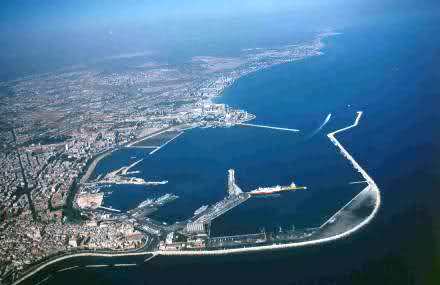
Maritime and port transport was also heavily affected by the weather. Major northern European ports, notably Rotterdam, Hamburg and Antwerp, recorded a significant drop in terminal productivity. Low temperatures and ice on yards slowed loading and unloading operations, limited crane use and extended truck dwell times within port areas. Maersk and Hapag-Lloyd issued operational notices warning of longer waiting times and slower inbound and outbound flows, with direct consequences for intermodal transport planning.
The simultaneous slowdown at the three main northern European ports had a systemic effect on continental logistics. Goods bound for or coming from Italy experienced cascading delays, with difficulties in meeting delivery windows and impacts on drivers’ shift organisation. Container terminals saw a growing number of units awaiting handling, generating congestion and further delays for road transport.
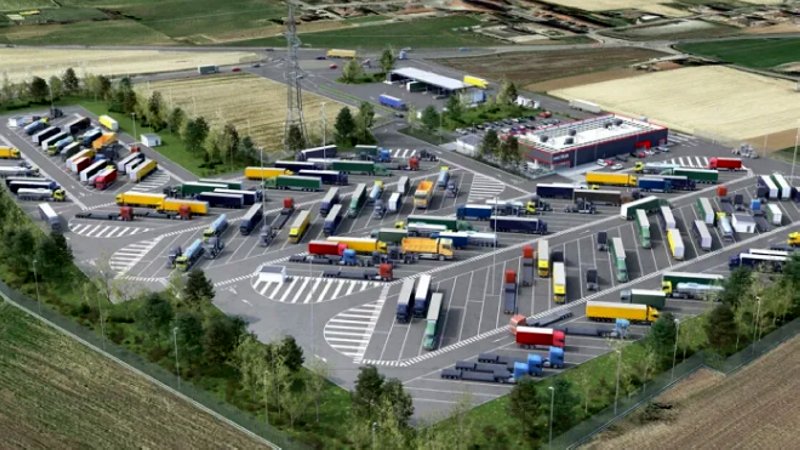
On the road network, the situation was particularly critical in France. Authorities imposed widespread circulation bans for heavy goods vehicles over 7.5 tonnes in 15 departments, forcing trucks to stop in designated parking areas “until further notice”. In other northern departments, additional restrictions were introduced, including overtaking bans and a speed limit of 80 kilometres per hour for vehicles over 3.5 tonnes. On 6 January alone, more than 600 kilometres of queues were recorded on the roads of the Île-de-France region, rising to over 900 kilometres on the first day of winter sales.
In Italy, the bad weather mainly affected the Centre-North. On 6 January, Autostrade per l’Italia activated its 2025–2026 Snow Plan, deploying around 400 operational vehicles and more than 600 staff for clearance and road treatment activities. The main critical points were along the Apennine and Tuscan stretches of the A1 Milan–Naples motorway, with lane reductions and vehicle filtering to allow snowplough operations. Rete Ferroviaria Italiana also activated its Snow and Ice Plan across the national rail network.
Rail transport showed widespread technical fragilities. In the Netherlands, operator NS suspended the entire rail service until 9.00 GMT on 6 January due to points failures caused by cold and snow. In France, numerous lines were interrupted and the Ratp suspended all bus services in Paris for the whole morning of 6 January. In the United Kingdom, disruptions mainly affected northern Scotland, while Eurostar services between London and the Netherlands did not operate beyond Brussels.
In the Balkans, the event took on the dimensions of a humanitarian emergency. In Bosnia-Herzegovina and Serbia, tens of thousands of households were left without electricity and heating due to exceptional snowfall, which reached almost 40 centimetres in some Serbian locations and around half a metre in Sarajevo. Transport infrastructure was paralysed, with trains stuck for hours and urban public transport suspended in several cities.
From a meteorological perspective, the cold spell was triggered by a rare atmospheric configuration, characterised by a Greenland anticyclonic block that diverted Arctic air masses from Russia and Siberia towards western Europe. Temperatures fell to 12–15 degrees below seasonal averages, with minimums of -12.5 degrees recorded in the United Kingdom. According to several meteorological analysts, the intensity and duration of the event make it a case study for recent European climatology.
The economic and operational impact on the entire logistics supply chain was significant. For road haulage, already burdened by structural cost increases that came into force on 1 January 2026, the bad weather meant longer cycle times, forced stops, shift reorganisation and the risk of penalties for late deliveries. Sectors particularly sensitive to punctuality, such as perishable food, pharmaceuticals and just-in-time industrial production, faced major operational challenges.
According to various sector analyses cited in the dossier, the January 2026 event highlighted the systemic vulnerability of the European transport system to extreme weather events. The initial underestimation of the phenomenon by some national meteorological services, acknowledged by French transport minister Philippe Tabarot, affected the timeliness of responses. Conversely, where snow plans were activated preventively, as in Italy, the emergency was managed with greater operational continuity.
Pietro Rossoni