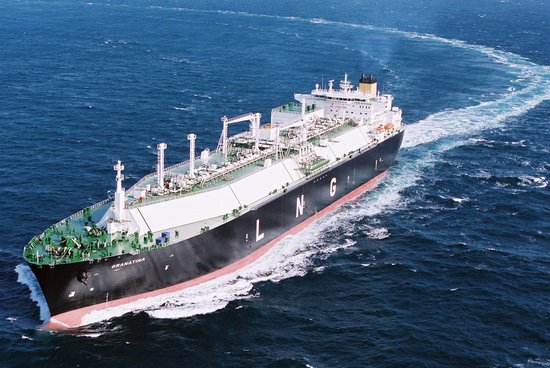



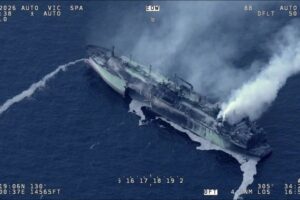


During the night between 3 and 4 March 2026, the Russian LNG carrier Arctic Metagaz was involved in a series of explosions followed by a large fire in the central Mediterranean, in international waters between Malta and Libya. The vessel, about 277 metres long and built in 2003, was carrying around 61–62 thousand tonnes of liquefied natural gas that had departed on 24 February from the Russian port of Murmansk and were bound for Port Said in Egypt.
The crew, consisting of 30 Russian seafarers, issued a distress call after the explosions. Rescue operations were subsequently coordinated by maritime authorities in the region, with the involvement of the Maltese Armed Forces in the SAR area. All seafarers were evacuated in lifeboats and rescued by a passing vessel, the Omani tanker Respect, which later transferred them towards Libya. Arctic Metagaz is an LNG carrier with a capacity of about 138,000 cubic metres of LNG and has been identified by several sources as part of the so-called Russian shadow fleet used to transport hydrocarbons subject to international sanctions. According to some sources, the vessel may be linked to export chains connected with the Arctic LNG 2 project developed by the Russian company Novatek.
There are conflicting versions regarding the cause of the incident. The Russian Ministry of Transport and other authorities in Moscow claim the vessel was struck by Ukrainian naval drones, describing the episode as an act of terrorism and directly linking it to the ongoing conflict between Russia and Ukraine. This version has not been confirmed by independent sources and Kyiv has not claimed any operation in the Mediterranean. As a result, the causes of the explosion remain formally unverified.
After the vessel was abandoned, some sources reported that it sank around 130 nautical miles north of Sirte, in the waters of the central Mediterranean. According to this reconstruction, the wreck would lie on the seabed and concern would focus on potential leaks of fuel and cargo residues. Other sources, including Italian ones, suggest the wreck may still be afloat, pushed by currents in the Sicily Channel. The most recent estimates released by Italian sources place the drifting object in international waters between Malta and the Pelagie Islands, at a distance of between about 25 and 30 nautical miles from Linosa and between 35 and 40 miles from Lampedusa. Currents and winds, according to these reconstructions, appear to be gradually pushing the wreck away from the Italian coastline, but the situation remains under observation.
Concern mainly relates to the potential environmental impact. Even if much of the liquefied natural gas may have dispersed or burned during the fire, significant quantities of service fuels could still remain on board. The wreck may still contain around 900 tonnes of diesel fuel as well as other oils and materials used for the vessel’s operation. Any release of these substances in the Sicily Channel could have serious consequences for marine ecosystems in the area, which include fishing grounds and protected zones of high environmental value.
The problem is not limited to environmental risks. A vessel nearly 300 metres long and without control also represents a potentially dangerous obstacle along one of the Mediterranean’s busiest maritime routes. The Sicily Channel is crossed daily by tankers, LNG carriers and container ships heading towards European ports or the Suez Canal. For this reason, maritime authorities in the countries of the region have issued navigational warnings and advised vessels to avoid the area. Italy has deployed a monitoring operation involving units of the Marina Militare (Italian Navy) and the Guardia Costiera (Italian Coast Guard), along with aerial and satellite observation systems to track developments. The Ministero dell’Ambiente e della Sicurezza Energetica (Ministry of the Environment and Energy Security) is also involved in assessing environmental risks.
The case has also reached the Italian government, and Palazzo Chigi (Office of the Prime Minister) has convened a meeting dedicated to the situation of the vessel. However, the issue of responsibility for recovering the wreck remains unresolved. The flag state, the shipowner and the vessel’s owner have so far not indicated any intention to intervene. In the absence of an entity formally claiming the wreck, it could be considered a “res nullius”, meaning property without an owner that may be claimed by whoever first takes possession of it.
The paradox is that no private operator would have an incentive to do so. Salvage or stabilisation operations for a heavily damaged LNG carrier would involve high costs and considerable technical risks, likely exceeding the economic value of the scrap. The result is an operational vacuum in which coastal states are called upon to manage the risk without having a clearly responsible counterpart.
The Arctic Metagaz case therefore highlights a structural weakness in the international maritime system: the presence of fleets of vessels operating on the margins of the traditional insurance and regulatory framework, often used to circumvent sanctions and trade restrictions. In the event of an accident, managing the consequences inevitably falls on coastal states and local maritime authorities.