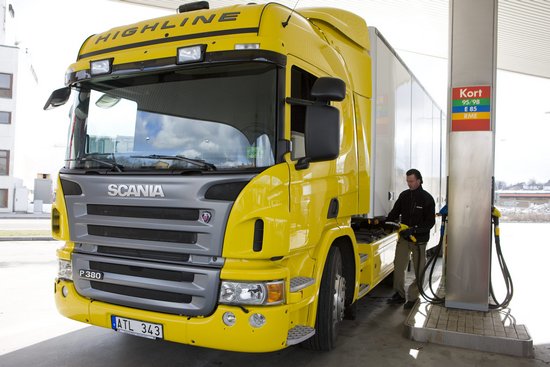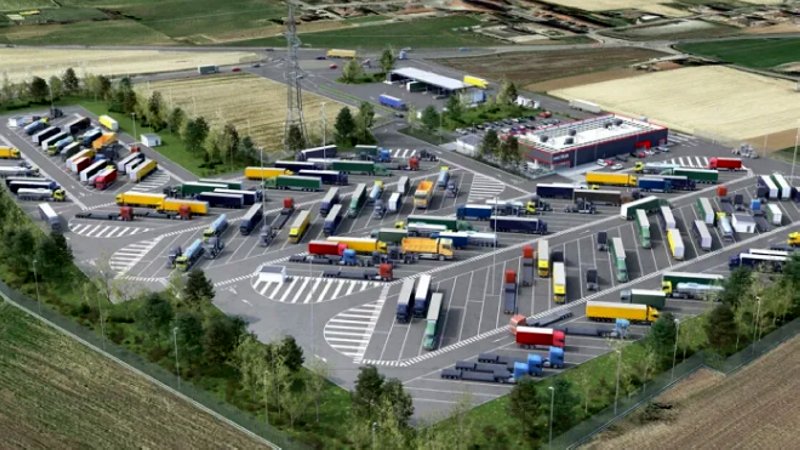







This year’s operation, dubbed a crackdown on “Christmas parking”, refers to the prolonged parking of foreign heavy goods vehicles during the festive period, allowing drivers to return home. This is considered a sign of irregular cabotage. On Christmas Eve 2025, the Belgian transport union Ubt-Fgtb asked the country’s enforcement authorities to carry out a series of targeted inspections on trucks registered mainly in Central and Eastern Europe left parked in car parks and industrial areas across Belgium. Checks focused in particular on the port of Ghent and near customers’ premises, where during the holidays dozens of trucks accumulate while drivers return to their home countries by car, minibus or plane.
Ubt-Fgtb president Frank Moreels welcomed the launch of the inspections, stressing in a statement that the operation confirms the presence of foreign companies operating permanently in Belgium without applying the minimum wages and social conditions required by national and European legislation. According to the union, this practice creates unfair competition to the detriment of Belgian hauliers and companies that comply with the rules on the posting of workers.
The inspections were launched under the coordination of the federal minister for the fight against social fraud, Rob Beenders. Labour inspectors recorded the number plates of parked vehicles and then cross-checked the data with automatic number plate recognition systems, the ANPR cameras, to verify the duration and continuity of the trucks’ presence on Belgian territory, an element incompatible with mere transit activity.
Authorities announced around ten operations in December. In addition to document checks, drones were used to locate trucks left in parking areas, while thermal cameras were employed to ascertain whether the driver was present inside the vehicle. According to Tom Peeters, deputy federal secretary of Ubt-Fgtb, this approach is considered essential both for protecting drivers and for defending transport companies that operate in compliance with social legislation.
The union argues that the mass abandonment of foreign-registered trucks shows that many drivers do not actually work in the country where they hold an employment contract, but carry out most of their activity in Belgium and neighbouring states. In such cases, according to Ubt-Fgtb, European rules on posting are not applied, despite requiring pay and working conditions to be aligned with the country where the activity is effectively performed. The obligation to consider the return journey to Belgium as working time, subject to driving and rest time rules, is also recalled.
The 2025 Christmas operation forms part of a broader strategy to combat social fraud in road transport. Past checks in the ports of Zeebrugge and Ghent had already highlighted the scale of the phenomenon, with numerous infringements relating to extended weekly rest taken in the cab, non-compliance with posting rules and drivers’ working conditions. This year’s actions aim to replicate that inspection model at a time when the concentration of vehicles makes checks easier to carry out.
Alongside transport companies, Ubt-Fgtb is now calling for the direct involvement of Belgian clients. According to the union, major economic players view transport purely as a cost to be squeezed, often through long subcontracting chains that obscure responsibilities. The demand is to introduce joint liability for clients with regard to irregularities along the logistics chain and to limit the use of subcontracting, in order to restore fair competitive conditions in the market.