







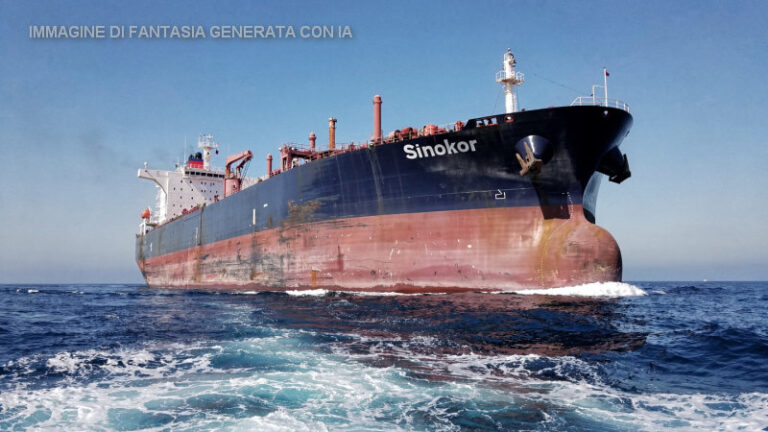
What had until now been described as an informal, quietly financed arrangement became, on 2 February 2026, a corporate transaction with defined terms, shareholdings and regulatory filings. Sas Shipping Agencies Services Sàrl, the Luxembourg-based vehicle of the MSC group, signed an "investment framework agreement" with Ga-Hyun Chung and Sinokor Maritime providing for MSC to acquire 50% of Sinokor’s share capital. Official confirmation comes from filings submitted to the Hellenic Competition Commission (Greek competition authority) and the Cyprus Commission for the Protection of Competition (competition authority), which explicitly refer to "joint control" of Sinokor by MSC and Chung. The era of speculation is therefore over: Gianluigi Aponte moves from presumed silent partner to equal shareholder in the world’s leading transparent VLCC operator.
The acquisition campaign that led Sinokor to purchase more than forty second-hand VLCC tankers in a matter of months had already been linked by Lloyd’s List to the MSC group. Market sources described the operation bluntly as "it's Aponte's money" and estimated that around $5 billion (€4.6 billion) had been made available by the Italian-Swiss shipowner. That report also detailed parallel negotiations for an order of new VLCCs at the Chinese shipyard Hengli Heavy Industry. The antitrust filing now turns those reconstructions into official fact and clarifies the corporate structure that had remained the key unknown.
Reuters summarised the Cypriot filing with the headline "Msc to buy 50% stake in tanker giant Sinokor", noting that after completion the two partners will jointly control the company and that the transaction is subject to regulatory approval. Bloomberg places the deal in the context of the third Gulf war, describing a "red-hot" VLCC market in which Chung’s bet — financed by Aponte — has been "supercharged" by the conflict: vessels acquired at high prices on the second-hand market have become exceptional cash generators amid a sharp contraction in available supply.
The scale of the new operator is unprecedented for the segment. Some sources estimate that Sinokor owns around 78 VLCCs, with projections rising to at least 88 units within the quarter and to 120–130 including vessels controlled through time charters, equivalent to at least 24% of the regular VLCC spot fleet worldwide in 2026. Lloyd’s List suggests that, including vessels under acquisition, total exposure could approach 150 ships, or nearly 20% of the entire global VLCC fleet once shadow fleet units and sanctioned tonnage are excluded.
This level of concentration has no precedent in the segment’s history. Breakwave Advisors, a sector-focused analytics firm, explicitly refers to the emergence of the "era Sinokor", noting that no single operator has ever achieved such a share of the regular VLCC spot market, where fragmented ownership has historically limited the ability of individual players to influence freight rates. Maritime Data describes a "new Vlcc leader", while Splash247 calculates that the six largest VLCC owners — Sinokor, China Merchants, Cosco, Fredriksen, Bahri and Angelicoussis — together account for close to 30% of a global fleet of 911 supertankers, with Sinokor leading thanks to MSC-backed capital.
On the spot market, the effects are already measurable. Transport Topics reports that for several weeks Sinokor controlled almost the entire pool of VLCCs available for prompt cargoes from the US Gulf, at times dominating nearly 100% of vessels able to reach the Texas coast without prior commitments. The cost of chartering a VLCC from the US Gulf to China exceeded $17.3 million on 25 February 2026, the highest level since 2020, with some analysts suggesting that Sinokor is strategically withholding tonnage to support rates. In this context, the partial closure of the Strait of Hormuz and the need to lengthen routes or use floating storage have further constrained effective supply, amplifying the impact of fleet concentration.
For MSC, formalising joint control of Sinokor marks a qualitative shift from the group’s traditional diversification strategy — containers, cruises, ro-ro, car carriers, terminals and inland logistics — and its first structured entry into crude oil shipping. For Aponte, the economic rationale rests on at least three factors. The first is returns: in a tight VLCC market, with a limited global orderbook and just one VLCC delivered in the whole of 2024, returns on capital invested in existing vessels exceed those of many other maritime asset classes. The second is cyclical diversification: adding crude to a portfolio dominated by containers and passenger transport reduces exposure to a single major shipping cycle, creating a natural hedge between segments with uncorrelated rate dynamics. The third is bargaining power: through a joint venture controlling an operator capable of influencing freight rates on key routes from the US Gulf, the Middle East and West Africa to Asia and Europe, MSC gains new leverage with oil companies, major commodity traders and importing countries.
Choosing joint control rather than full acquisition preserves Chung’s operational expertise and the continuity of the Korean commercial platform, while MSC contributes capital, global relationships and large-scale fleet management capabilities. Some observers are already referring to a "new tanker empire" in the making, combining industrial scale — control of tonnage — with a strong financial dimension at a particularly favourable point in the cycle for long-term capital.
The transaction nevertheless raises complex regulatory questions. The Greek and Cypriot authorities have opened a merger review which, given the scale of the fleet involved, could attract scrutiny from other jurisdictions, including outside the EU. According to some analysts, a 24% share of the regular VLCC spot market — likely to increase if all pending acquisitions are completed — is unprecedented and will require antitrust authorities to assess whether such concentration distorts competition in freight markets.
There is also an issue of supply security: if an operator with Korean roots, now partly owned by a European group, controls such a significant share of available tonnage, the energy policies of importing countries such as China, India, the EU and the United States cannot ignore the risk of logistical dependency. At the same time, some analysts see the MSC–Sinokor joint venture as a potential counterweight to the shadow fleet linked to sanctioned countries, insofar as regular-market supply remains concentrated but transparent and subject to Western regulatory compliance.
Finally, the question of a "systemic precedent" remains open: if the Sinokor–MSC model proves replicable, similar aggressive consolidation could emerge in other segments — such as LNG carriers or chemical tankers — with a small number of major private players controlling significant shares of global capacity. For now, in the world of supertankers, the picture is clear: behind the new dominant operator there is no longer just a Korean tycoon, but a Korea–Switzerland–Mediterranean axis led by the Aponte family, backed by a notified agreement, a formal corporate structure and ongoing antitrust scrutiny in at least two European jurisdictions.
M.L.