







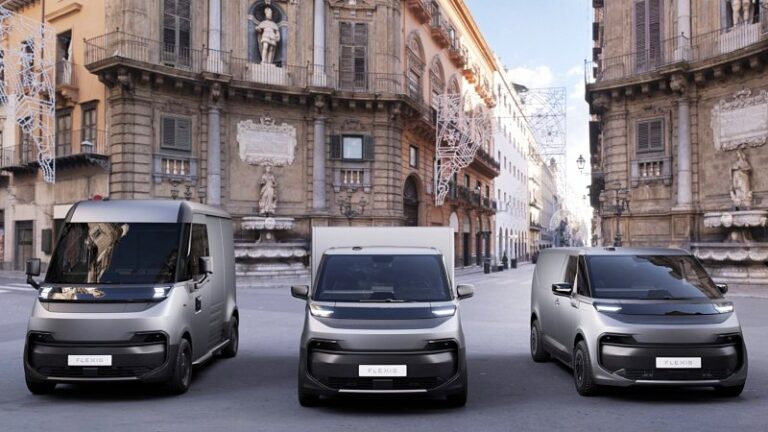
Renault Group is taking full control of Flexis, the joint venture set up on 22 March 2024 with Volvo Group, joined on 3 April 2024 by CMA CGM. The definitive agreement, announced on 22 February 2026, provides for the acquisition of the 55% of capital still held by the two partners, equal to 45% owned by Volvo Group and 10% by CMA CGM, bringing Renault’s stake to 100%. Completion is expected by the end of the first half of 2026, subject to approval by the competition authorities.
According to Renault Group, the transaction will enable Flexis to enter a new phase of development under a unified industrial leadership. The start of production of the first model, the Renault Trafic Van E-Tech Electric, remains confirmed by the end of 2026 at the Sandouville plant in Normandy. From 2027, the vehicles will also be distributed through the Renault Trucks network, in line with the longstanding collaboration between Renault Group and Volvo Group in the light commercial vehicle segment.
Flexis SAS was established in March 2024 as a France-based joint venture with the aim of developing a new generation of electric vans for urban logistics and last-mile delivery. The initial shareholding structure saw Renault Group and Volvo Group each holding 45%, with CMA CGM owning 10%. Investment plans envisaged €300 million each from Renault and Volvo and up to €120 million from CMA CGM by 2026, through its energy fund Pulse.
During 2024 and 2025, the technological pillars of the project were defined: a dedicated skateboard-type electric platform, an 800-volt architecture and a Software Defined Vehicle approach, with continuous updates and integrated digital services. In May 2025, Renault Group confirmed assembly in Sandouville and a plan for around 550 new hires over four years to support industrialisation.
The first indications of a possible reorganisation of the shareholder structure emerged in early February 2026 in the French press. A few days later came the formalisation of the binding agreement for Renault Group to acquire the stakes held by Volvo and CMA CGM. Flexis will continue to operate in France, with around 1,300 employees involved between the Technocentre in Guyancourt and the Centre of Excellence for Light Commercial Vehicles in Villiers-Saint-Frédéric, until industrialisation in Sandouville.
CMA CGM’s exit from the capital does not amount to a commercial withdrawal from the project. According to some business press sources, the logistics group may remain a partner and customer for the future electric vans, particularly for Ceva Logistics operations and urban distribution, without retaining a direct role in industrial management. In official statements, the transaction is presented as consensual, with CMA CGM stating that it is proud to have supported the project during its decisive start-up phase.
The reasons for the exit have not been officially detailed, but analysis of French sources highlights several recurring factors. On the one hand, Renault Group appears to have chosen to bring the development of future electric commercial vehicles fully in-house in order to streamline governance and more closely integrate platform, software and industrial planning. Some sources also point to a more cautious assessment of the pace of the transition to electric vans compared with initial forecasts, with implications for the valuation of the joint venture.
On the other hand, for CMA CGM the exit can be seen as a reallocation of resources. With a commitment of up to €120 million by 2026, compared with €300 million for each of the other partners, the shipping group can retain access to electric vehicles as a user while reducing exposure to production risk linked to a completely new platform. CMA CGM’s decarbonisation strategy spans several areas, from ships powered by alternative fuels to low-emission logistics solutions, and does not necessarily require a direct role in vehicle manufacturing.
Volvo Group is also selling its 45% stake but will remain an integral part of the commercial ecosystem through Renault Trucks, which will distribute the vehicles from 2027. In this way, cooperation between the two groups will continue at distribution level, albeit under a simplified corporate structure. By moving to full ownership, Renault Group is concentrating industrial and strategic responsibility for Flexis at a time when the electric commercial vehicle market is still consolidating.
Massimiliano Barberis