




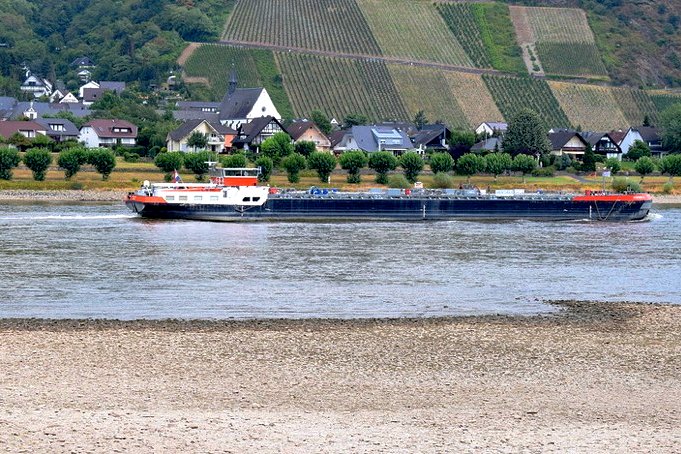
Mediterranean Shipping Company has introduced traffic congestion surcharges on rail, road and combined road-rail services to and from the ports of Antwerp and Rotterdam bound for Germany, with a specific link to the Andernach intermodal terminal on the lower Middle Rhine near Koblenz. The announcement concerns traffic made impracticable by the Rhine water crisis, which in the same week reached the lowest levels ever recorded on the river.
At the Kaub gauge, a key reference point for navigability on the Middle Rhine between Koblenz and Mainz, the water level fell to around 24-25 cm in the first week of August - the lowest value since 1880, according to ETH Zurich - and BDB, the Bundesverband der Deutschen Binnenschifffahrt (Federal Association of German Inland Navigation), expects a further fall below 10 cm this week, a threshold never reached before. BDB director Jens Schwanen told Rheinische Post that, at those levels, commercial navigation would no longer be able to carry freight in the area, and that the Rhine would in effect be split into two sections no longer connected by navigation, with Amsterdam, Rotterdam and Antwerp remaining linked only to the northern part of the river and to western Germany’s canal network.
The first signs of low water appeared as early as late June, ahead of the usual seasonal pattern, and by mid-July Kaub was approaching 40 cm. In the first week of August the situation deteriorated at all the main measuring points: in Cologne the gauge reached a record low of 67 cm on 1 August, falling a few days later to 60 cm; at Duisburg-Ruhrort new lows of around 150 cm were recorded; in Düsseldorf the level fell to 15 cm; and at Emmerich the gauge turned negative, at between -6 and -8 cm, now measured only by probe because the float is dry.
The surcharge mechanism, common to all carriers, works in bands linked to the water level recorded at 5.00am on the day of departure at the reference gauges: Kaub, Duisburg-Ruhrort, Cologne and Emmerich, under the Elwis system, Germany’s electronic waterway information service. Maersk applies an ordinary Low Water Surcharge scaled according to these levels, in force since 15 July for full containers, to which it has added an extraordinary Andernach Contingency Surcharge of €625 per container, due to the interruption of barge operations to the Andernach terminal. When the Kaub gauge falls below 81 cm, or the Duisburg-Ruhrort gauge below 181 cm, Maersk no longer guarantees loading and switches to case-by-case arrangements. Hapag-Lloyd publishes a table that, at Kaub, rises to €775 per 20-foot container at the strictest restriction level; Zim applies differentiated surcharges for the upper Middle Rhine and the lower Rhine; Contargo, the river’s main combined container transport operator, updates its own Kleinwasserzuschläge (low-water surcharges) daily on the same four gauges; and Hutchison Ports Europe Intermodal also follows similar tiered tariff schemes.
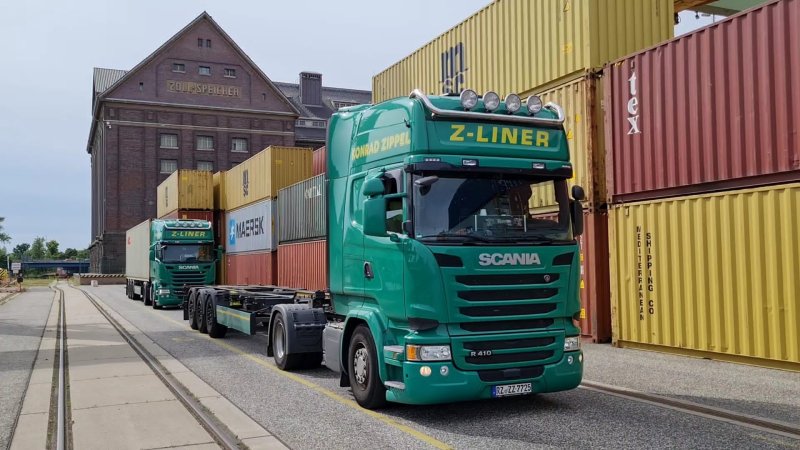
When barges are no longer a viable option, as on the Andernach stretch, cargo is diverted to rail or lorries, more expensive modes whose additional surcharge offsets the forced modal shift, and this is precisely the mechanism behind MSC’s surcharge on rail, road and combined road-rail services. Neither alternative, however, can absorb the volumes involved. DIHK, the Deutsche Industrie- und Handelskammer (German Chamber of Industry and Commerce), calculates that a 25% fall in river capacity on the Rhine is equivalent to almost 3 million tonnes less freight a month, or around 120,000 lorry journeys, capacity the association describes as simply unavailable, both in vehicles and drivers. The low water levels on the Rhine and many other rivers are severely hampering freight transport, DIHK expert Dirk Binding told Reuters as early as late July. The rail network also offers limited room for manoeuvre, as it is tied up in multi-year modernisation works that cause frequent disruptions on main routes.
The federal government intervened directly on Thursday 6 August, when transport minister Steffen Bilger (CDU) convened a crisis summit in Bonn with companies and industry associations, announcing an opening to exemptions from Sunday driving bans for lorries and a commitment by DB Cargo, Deutsche Bahn’s freight subsidiary, to mobilise additional rail capacity. In the following days, Rhineland-Palatinate, Saarland, North Rhine-Westphalia and Lower Saxony activated exemptions for substitute transport made necessary by low water levels on inland waterways, with different deadlines: until 30 September in Rhineland-Palatinate and Saarland, and until 31 August in North Rhine-Westphalia and Lower Saxony, the latter limited to vehicles over 7.5 tonnes and vehicles with trailers. North Rhine-Westphalia also allows journeys on Saturdays for the duration of the summer holidays.
On the industrial front, VCI, the Verband der Chemischen Industrie (German Chemical Industry Association), through its chief executive Wolfgang Große Entrup, is warning of concrete risks to production, with the steel sector identified as particularly exposed and transport costs already tripling or quadrupling on some routes. The Bundeskartellamt (Federal Cartel Office), Germany’s antitrust authority, reported in July regional fuel price differences of up to 11 cents per litre for petrol and 10 cents for diesel between the north and south of the country, a gap attributed mainly to differing supply costs. Assessments of the macroeconomic impact by two German institutes should not be conflated, as they use different methodologies and time horizons. IfW Kiel, through economist Stefan Kooths, puts the impact on third-quarter GDP at between -0.1 and -0.2 percentage points, with estimated damage of €1-2 billion in the quarter, while IW Köln focuses instead on the full year: GDP growth in 2026 could be up to 0.4 percentage points lower than previously expected if the disruption to navigability continues.
The impact is not uniform along the river. According to IW economist Simon Gerards Iglesias, quoted by SWR, the Rhine is narrower in its southern stretch than in the north, meaning industries located further south, including Mercedes-Benz suppliers in the Stuttgart area, are proportionally more exposed than those on the lower Rhine. BDB identifies the most critical bottleneck in the stretch between Budenheim, near Mainz, and St Goar, where the guaranteed minimum depth of the waterway is only 1.90 metres, 20 cm less than the stretches upstream and downstream: this is the same area where Andernach, the terminal cited in the MSC announcement, is located. Deepening this stretch of the Middle Rhine has been included in the federal infrastructure plan as a priority requirement since 1992; the project, which aims to gain around 20 centimetres of depth, has still not been carried out and completion is not expected before 2033.
Antonio Illariuzzi