



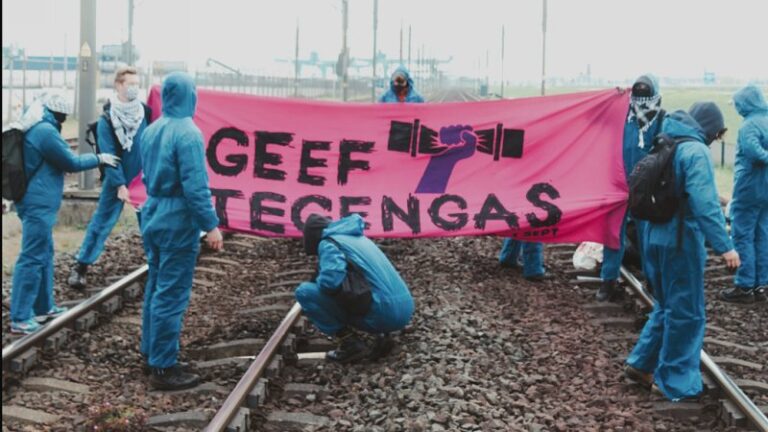
- Since 9 May 2026, the Dutch group Geef Tegengas has been blocking the Havenspoorlijn, the main freight railway serving the Port of Rotterdam. Sit-ins on the tracks have halted container trains bound for the European network for several hours at a time. The actions follow customs delays on 23 January and trade union mobilisation against the pay freeze.
- The protests in 2026 build on a cycle of industrial conflict that began in October 2025, when a strike by lashing workers paralysed the port’s main container terminals for several days, leaving around 18-20 container ships waiting at anchor and halting approximately 17,000 TEU per day. The current campaign is politically distinct but logistically connected, as it targets the same infrastructure nodes.
- Rotterdam is not an isolated case. Across Europe in 2025 and 2026, a wave of logistics disruption has targeted military and fossil-fuel supply chains linked to the conflict in Gaza, from terminals in Barcelona to depots in Antwerp. Transnational coordination networks have made the Dutch port the most visible symbol of this strategy of “supply chain activism”.
In May 2026, the climate and peace action group Geef Tegengas launched a campaign of daily blockades on the Havenspoorlijn, the main freight railway serving the Port of Rotterdam. It said it intended to disrupt Europe’s leading logistics hub until the Dutch government imposed a complete trade and military embargo on Israel and began substantially reducing the fossil-fuel traffic passing through the port. The announcement came the day after the first action, held on Saturday 8 May, when dozens of activists occupied the tracks at the junction of Vondelingenweg and Petroleumweg, in the heart of the port area. The protest blocked freight trains heading towards the Dutch hinterland and the wider continental network for several hours. The morning began with the sit-in and ended with police clearing the site in the afternoon.
The same pattern was repeated over the following days: on day two, protesters occupied a different section of the same line, while on days three and four they returned to the area around Pernis, near Vondelingenweg. The local newspaper De Havenloods ran the headline “And that makes day four… Havenspoorlijn blocked yet again”, adopting a tone somewhere between disbelief and exhaustion that reflected how port operators viewed a systematic action with no declared end date. Freight trains leaving the container terminals and the Maasvlakte basin remained at a standstill until the blockade was removed, triggering knock-on effects for intermodal connections and shippers that depend on rail punctuality.
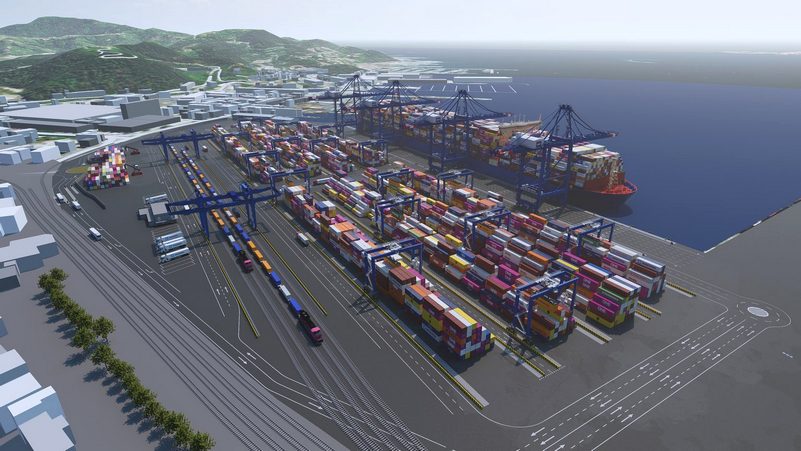
The operational impact of these actions differs from that of a general port strike. The blocked section is an essential part of the rail corridor linking Maasvlakte with the Dutch hinterland and the core of Europe’s freight networks. The choice of location is deliberate: it is strategic both for its symbolic value and for the concentrated logistics damage it can cause. According to Geef Tegengas, the actions have already caused millions of euros in losses to port operations. The organisers have also announced a two-day “mass action” for 26 and 27 June, presented as an escalation from the daily protests. They have referred to the events of 10 and 11 October 2025, when the so-called “Rotterdam Block Party” blocked road access to the APM Maasvlakte 2 and RWG terminals for six hours, stopping lorry traffic to and from the port.
The events of 2026 follow a year already marked by exceptional industrial unrest. In autumn 2025, the Port of Rotterdam was hit by an indefinite strike involving workers employed by lashing companies, which secure cargo on container ships. The action paralysed the main terminals: APM Maasvlakte 2, RWG, ECT Delta, Hutchison Ports Delta 2 and Euromax. The shutdown halted around 17,000 TEU per day and left approximately 18-20 container ships waiting at anchor, creating congestion comparable with that seen during the major pandemic-related disruptions. The industrial dispute was accompanied by the first actions organised by Geef Tegengas and pro-Palestinian networks. On 10 October 2025, they blocked road access to the terminals and began developing a narrative of the port as the “beating heart of the logistics empire” that had to be targeted, in line with their “Empire of Logistics” campaign.
In 2026, the trade union and political-environmental strands have remained partly separate, although they reinforce one another. On the labour front, customs officers staged a “stiptheidsactie” at the RWG terminal on 23 January, applying every prescribed procedure with exceptional strictness and inspecting each incoming lorry in meticulous detail. Queues formed at the terminal entrances and extended onto the ordinary road network. During the same period, FNV Havens (FNV Ports) called meetings and consultations to secure a mandate for broader action against government plans affecting income security and protections for port workers. The “nullijn”, or freeze on wage increases for 2026, has become the trigger for an unresolved dispute that could lead to action on a much larger scale than the rail blockades organised by Geef Tegengas. The two fronts have not joined forces, but their coexistence has created a context of structural fragility in which targeted action can rapidly develop into a wider logistics crisis.
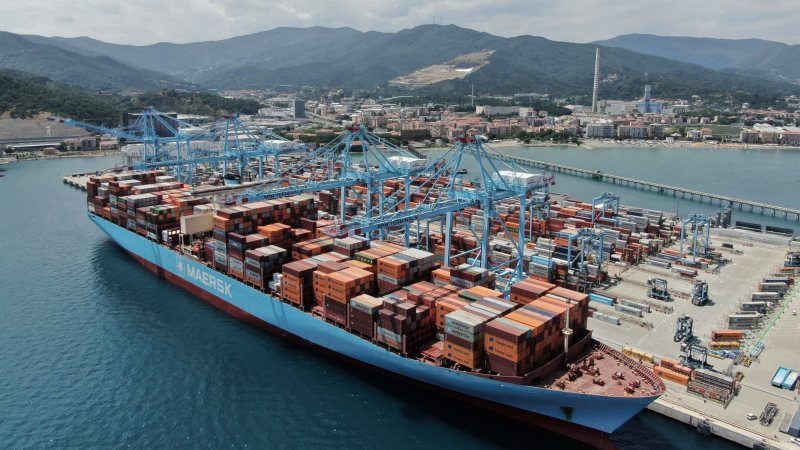
At the same time, the Rotterdam Palestina Coalitie (Rotterdam Palestine Coalition) and other pro-Gaza networks have organised campaigns throughout 2026 focusing directly on the port and shipping companies. The most visible campaign has targeted Maersk, which activists accuse of complicity in the conflict in Gaza. The slogan “Stop Maersk! Stop complicity! The Port of Rotterdam…” has circulated on social media and is helping to mobilise support for the June protests. The protest ecosystem also includes Rights Forum and other Dutch groups organising sit-ins, marches and political pressure campaigns. Although these actions do not always take place inside the port area, they continue to focus public attention on the logistics chain passing through Rotterdam.
The Dutch port is not an isolated case in Europe. Since 2024, a movement of “supply chain activism” has become increasingly established, targeting nodes in the continent’s logistics network as leverage for political pressure over the conflict in Gaza. In Barcelona, groups similar to Geef Tegengas have organised blockades at port terminals with comparable objectives. In Antwerp, pro-Palestinian coordination networks have reported pressure campaigns targeting depots and logistics operators involved in the transit of military supplies. In Belgium and France, the political debate over the responsibility of ports within military supply chains has reached parliament, with parliamentary questions and proposed embargoes partly reflecting activists’ demands. The shared strategy of these movements is to shift protests from the symbolic sphere of demonstrations and petitions to the operational level, disrupting the continuity of logistics flows to make the contested traffic more costly, both economically and politically.
The risk emerging in Rotterdam in 2026 is one of selective and repeated disruption rather than a total shutdown. The known actions have lasted several hours, with the direct impact concentrated on rail services and customs inspections. The most exposed flows are container traffic along the Havenspoorlijn, shipments involving fossil fuels or cargo linked to military supplies, which are explicitly included in the activists’ agenda, and intermodal services that depend on punctuality. For now, the impact is not comparable with the paralysis caused by the lashing strike in 2025. However, the combination of unresolved industrial tensions, structured political and environmental campaigns and a “mass action” announced for late June creates a scenario in which cumulative pressure could, at certain points, lead to significantly more serious disruption across the European supply chain.
M.L.