







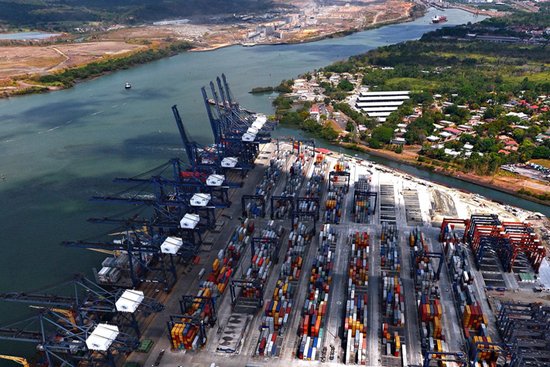
Cosco Shipping’s decision to suspend all container services at the port of Balboa, in Panama, has turned a legal dispute between the Panamanian Government and Hong Kong conglomerate CK Hutchison into an open confrontation involving global trade flows, multibillion-dollar arbitration proceedings and geopolitical repositioning. The move by the Chinese giant, which has also extended the suspension to its subsidiary OOCL, came just days after the terminals were taken over by the new operators appointed by Panama and is being interpreted by analysts as the first Chinese retaliatory measure following the so-called "forced takeover" of CK Hutchison’s assets.
The suspension applies to all future bookings at Balboa, with the clarification that cargo already arrived would still be handled, in order to limit the immediate impact on customers. Volumes previously routed through Balboa have been reallocated to alternative Atlantic terminals, including those operated by SSA Marine and Evergreen, with possible increases in transit times for traffic that used Balboa as a transhipment hub for the Latin American Pacific coast. Its exclusion by a carrier of the scale of Cosco-OOCL is not a marginal adjustment, but an operational signal that weighs on the planning of global shippers and on the reliability of transpacific corridors. The decision shows that the tools of pressure in a geopolitical dispute are not only diplomatic: the choice to suspend services at a critical hub can rapidly alter transhipment operations, as well as the effective capacity and costs of the supply chain, even in the absence of a broad shock to freight rates.
To understand the significance of Cosco’s move, it is necessary to retrace the sequence of events that, since the start of 2026, has turned the management of Panama’s terminals into one of the most sensitive geo-logistics dossiers internationally. It all began on 29 January, when the Supreme Court of Panama declared Law No 5 of 1997 unconstitutional. The law had provided the legal basis for the concession of the Balboa and Cristóbal terminals to Panama Ports Company, a company controlled by China’s CK Hutchison (Hong Kong). The ruling effectively made it illegal for PPC to continue operating under the previous system, paving the way for a change of operator at the two ports on the Panama Canal corridor.
On 23 February, the Panamanian Government followed up on the ruling by issuing a decree authorising the occupation of the terminals at Balboa, on the Pacific side, and Cristóbal, on the Atlantic side, taking control of the infrastructure, equipment and IT systems. At the same time, 18-month temporary concessions were awarded to two operators linked to major European carriers: APM Terminals, a Maersk subsidiary, for Balboa, and TIL Panama, an MSC company, for Cristóbal. The aim was to ensure operational continuity at the terminals pending a structural solution. In the same period, on 12 February, CK Hutchison had already formally notified a dispute against the Republic of Panama under an investment protection treaty, opening the way to international arbitration.
The legal battle continued in March. On 6 March, CK Hutchison announced an escalation of legal action against Panama, challenging the legitimacy of the port takeover and describing the operation as an occupation of the facilities. In the days immediately afterwards, Panama Ports Company quantified the potential damage by launching arbitration proceedings before the ICC (International Chamber of Commerce), with an initial claim of more than $2bn, citing the loss of concessions that had been in force for almost 30 years. On 24 March, the company said it had further increased the value of the claim, definitively exceeding the $2bn threshold, about €1.85bn, after accounting for the seizure of assets and the loss of the concessions.
The Panamanian authorities have reported a gradual stabilisation of the terminals under APM and TIL management, with testing of the new IT systems, the restoration of export flows and the restart of empty container handling. However, the normalisation declared by the Panamanian authorities coexists with a diplomatic dispute that has widened far beyond the boundaries of the original commercial litigation.
Antonio Illariuzzi