






Three railway base tunnels are currently at an advanced stage of construction in Europe: the Mont Cenis tunnel on the Turin-Lyon line, the Brenner tunnel and the Semmering tunnel between Lower Austria and Styria, on the Vienna-Graz route. But while forecasts for the completion of the first two tunnels continue to be pushed back, the countdown has officially begun for Semmering. The 27.3-kilometre Austrian tunnel will open for operations in December 2029, compared with the latest forecast, which had referred more generally to 2030. The schedule will therefore be met and, in fact, brought forward by a handful of months. Confirmation came directly from Austria’s mobility ministry and the chief executive of the federal railways ÖBB during a recent visit in which the tunnel was travelled through in full.
Work on the twin-bore Semmering tunnel formally began on 25 April 2012 and will therefore be completed after almost 17 years of construction, now with a fixed date. To be objective, however, it should be remembered that the project has had a distinctly difficult path. Initial planning dates back to 1989, but mainly because of environmental concerns and difficulties with local stakeholders, time passed until 2005 without any outcome. At that point, the project was even abandoned. A new route was presented again in 2010, but here too there was no shortage of complications, including from a legal and administrative standpoint, with disagreements between the different Länder, until final approval came only in 2012.
That brings us to recent developments. By the end of 2024, all excavation work on the two tunnel bores from Gloggnitz to Mürzzuschlag had been completed, and since summer 2025 the technical fit-out of the tunnels has been under way, including all the systems required for rail operations: track, power supply, signalling, safety and fire protection. The long timescales for this work should come as no surprise, as they are fully in line with those of comparable projects, such as the Gotthard base tunnel, which opened in 2016, although excavation had been completed between 2010 and 2011.
With the opening of Semmering in 2029, one of the most demanding projects, with major positive effects for the entire Austrian rail network, will also be completed. The new base tunnel can be seen as a key piece completing the new high-capacity railway, at the heart of the TEN-T Baltic-Adriatic corridor, after the new Koralbahn entered service in December 2025. The 125-kilometre railway between Graz and Klagenfurt includes the 32.9-kilometre base tunnel beneath the Koralpe. In 100 days of operation, taking into account the November pre-opening reserved exclusively for freight traffic, the Koralbahn handled 1,000 cargo trains carrying more than one million tonnes of goods.
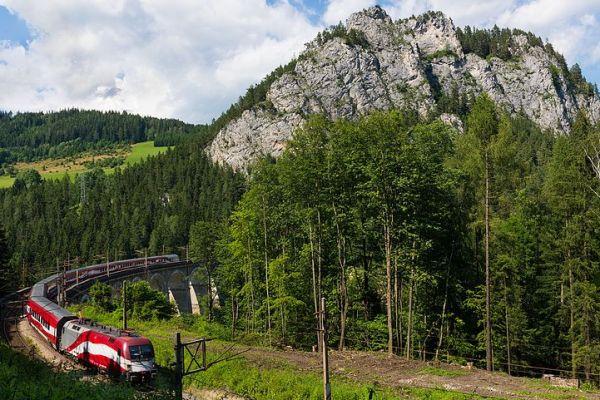
The Semmering tunnel replaces the historic railway built in the mid-19th century by the Italian engineer Carlo Ghega, known in Austria by his adopted name Karl von Ghega. At the time, the line was considered a masterpiece of mountain railway engineering and is now a Unesco World Heritage site. Today, however, it is outdated and unsuitable for current traffic, especially freight, because of its steep gradients and tight-radius curves, as well as tunnels whose profile does not allow the passage of large-gauge intermodal trains.
Piermario Curti Sacchi