




Switzerland and South Korea are looking ahead, already preparing to invest in Ukraine’s post-war future. At the centre of their interest is the country’s railway infrastructure, which on one hand needs upgrading and modernisation, and on the other must be fully integrated into the European TEN-T corridor network. Starting with Switzerland, the Swiss Confederation has signed an agreement in Washington with the World Bank, complementing commitments already made by Bern and the Swiss private sector in support of Ukrainian railways.
The plan has not been detailed, as it remains a framework agreement and does not yet address specific projects. The aim of the Swiss authorities is to be ready to take a leading role once investment becomes possible, thereby creating new opportunities to expand the business of national companies. Although economic interest remains the guiding thread, the initiative is presented as a development opportunity: “Reliable transport infrastructure promotes trade, economic recovery and job creation”.
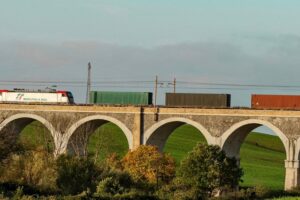
South Korea’s proposal is more concrete. Authorities in Seoul have approved an initial allocation of seven million euros for a feasibility study on a new rail link between Ukraine’s capital, Kyiv, and the European Union border. This commitment stems from an agreement between Ukrainian state railways and several South Korean engineering consultancy firms, and remains open to additional international funding. The next step will be to assess possible route alternatives and define the technical specifications of the connection, which are still under discussion. However, the objective is clear: to develop a line integrated with European TEN-T standards, meaning the adoption of standard gauge, compatible electrification systems and European signalling.
Initially, Ukraine and South Korea are focusing on speeding up passenger transport, but freight development is also being considered as an alternative to other modes, particularly road. Ukraine views the development of new railways not only as an infrastructure project, but as a key opportunity for national reconstruction and, above all, for integration into the European transport area. While not officially stated, South Korea also sees the initiative as a way to counter China’s dominance in global markets. Beijing has repeatedly offered not only its technology, but also major construction companies and financial resources, as seen in the Balkans, notably with the Budapest–Belgrade railway project, part of the Belt and Road Initiative (New Silk Road).
Piermario Curti Sacchi