






The Italian market for industrial vehicles over 3.5 tonnes has opened 2026 with a moderately positive trend. In February, 2,329 units were registered, up 2.3% from the 2,276 recorded in the same month of 2025. Data released by Unrae indicate that growth is mainly driven by the heavy vehicle segment, while the mid-range category continues to show weakness.
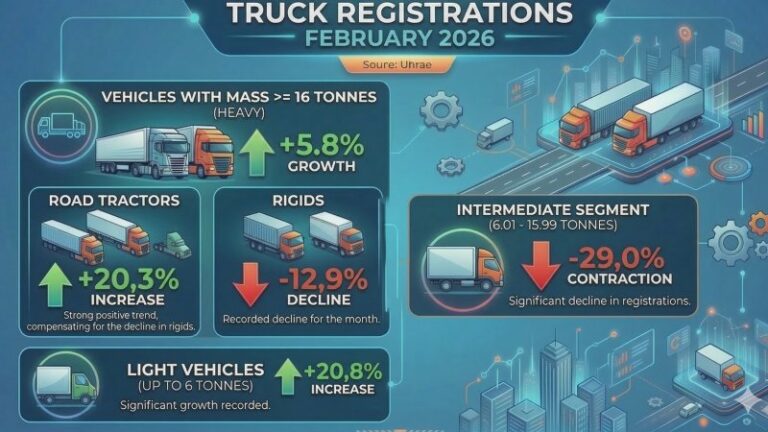
More specifically, vehicles with a gross weight of 16 tonnes or more recorded year-on-year growth of 5.8% in February. Within this segment, road tractors stood out with an increase of 20.3%, offsetting the decline in rigid trucks, which fell by 12.9%. This trend reflects the central role of long-distance haulage and activities linked to both national and international logistics.
The segment of light vehicles up to 6 tonnes also performed positively, registering growth of 20.8%. This category, often used for urban distribution and short-range logistics services, confirms robust demand, supported in part by the expansion of e-commerce and last-mile delivery operations.
The picture changes in the mid-weight segment, between 6.01 and 15.99 tonnes, which recorded a contraction of 29%. The decline in this category continues a trend already observed in recent months and signals a reorganisation of demand, with increasing polarisation between lighter vehicles for urban distribution and heavy vehicles deployed on medium- and long-distance routes.
Overall, the first two months of the year show modest but stable growth. Between January and February 2026, a total of 5,000 industrial vehicles were registered, up 3% from the 4,854 recorded in the same period of 2025. According to Giovanni Dattoli, president of the Sezione Veicoli Industriali di Unrae (Unrae Industrial Vehicles Section), the start of the year reflects the sector’s expectations: “The year has opened with a moderately positive trend, in line with forecasts indicating substantial market stability for 2026. The hope is to maintain levels at least in line with 2025 and, if possible, to replicate the performance recorded in the 2023–2024 period.”
In this context, renewing the circulating fleet remains a central issue for the entire freight transport sector. Around 765,000 industrial vehicles over 3.5 tonnes are currently operating in Italy, with an average age of 14.5 years and more than 43% of vehicles still predating the Euro IV standard. This factor affects both transport efficiency and environmental targets, making more stable incentive policies strategically important. “We view positively the possibility of relying on multi-year support instruments, long requested by Unrae, which would allow companies to plan with greater certainty the investments needed to renew a circulating fleet that remains particularly old,” Dattoli stressed.
This issue is closely linked to the energy transition of heavy transport. According to the manufacturers’ association, the Italian system still shows a significant gap compared with other major European markets, particularly regarding the availability of infrastructure dedicated to industrial vehicles. Among the priorities identified is the development of high-power charging points for heavy vehicles, with capacities above 350 kilowatts, considered essential to support the deployment of electric trucks on long-distance routes. This is accompanied by concerns over energy costs and the need for measures encouraging the adoption of low- and zero-emission vehicles.
In this context, Unrae also points to a revision of the motorway toll system as a possible lever to encourage technological renewal of fleets. The introduction of criteria aligned with the European Eurovignette Directive, which links tolls to vehicle emissions, could help make the use of lower-impact vehicles more competitive. At the same time, the association stresses the need for an approach based on technological plurality. Alongside electric vehicles, the decarbonisation pathway for heavy transport could also include the use of advanced biofuels, HVO and bioLNG, solutions capable of reducing emissions while using existing technologies and infrastructure.