





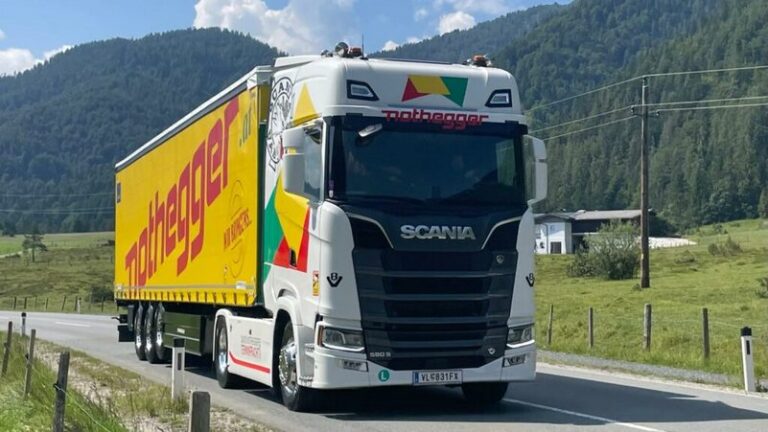
The regional court of Innsbruck declared the insolvency of Nothegger Transport Logistik on 9 March 2026, a long-established haulage company based in St. Ulrich am Pillersee in Austria’s Tyrol region. The insolvency procedure was opened following a petition by Österreichische Gesundheitskasse (Ögk, the Austrian Health Insurance Fund), the country’s public health insurance body, which is a creditor for unpaid contributions. The group is one of Austria’s main road haulage operators: it employs around 300 workers and operates a fleet of more than 700 vehicles, including tractor units and semi-trailers, with activities across several European countries.
Austrian creditor protection associations estimate the company’s total liabilities at around €15 million. The largest component concerns exposure to the banking system, amounting to roughly €9.2 million. This is followed by about €3.2 million in outstanding social security contributions owed to Ögk and approximately €1.8 million in tax debts, in addition to further positions with suppliers and other creditors. According to the Austrian press, the collapse was mainly caused by a liquidity crisis linked to the management of tax and social contribution moratoria introduced during the pandemic.
Nothegger Transport Logistik is a relatively young company: it was founded in 1992 as an operator specialising in international road transport and over time built a logistics network with a strong transalpine focus. The company operates in several freight transport segments, including refrigerated services, curtain-sided semi-trailer transport, intermodal operations and the transport of sensitive or hazardous goods. The group is led by Karl Nothegger and has maintained a family-run structure, while developing over the years a system of branches and affiliated companies across several European countries.
According to reconstructions by creditor associations, the group’s operational scale included more than 700 vehicles, both owned and under financial leasing contracts, along with logistics infrastructure and company real estate. Among the assets mentioned in the proceedings is a main property in St. Ulrich am Pillersee, estimated to be worth around €1.9 million, as well as shareholdings in affiliated companies, including Nothegger Immobilien. The overall asset base therefore includes property and infrastructure, but not enough to offset the pressure on liquidity.
According to several Austrian business media outlets, during the pandemic the company made extensive use of extraordinary support measures introduced by the government, which allowed the deferral of tax and social contribution payments. The temporary suspension of these payments eased pressure on the company’s accounts in the short term but led to an accumulation of debts towards the tax authorities and the social security system. With the end of emergency measures and the resumption of normal payment schedules, the company was required to repay significant amounts without having adequate liquidity reserves.
According to creditor organisations, the combined burden of bank debt and outstanding contributions progressively eroded the company’s ability to meet current payments. The situation worsened when an audit by Ögk identified additional unpaid contributions amounting to several million euros. This finding helped accelerate the crisis, eventually prompting the public health insurance body to file the insolvency petition that initiated the proceedings before the Innsbruck court.
Before the opening of the procedure, company management attempted to identify a solution to avoid bankruptcy. Among the options considered were the entry of an external investor and the sale of one of the group’s properties. The real estate transaction was expected to generate sufficient liquidity to cover a substantial part of the most urgent arrears, but negotiations were not concluded in time to prevent insolvency.
The start of the procedure now entails the appointment of an insolvency administrator and the verification of liabilities, as well as an assessment of the prospects for continuing operations. In the weeks following the opening of the proceedings, creditors and the court will decide whether conditions exist for a restructuring with business continuity or whether liquidation and the sale of individual assets will be the most likely outcome.
The insolvency has also had immediate social repercussions. Around 300 workers are directly involved, many of whom reportedly learned of the opening of the procedure only hours before it was officially announced. Arbeiterkammer Tirol (Tyrol Chamber of Labour) has announced assistance for employees to ensure recognition of wage claims and support during the subsequent stages of the proceedings.
Beyond its impact on the Tyrolean region, the crisis is also significant for international logistics because of the company’s established presence along major European freight corridors. Over the years Nothegger built an operational network linking central Europe, becoming a regular operator along Alpine corridors. The insolvency also illustrates the difficulties some businesses face in exiting the extraordinary measures introduced during the pandemic. In road haulage, a sector characterised by tight margins and strong international competition, the accumulation of deferred tax and social contribution debts during the health emergency can become a source of vulnerability once payments fall due again. The combination of rising operating costs, pressure on freight rates and the end of moratoria can put even well-established operators under strain.
P.R.