





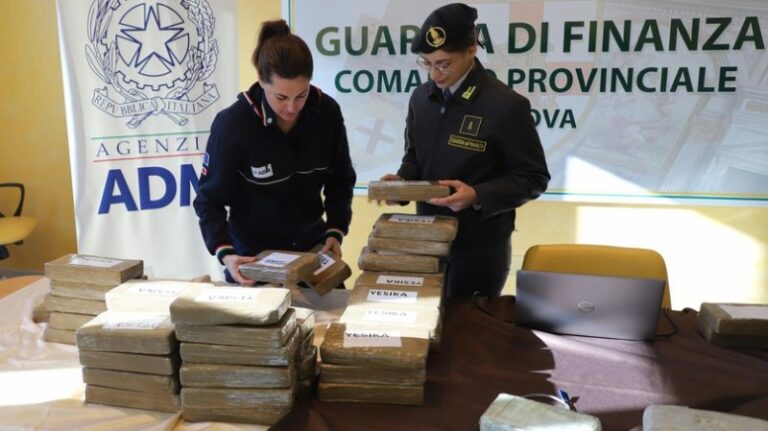
On 8 January 2026, one of the most significant anti-drug operations of recent years was concluded at the port of Genoa, with the seizure of more than two tonnes of pure cocaine hidden inside a container arriving from South America. The operation was carried out in the Sampierdarena port basin by officers from the provincial command of the Guardia di Finanza in Genoa, together with officials from the anti-fraud unit of the Italian Customs Agency.
Inside the container, officers discovered 2,109 packages containing a total of 2,380 kilograms of narcotics. Tests conducted at the time of inspection confirmed that the substance was pure cocaine. If released onto the market, the shipment could have generated estimated proceeds of around €1.5 billion.
The drugs were carefully concealed inside 87 brightly coloured jute sacks wrapped in nylon netting. This method requires advanced logistical planning and the availability of a structured criminal network, with support points both at the ports of departure and at those of arrival. The container had departed from one of Colombia’s main ports, not specified by investigators, in a country that plays a central role in narcotics trafficking routes to Europe.
The operation forms part of an intensive control effort on the trade routes linking South America to the port of Genoa, a hub that has historically represented a crossroads for European maritime flows. This logistical centrality also makes the Ligurian port particularly exposed to international criminal organisations. According to Italy’s Anti-Mafia Investigative Directorate, in recent years Liguria has accounted for a significant share of national cocaine seizures, with Genoa becoming one of the main entry points for shipments originating from the Andean region.
Between 2024 and 2025, several major seizures of narcotics and chemical precursors were carried out within the port of Genoa, revealing the involvement of structured criminal networks and compromised segments of the logistics chain. In February 2024, an initial operation led to the seizure of 145 kilograms of cocaine at the exit of the port area. The operation stemmed from a night-time check by Carabinieri from the Anti-Terrorism Unit, who intercepted two Italian nationals in a car following an attempted escape that ended with a ramming manoeuvre. The drugs, divided into 130 packages and hidden in four large bags, were traced back to a system for retrieving shipments from inside the port. Subsequent investigations led, in 2025, to the arrest of a port worker who had provided access badges and logistical support.
A few weeks later, in April 2024, a broader operation coordinated by the Carabinieri’s Special Operations Group resulted in the execution of 22 precautionary measures across Liguria and Calabria. The investigation, known as Operation Cook, uncovered an international cocaine trafficking network from South America, using the port of Genoa as an entry point and involving an unspecified number of port operators. The case highlighted the existence of a stable criminal structure capable of exploiting vulnerabilities in the logistics chain.
In November 2024, a further investigation, dubbed Operation Gigante and conducted by the Anti-Mafia Investigative Directorate, led to the arrest of six individuals for mafia infiltration in port logistics. The inquiry involved entrepreneurs, employees of shipping companies and individuals linked to organised crime circles, uncovering an attempted import of cocaine from Ecuador financed with more than €600,000. The shipment ultimately failed due to operational problems at the port of Guayaquil. Weapons and ammunition were also seized during the operation.
Also in December 2024, the Guardia di Finanza and the Customs Agency intercepted 260 kilograms of cocaine hidden in a refrigerated container carrying frozen fish from Ecuador. In this case, the discovery was made thanks to a report from medical and veterinary staff from the Ministry of Health during a sanitary inspection. The substance, concealed in packages wrapped in life jackets and nets, was estimated to be worth between €30 million and €40 million.
Throughout 2025, investigative attention remained high. In March, 240 kilograms of cocaine were seized after being hidden in a container of canned tuna from Ecuador, with an estimated value of between €40 million and €50 million. In May, a joint operation by the maritime border police and the Customs Agency led to the seizure of 140 kilograms of pure heroin concealed inside tens of thousands of bricks transported in containers from Iran and destined for northern Europe after unloading in Genoa. The case demonstrated how the Ligurian port is also used as a transit point for trafficking not intended for the Italian market.
In November 2025, enforcement activity also focused on chemical precursors. The Guardia di Finanza and the Customs Agency seized an industrial shipment containing around 700 kilograms of potassium permanganate, a substance used in the production of cocaine and heroin, which had arrived from South Africa without the required authorisations from the Ministry of Health. The operation underlined the importance of controls not only on finished drugs, but also on the raw materials used in refining processes. Overall, between 2024 and 2025, more than three tonnes of cocaine, 140 kilograms of heroin and significant quantities of chemical precursors were seized at the port of Genoa, alongside preventive operations that led to dozens of arrests.
M.L.