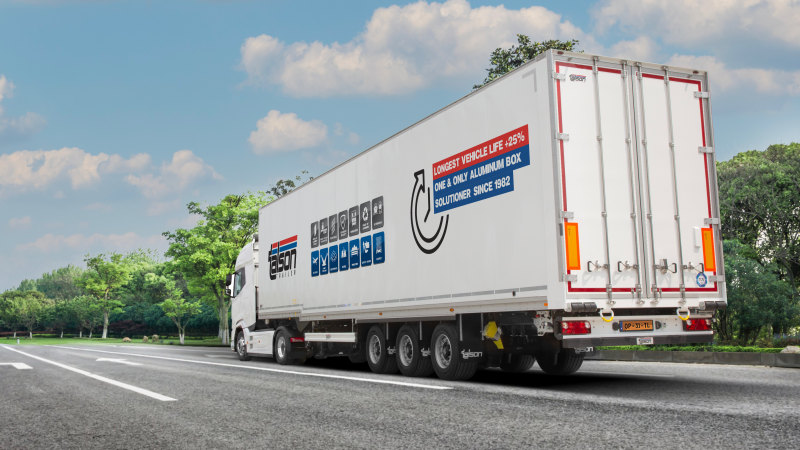








The European road freight market is going through a more complex phase than the traditional cycles observed in the past, according to an analysis released in December 2025 by Lithuanian haulage giant Girteka. By the end of 2025, the cooling seen in autumn did not translate into either a real contraction or a clear recovery, but rather into a condition of ongoing volatility that has now become the sector’s new operating baseline. Transport demand remains uneven and highly sensitive to short-term changes, while available capacity in Europe is structurally insufficient to manage sudden swings in volumes.
Manufacturing activity in the euro area continues to hover around the threshold between expansion and contraction, with indicators reflecting widespread fragility. In this context, a paradox has emerged: overall weak demand coexists with a market that no longer has an adequate surplus of industrial vehicles. The traditional reserve of trucks ready to absorb traffic peaks has largely been depleted, making the system less elastic and more exposed to sudden tensions.
Analysts explain that this reduction in capacity cannot be traced back to a single event, but is the result of a process that began in the post-pandemic period and accelerated during the slowdown of 2023–2024. In those years, insolvencies in the European transport and storage sector rose by around 180% compared with historical levels, forcing many small and medium-sized carriers out of the market. Many of the operators that survived downsized their fleets or postponed investments, contributing to a structural contraction in supply.
Unlike demand, capacity takes a long time to rebuild. Operators remain cautious about purchasing new vehicles because of rising compliance costs and regulatory uncertainty. Tolls, reporting obligations and cross-border rules are constantly evolving, making long-term investment planning more complex. According to Tomas Šilinikas, pricing director at Girteka, even when demand cools the market no longer has enough vehicles to absorb fluctuations, which is why spot rates do not collapse in the way seen in the past.
The picture is further compounded by the driver shortage, which in 2024 reached 426,000 unfilled positions across Europe. An ageing workforce and limited inflows of new drivers further compress capacity elasticity. As a result, even if more vehicles were available, there would not be enough human resources to put them into operation, with direct effects on the continuity of transport networks.
According to Girteka, current volatility therefore does not appear to be a cyclical phenomenon set to fade with an economic recovery. Several factors combine to make it structural. Macroeconomic indicators point to modest growth, driven mainly by domestic consumption rather than exports, resulting in logistics flows that are highly sensitive to shifts in confidence. Energy costs, while more stable than during the 2022 crisis, remain exposed to geopolitical tensions and continue to have a rapid impact on cost structures.
Regulatory pressure represents a further element of instability. CO₂-based toll increases introduced in Germany marked a turning point, while in the Netherlands the eurovignette is set to be replaced by a distance-based charging system by mid-2026. Other member states could follow the same path. In several European markets, emissions- and distance-related tolls account on average for around 14% of total transport costs, with peaks of about 23% on specific routes, and further increases are expected as kilometre-based systems are expanded.
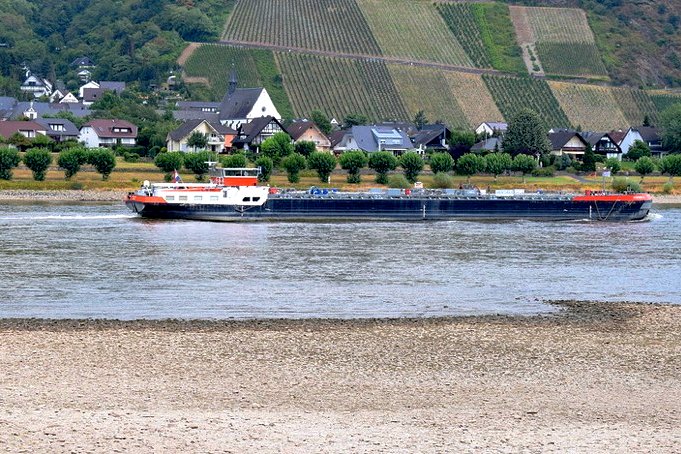
Added to these factors are the effects of climate change. Heatwaves affecting agricultural flows, floods damaging infrastructure and increasingly frequent extreme events introduce elements of operational unpredictability that require rapid adaptation across the entire logistics chain.
In this scenario, operators are revising their strategies with a focus on network resilience. The response goes beyond faster reactions and involves designing systems capable of absorbing shocks without interrupting service. Girteka says that long-term contracts play a central role. With spot rates weakening in the final part of 2025, the gap with contractual prices has narrowed, strengthening interest in stable agreements that guarantee access to capacity in a structurally tight market.
At the same time, the digitalisation of processes is advancing. Predictive analytics, real-time visibility and scenario simulations make it possible to identify bottlenecks, redirect flows and optimise asset deployment on a regional scale. Data management is becoming as central as the management of physical assets, with a direct impact on operational reliability.
Pricing models are also evolving. Flexible clauses for fuel and tolls, dynamic adjustment mechanisms and shorter tender cycles allow risk to be shared between carriers and shippers, while preserving the stability of long-term relationships. From the shippers’ perspective, attention is gradually shifting from cost containment alone to risk management. More robust supply chains are built on collaboration, forecast sharing, transparent volume commitments and joint planning linked to seasonality and regulatory changes.
Girteka’s analysis concludes with an outlook for 2026 pointing to slow stabilisation, with modest European economic growth driven mainly by household consumption. At the same time, operational complexity is set to increase. Regulatory costs, environmental reporting obligations and ESG requirements will increasingly influence capacity availability and price formation. Logistics networks designed solely around cost optimisation are more exposed to sudden shocks, while those oriented towards operational continuity show a greater ability to adapt.