





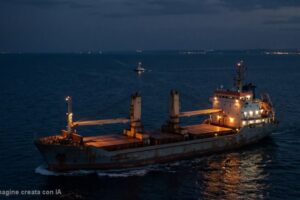


On 27 June 2025, a violent explosion struck the engine room of the oil tanker Vilamoura as it was sailing in the eastern Mediterranean, about 80 nautical miles off the coast of Benghazi. The incident, which disabled the propulsion system and left the ship adrift, marks the fifth suspicious event of its kind since the start of the year, reinforcing a troubling pattern of targeted attacks against vessels suspected of being part of the so-called Russian shadow fleet, used to circumvent Western sanctions on crude oil exports.
The Vilamoura, built in 2011, sails under the flag of the Marshall Islands and is operated by the Greek company TMS Tankers, owned by shipowner George Economou. At the time of the explosion, it was carrying approximately one million barrels of oil from the Libyan port of Zuaitina. Despite the force of the blast, the crew was unharmed and no spills were reported. A rescue operation was promptly launched: the Maltese-flagged firefighting tug Boka Summit reached the vessel the following day and began towing it towards Greece. According to AIS tracking, the two ships are heading for the Gulf of Laconia at a speed of about four knots, where the tanker will undergo a technical assessment.
The Vilamoura explosion is the latest in a disturbing sequence of similar incidents in the Mediterranean throughout 2025. In January, the Seacharm, also operated by the Greek company Thenamaris, was damaged in the Turkish port of Ceyhan. In February, three more incidents occurred in the space of a single week: the Grace Ferrum was hit off the Libyan coast, the Seajewel was attacked with magnetic devices off Savona, and the Koala was involved in an explosion in an unspecified location linked to Russian ports.
In each of these cases, the tankers had docked in previous weeks at Russian oil terminals such as Ust-Luga and Novorossiysk. The Vilamoura, according to maritime consultancy Vanguard Tech, also called at the port of Ust-Luga in April and at Novorossiysk in May, officially to load Kazakh crude. These coincidences reinforce the suspicion that the targeted ships are being deliberately struck by actors aiming to damage maritime infrastructure connected, directly or indirectly, to Russian oil trade.
The most emblematic case remains that of the Seajewel, damaged in the Ligurian Sea on 14 February. The incident was reconstructed in detail by the Italian authorities: two magnetic devices were placed under the ship’s hull, one of which caused a deep gash, while the second exploded on the seabed, resulting in a fish die-off. Bomb disposal experts and navy divers confirmed the deliberate nature of the attack. Surveillance cameras along the Vado Ligure seafront captured suspicious activity in the hours before the explosion, including one man signalling out to sea with a torch and two others talking intensely on mobile phones while gazing towards the horizon.
According to the investigation, led by the Savona public prosecutor’s office, the attack may have been carried out by sabotage units linked to the Ukrainian secret services. The central command of the coastguard is also taking this hypothesis seriously, having listed the Seajewel among high-risk vessels and citing AIS anomalies recorded near Russian ports such as Novorossiysk. The tanker had repeatedly switched off its transponders, a common tactic among ships involved in clandestine operations within the shadow fleet. Investigators also uncovered opaque company ownership structures: the Seajewel is registered under Realm Navigation Incorporated, a company based in Monrovia, Liberia, in a building that houses dozens of firms, many of which are already under international sanctions or scrutiny by European authorities.
Completing the picture is the case of the Russian cargo ship Ursa Major, which sank in December 2024 in the western Mediterranean after being struck by three consecutive explosions. The ship, owned by Oboronlogistics, is known for transporting military equipment on behalf of the Russian Ministry of Defence. That incident too, in its dynamics and target, appears to have been a deliberate operation.
Taken together, these episodes point to a silent but increasingly worrying escalation. The Mediterranean, long considered a relatively stable zone for commercial and energy traffic, is now turning into a new theatre of tension. The rise in attacks raises fears of a domino effect across the maritime transport sector, with growing uncertainty over trade routes, rising insurance premiums, increased risks for crews and potential disruptions to Europe’s oil supplies.