






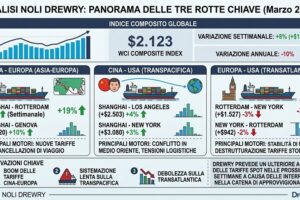


By mid-March 2026, the consequences of the war launched by the United States and Israel against Iran are starting to affect spot container freight rates. This emerges from the update of the Drewry World Container Index released on 12 March 2026, which shows the global composite index rising by 8% compared with the previous week to reach 2,123 dollars per 40-foot container. Behind this average, however, lie very different trends depending on the routes: strong growth on Asia–Europe services, modest increases between China and the United States, and a slight decline on the transatlantic corridor.
The rise is driven by routes between China and Europe, where freight rates recorded the sharpest increases across the markets monitored by Drewry. The Shanghai–Rotterdam route posted the largest jump, up 19% to 2,443 dollars. The Shanghai–Genoa connection also recorded a significant rise of 10%, reaching 3,120 dollars and therefore moving above the 3,000-dollar threshold. On an annual basis, however, values remain slightly in negative territory, down 3% and 6% respectively.
Rates on these routes could rise further in the coming days, and not only as a direct consequence of the Middle East conflict. Drewry highlights two factors: carriers’ capacity management policies and the announcement of new tariff levels. Some shipping lines, including MSC and CMA CGM, have already announced that new FAK rates will be introduced on 22 March. At the same time, according to Drewry’s Container Capacity Insight report, five sailings on Asia–Europe routes have been cancelled for next week. In the opposite direction, between Europe and Asia, the market appears more stable. The Rotterdam–Shanghai route recorded a slight decline of 3% to 528 dollars per 40-foot container, although it still shows an 8% year-on-year increase.
Transpacific routes also continue to show a positive trend, albeit with smaller increases than in the previous week. Freight rates between Shanghai and Los Angeles rose by 4% to 2,503 dollars per 40-foot container, while those between Shanghai and New York increased by 3% to 3,080 dollars. Despite these rises, levels remain lower than a year ago, with declines of 14% and 24% respectively.
According to Drewry, the transpacific sector continues to be influenced by geopolitical and logistical factors. The conflict in the Middle East is creating tensions in global supply chains and is helping support freight rates in the short term. From an operational perspective, the Container Capacity Insight report indicates that seven sailings are scheduled to be cancelled next week on transpacific routes serving the US East and West coasts.
The trend is different on the transatlantic corridor, where freight rates recorded a slight weekly decline. The Rotterdam–New York route fell by 3% to 1,527 dollars per 40-foot container, also posting the largest annual drop in the sample at 36%. The New York–Rotterdam route also declined, slipping 2% to 942 dollars, although it still shows a 10% increase compared with last year.