


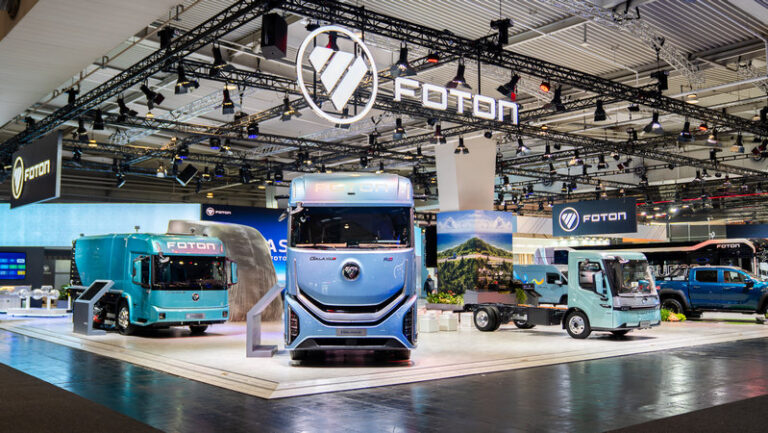
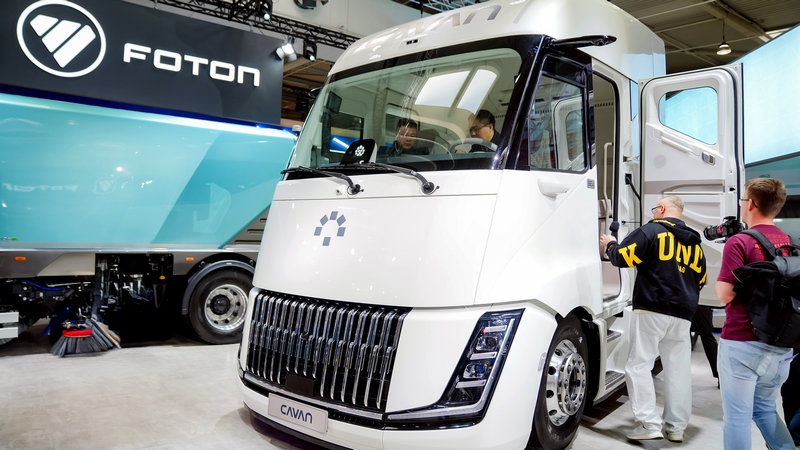
Foton is attending IAA 2026 with a large stand showcasing eight commercial vehicles, led by its flagship Cavan Beacon, a long-haul tractor built on a platform developed specifically for battery-electric and hydrogen fuel-cell powertrains. Hanover marks the model's world premiere, underlining the importance of the German event for the Chinese manufacturer, which is entering the continent not only with a full product range but also with a growing sales and service network, while announcing plans to begin assembly in 2028.
The Foton Cavan Beacon platform is a modular design based on three architectures: body, electrical and electronic systems, and chassis. By combining different cab configurations, electric axles, battery packs and fuel-cell systems, Foton has developed 15 variants covering four energy solutions: battery charging, rapid battery swapping, gaseous hydrogen and liquid hydrogen. In its battery-electric version, the Cavan Beacon can accept a maximum charging power of 1.44 MW. At this power level, the manufacturer says charging from 20% to 80% takes 18 minutes, providing a range of more than 600 km for this version and more than 1,000 km for the hydrogen fuel-cell model.
On energy consumption, the company claims an overall reduction of 15%. This is supported by a drag coefficient of 0.28, control strategies that adapt to the vehicle's mission and a predictive thermal management system. The electric 4x2 configuration consumes as little as 105 kWh per 100 km, while the 6x4 uses 115 kWh per 100 km and the hydrogen-powered 6x4 consumes a minimum of 7.6 kg per 100 km. Driver assistance is provided by a combined ICA/HWP system with 22 functions designed for motorway operation. These include adaptive cruise control, lane centring, automatic lane changing and assisted overtaking. In tests cited by the manufacturer, the system responded correctly in more than 99% of abnormal driving situations. The vehicle architecture is designed to support the future development of Level 4 autonomous driving functions.
Inside the cab, Foton has adopted four-point floating suspension and air-suspended seats, which the company says reduce vibrations by 25% and improve comfort by 20%. The low-floor configuration has a floor height of 1,450 mm. The bunk is one metre wide and storage capacity reaches 420 litres, while the doors feature power-assisted opening. The driving position has a 12.3-inch digital instrument cluster and a 15.6-inch central touchscreen, featuring a commercial vehicle-specific navigation system, smartphone connectivity and interaction between the two displays. The equipment also includes a voice assistant based on a large language model.
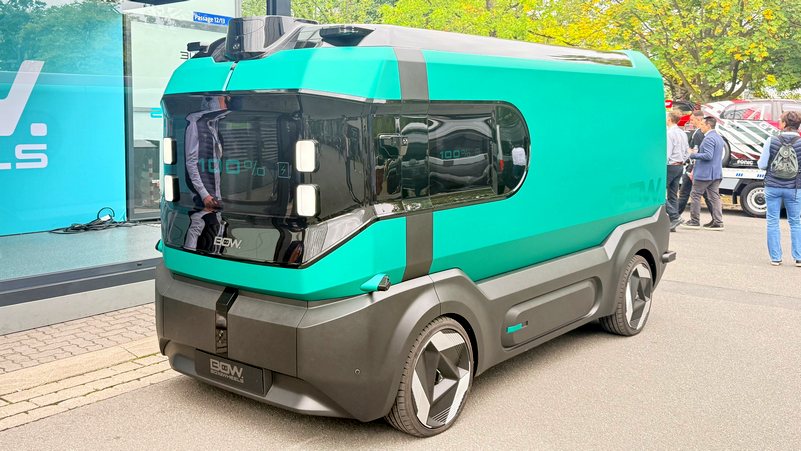
The Cavan Beacon is one of seven vehicles displayed by Foton at IAA, covering segments from heavy-duty trucks to pick-ups. The Galaxus R9 PHEV is a plug-in hybrid heavy-duty truck, while the eGalaxus D3 is a medium-duty electric vehicle configured as a road sweeper. The Daystar is a light commercial vehicle and the Cavan C1 an electric van, the only model in the group already on sale. Completing the range are the Tunland V9 PHEV plug-in hybrid pick-up and the eAurora electric bus. Foton is also displaying six components developed in-house: traction batteries for heavy-duty vehicles, electronic control systems, electric axles for light and heavy commercial vehicles, vehicle control units and megawatt-level charging equipment.
During the press conference, Chang Rui, general manager of Baic Group and chairman of Baic Foton, handed over the group's 13 millionth vehicle: a Galaxus 9 that had completed a series of road tests in Spain under real-world operating conditions. On the same occasion, Liu Xuguang, executive vice-president of Baic Foton, outlined the company's European strategy, summed up by the phrase "In Europe, For Europe", under which the manufacturer is focusing on three technologies: battery-electric, hybrid and hydrogen fuel-cell powertrains.
Foton already has an active sales network in around 20 European markets, which is expected to expand into further countries by 2028, supported by a service network of more than 300 locations. For spare-parts logistics, Foton uses a regional centre in Germany and national warehouses in 17 countries, including the UK, France and Hungary. The German hub is in Unna, North Rhine-Westphalia, and has been operational since February 2026, covering around 20,000 square metres. By August, it was handling almost 1,600 original spare-parts SKUs, including engines, brakes, chassis components and electrical parts, supported by an IT management system, automated storage and robotic picking. Delivery times stated by the manufacturer range from one to four days for Germany, Belgium and the Netherlands, and from five to 14 days for other European markets.
The company has announced the launch of an energy ecosystem in Europe comprising photovoltaic installations, energy storage systems, charging, vehicle-to-grid energy transfer and load testing. The target is to reach at least 5,000 charging points across the continent, alongside agreements with local partners covering leasing, fleet management and used vehicles. Foton also plans to establish a technology centre in Europe to define products for the local market, while the start of local assembly, subject to regulatory approvals, is scheduled by 2028.
P.R.