





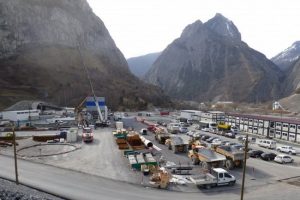
The announcement that procedures have begun for the construction of the international high-speed rail station at Susa on the new Turin–Lyon railway, even if the timing was entirely coincidental, struck many as an attempt to intervene directly in the ongoing and increasingly heated debate over where to locate the "gateway station" on the Italian section, before the entrance to the Mont Cenis base tunnel.
To understand the significance of this announcement and the issues at stake, it is worth clarifying that there are two possible locations for the international station: Susa and Bussoleno. More precisely, the original project provided only for Susa, while Bussoleno was proposed at a later stage. This is not merely a discussion about where to build a passenger station, which might appear to be driven by local rivalries. Given the wider implications and future prospects, the choice could determine the fate of the entire transalpine railway between Turin and Lyon, particularly the role and capacity envisaged for freight transport.
From a technical and transport perspective, Susa, where the recently launched procedures envisage an estimated investment of €115 million, is not an entirely optimal solution. The station would connect not with the existing Turin–Bardonecchia railway but with the Susa branch line, served by only a handful of regional trains. Nevertheless, Susa was selected at the outset of the transalpine railway project primarily because it was intended to mark the beginning of a new high-capacity railway running on an entirely separate alignment all the way to Turin, apart from a possible connection with the nearby Bussoleno station. Just beyond Susa, the plans included the Orsiera tunnel, a twin-bore tunnel slightly over 19 kilometres long, extending to a junction with the existing network at Avigliana.
Subsequently, however, the idea of developing a scheme described as "low-cost" for the Turin–Lyon railway gained ground and was eventually adopted. Some of the works included in the original project were therefore dropped, leaving only the new alignment between Avigliana and Turin Orbassano, which remains under discussion in 2026. Between Susa/Bussoleno and Avigliana, the option of upgrading the existing railway was retained. With the Orsiera tunnel cancelled, the international station at Susa was effectively called into question as well. If the existing railway was to be used, upgrading the current station at Bussoleno would be simpler and certainly less expensive.
Support for Bussoleno has grown steadily over the years, eventually attracting figures such as Paolo Foietta, head of the Italian delegation to the Italy–France Intergovernmental Commission for the Turin–Lyon project, and former government special commissioner and president of the Observatory for the Italy–France railway line. The Bussoleno option has also brought together sections of the public and local authorities opposed to the new railway, as it would permanently eliminate plans for the long Orsiera tunnel, which has been challenged over alleged negative environmental impacts that have never been demonstrated.
In early October 2026, an informal technical working group met in Rome specifically to assess the best location for the new station. Although the surrounding area appeared increasingly inclined towards Bussoleno, the local administration in Susa had consistently defended the proposal to build the station within its municipality. This explains why the subsequent announcement came as something of a surprise. Just days after that meeting, Telt, the Franco-Italian project promoter responsible for overseeing construction and future operation of the cross-border section of the Turin–Lyon railway, announced the launch of procedures for the international station at Susa. Apparently caught off guard, Paolo Foietta himself had to clarify that Telt's announcement was not intended to prejudice the ongoing technical discussions or anticipate the final decision.
But why are Susa and Bussoleno not equivalent options? If the new international station is built according to the original design by Japanese architect Kengo Kuma, the possibility of constructing the Orsiera tunnel would remain open, even if the project were postponed for several years. This would eventually allow the new Turin–Lyon railway to continue on two independent tracks, following an entirely new alignment separate from the existing line. Conversely, if the decision favours upgrading the existing station at Bussoleno, the logical outcome would be to concentrate investment solely on the existing railway between Bussoleno and Avigliana. This would significantly reduce the capacity of the railway as a whole, almost entirely to the detriment of freight transport. Between Bussoleno and Avigliana, freight trains would have to share the tracks with all existing regional services and the frequent international passenger trains expected in the future, creating considerable operational difficulties.
How can this not be seen as a glaring contradiction, given the decision to build a new railway alignment between Avigliana and Turin Orbassano, while also expanding the freight terminal and improving the operations of the Sito intermodal logistics centre within the Turin rail hub? In practice, the Mont Cenis base tunnel will substantially increase capacity on the transalpine railway, allowing up to 250 trains a day to reach the Turin rail hub, but with a particularly restrictive bottleneck between Bussoleno and Avigliana.
Piermario Curti Sacchi