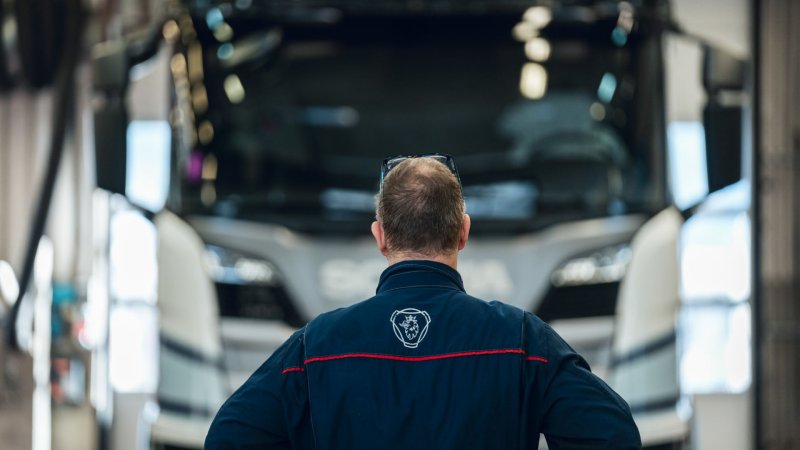




France’s road transport sector entered a phase of intense mobilisation between late March and early April 2026, with coordinated actions across multiple regions. The protests have been triggered by a sharp rise in diesel prices, linked to a new oil shock driven by escalating tensions in the Persian Gulf. Fuel costs have approached or exceeded €2.50 per litre in many areas, with operators reporting peaks close to €3. For a sector in which fuel is one of the main cost components, this surge has rendered many routes barely profitable or loss-making, hitting small operators particularly hard after years of successive crises, including the pandemic, inflation and high energy costs.
The mobilisation involves both hauliers and drivers of trucks and coaches, often owners or employees of small and medium-sized freight and passenger transport companies. Two organisations are leading the response: the Organisation des Transporteurs Routiers Européens (Otre) and the Fédération Nationale des Transporteurs Routiers (Fntr), both active in coordinating actions on the ground and engaging with the Government. Coach operators, particularly in the Paris area, have also joined the protests, with buses taking part in slow convoys along the boulevard périphérique.
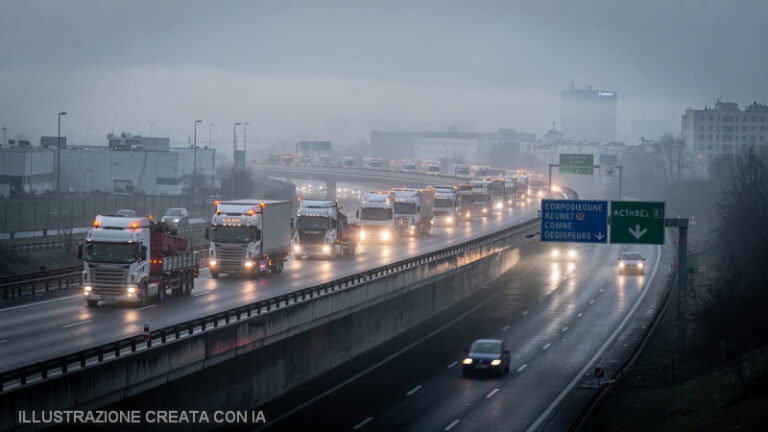
The hallmark of the protest is the “escargot” or snail operation, in which convoys of trucks or buses move at low speed along strategic routes, slowing traffic to highlight the sector’s difficulties without fully blocking circulation. On 30 March, this tactic was deployed on the Paris ring road, particularly near Porte de Vincennes, where several lorries and buses gathered in the morning before slowly circling the urban motorway.
Outside the capital, Auvergne–Rhône-Alpes has been one of the main protest hubs. In Lyon and Clermont-Ferrand, both slow-moving convoys and blockades at junctions and motorway entrances have been organised. On the A7 motorway near Chasse-sur-Rhône in Isère, trucks took to the road as early as 28 March. In Pays de la Loire, hauliers moved at walking pace along the Nantes ring road, while in Provence–Alpes–Côte d’Azur, Occitanie and Nouvelle-Aquitaine, Otre launched coordinated actions with Fntr’s support.
Operators began reporting diesel price increases from 28 February 2026, with a steady rise in the following weeks. By the second half of March, hauliers were publicly raising concerns, explaining that attempts to adjust their pricing had often met resistance from clients, leaving them operating below cost on many routes. On 27 March, the Government announced a €50 million aid plan, presented as targeted support to cover up to €0.20 per litre of diesel for one month for small and medium-sized companies facing severe liquidity constraints. On 29 March, TotalEnergies announced an extension of its price cap at filling stations, partly in response to pressure from both farmers and hauliers. By 1 April, protests had continued or intensified in southern regions, with Fntr urging its members to support local actions.
Many hauliers report fuel costs rising by hundreds of euros per week per vehicle, directly affecting the cash flow of businesses already operating on thin margins. Industry organisations stress that the sector is squeezed between freight rates that are often fixed or difficult to renegotiate and variable costs—fuel, tolls and maintenance—that continue to rise. Fntr in particular highlights the widespread failure to apply fuel indexation clauses in transport contracts, despite their legal basis. As a result, many companies are operating below cost, accumulating payment delays and financial fragility that can quickly lead to insolvency.
Otre and Fntr view the €50 million package as a positive signal but wholly inadequate, as it is limited to one month, restricted to SMEs in severe difficulty and lacks any structural dimension. The organisations are calling for “specific, exceptional and per-vehicle” support, modelled on measures introduced during the 2022 energy crisis, alongside a more automatic and durable mechanism reflecting the real costs borne by operators.
The demands put to the Government span several levels. In the short term, the associations are calling for a simple and immediately accessible per-vehicle support scheme to offset at least part of the additional fuel costs, as well as the extension and strengthening of measures beyond the one-month period covered by the €50 million package. They also demand the effective enforcement of fuel indexation clauses in transport contracts, ensuring that cost increases are shared between clients and carriers rather than borne entirely by the latter. In the medium term, the organisations are calling for policies that recognise the sector’s strategic role in the French economy, in order to prevent a wave of failures among the most vulnerable companies. Without more ambitious intervention, operators warn of a gradual erosion of the small business fabric and growing competitive imbalance in favour of larger, better-capitalised groups.
Pietro Rossoni