





Kuehne+Nagel strengthens Frankfurt
Kuehne+Nagel has signed a lease agreement with Fraport for a new 7,600 square metre air cargo facility in CargoCity South at Frankfurt Airport. Developed by Fraport, the site is intended to strengthen the group’s global network along the main international trade lanes. Completion and handover are scheduled by the end of 2028. The facility will be located within the secure airport area and will have direct airside access, enabling rapid movements between terminals and aircraft stands, reducing aircraft turnaround times and facilitating transfers between the group’s different operations. The project includes 16 gates and truck docks, designed to ensure scalable operations and greater flexibility in response to evolving demand. Planned features include LED lighting, heat pumps, electric vehicle charging points, smart metering systems and a rooftop photovoltaic system to generate renewable energy for the airport network. With this investment, Kuehne+Nagel will expand its total footprint in CargoCity South to more than 20,000 square metres, confirming its long-term commitment to Frankfurt as a global gateway for air cargo.
Maersk and Hapag-Lloyd return to Suez
Maersk and Hapag-Lloyd will resume some container services in the Red Sea and through the Suez Canal from mid-February under naval escort, marking a controlled return to the Asia–Europe route after more than a year of diversions around the Cape of Good Hope. The restart will take place within shared services and follows security assessments carried out in recent months after attacks on commercial vessels that began in late 2023. The first service to return to operation will be the ME11, linking India and the Middle East with the Mediterranean, which will transit high-risk areas with enhanced security measures. Maersk has confirmed that the protection of crews, vessels and cargo remains the primary operational criterion and that routing decisions will be continuously reassessed based on conditions on the ground. At a later stage, the company will also consider the possible return of the AE12 and AE15 services to the Red Sea, without providing a timetable at this stage. The ME11 is part of the Gemini Network, launched in 2025 by Maersk and Hapag-Lloyd to integrate part of their east–west activities and improve operational reliability. In December, a Maersk vessel had already carried out a single transit on the Red Sea route for operational purposes, without a full restoration of services.
Brazil joins the TIR
Brazil has become the 79th contracting country to the United Nations TIR Convention, joining the only global customs transit system and opening up new opportunities for regional and international logistics integration. Accession to the TIR allows the country to improve the efficiency and security of trade with neighbouring countries and extra-regional markets, strengthening South America’s role in global supply chains. According to the United Nations, the TIR system can reduce border crossing times by up to 92% and cut transport costs by up to 50%. Brazil’s accession is also considered strategic for enhancing investments in the bi-oceanic corridor, an infrastructure project that will link the Atlantic and Pacific oceans across Brazil, Paraguay, Argentina and Chile. The corridor aims to strengthen regional connectivity and Brazil’s position in the South American logistics landscape, but its competitiveness depends on the harmonisation of cross-border procedures. In this context, the TIR represents an operational tool to ensure smooth cargo flows along the infrastructure axis.
Emirates SkyCargo boosts pharma logistics
CargoLand by LGG is strengthening its role as a European hub for pharmaceutical logistics through a new partnership with Emirates SkyCargo, which introduces scheduled cargo services after several years of ad hoc operations. From 2026, the carrier will serve Liège Airport with five weekly flights operated with Boeing 777F aircraft, the first new cargo destination of the year for Emirates SkyCargo, significantly increasing capacity dedicated to temperature-sensitive healthcare products. Three of the five flights will link Liège with Chicago O’Hare and Al Maktoum International Airport in Dubai, creating an intercontinental corridor between Europe, North America and the Middle East for pharmaceutical shipments. The operating model involves a strategic freight forwarding partner responsible for end-to-end coordination of pharmaceutical flows and cold chain continuity, in line with Liège’s dedicated infrastructure and its 24/7 cargo operations. According to Julian Sutch of Emirates SkyCargo, the partnership strengthens the life sciences and healthcare offering from Belgium and Europe to major global markets. The launch of the services also reflects closer cooperation between the airline, freight forwarders and the airport within the CargoLand ecosystem. For CargoLand by LGG, the expansion supports a market-driven vertical growth strategy based on coordination with cargo partners, as underlined by Frédéric Brun, head of cargo and logistics commercial activities.
Maersk renews its mid-size fleet
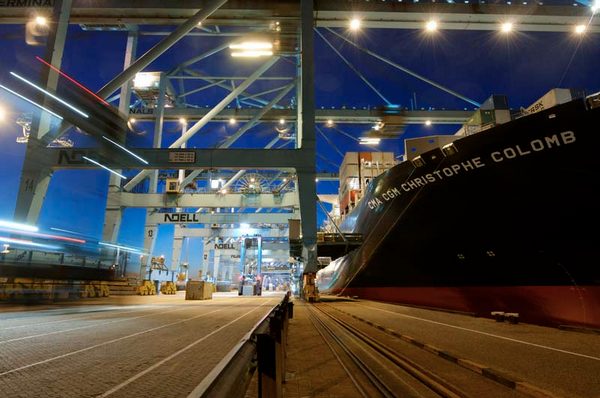
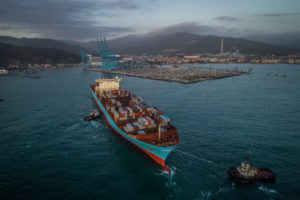
Maersk has taken delivery of Tangier Maersk, the first container vessel in a new series of six mid-size ships built by the Yangzijiang Shipbuilding Group at its Jingjiang yard in China. The vessels in the series each have a capacity of 9,000 TEU and are equipped with dual-fuel engines capable of operating on methanol, forming part of the group’s fleet renewal programme. Tangier Maersk will carry out its maiden voyage with a call at Shanghai and will be deployed on the TP15 service, linking East Asia with the US Gulf Coast via the Panama Canal. Delivery took place three months ahead of schedule, according to Maersk. A further four vessels in the same series will be delivered during 2026, while the final unit is scheduled for early 2027.
Reopening of the Cherbourg line
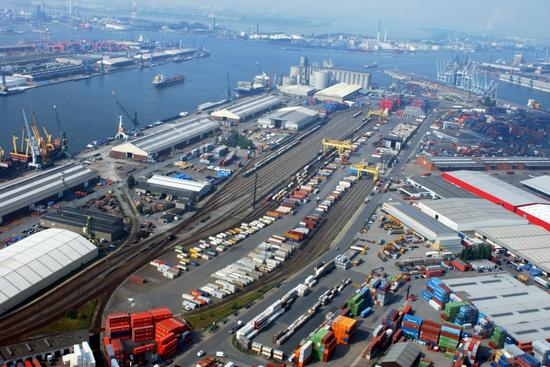
The railway line connecting the port of Cherbourg in northern France will partially reopen on 5 February, around ten days earlier than the initial estimate of mid-February, according to Pierre Sablier of SNCF Réseau Normandie. The line has been closed since 11 January due to the derailment of a freight train. Traffic will initially resume on a single track, following the completion of clearance operations in the Carentan area. The other track, on which the derailed train was travelling, suffered significant damage and will require around six weeks of work before full restoration, provisionally expected by mid-March. According to SNCF Réseau, 550 metres of track will be rebuilt, 1,250 metres of catenary and a turnout replaced, along with the consolidation of the surrounding area over 700 metres. The incident caused a total shutdown of the Cherbourg–Caen line, blocking rail freight connections to the port. The train involved was operating Brittany Ferries’ rolling motorway service between Cherbourg and Bayonne. Following the closure, cargoes from the United Kingdom were diverted by sea to Bilbao and then transported by rail to the French Basque Country. SNCF Réseau had initially estimated the damage at around €10 million.
Aegean–Danube rail corridor
Greece, Bulgaria and Romania have decided to seek funding, primarily from European sources, to modernise and make fully operational the Thessaloniki–Sofia–Bucharest rail axis, which forms part of the broader Aegean–Black Sea–Danube vertical corridor. The initiative aims to strengthen an infrastructure of economic and strategic-military importance by linking Aegean ports, notably Thessaloniki and Alexandroupolis, with the Black Sea coast and the Danube via Bulgarian and Romanian hubs. The project is part of the TEN-T network, in particular the Baltic–Black Sea–Aegean axis, and allows access to European Union instruments such as the Connecting Europe Facility, as indicated by the European Commission. At the end of 2025, the three countries signed a Memorandum of Understanding in Brussels to coordinate planning, timelines and funding sources, avoiding national fragmentation. The European Commission has elevated the corridor to priority status, committing to present a joint project and financing plan by 2026. Joint applications are planned for cross-border sections considered ready by 2030, in order to maximise European contributions. On the operational side, the resumption of the Sofia–Thessaloniki connection is expected between 2026 and 2027 and represents a first step towards a continuous axis up to Bucharest. The authorities indicate 2030 as the target for full operation of the modernised infrastructure, subject to the completion of financing plans and coordinated management of construction works.
Helrom launches Germany–Romania train
Helrom, an operator specialising in the rail transport of semi-trailers, is launching a new connection between Düsseldorf in Germany and Arad in Romania, marking the company’s first entry into the Romanian market. According to the company, the first departures are scheduled from Düsseldorf on 10 and 11 February and from Arad on 13 and 14 February. The service will link Helrom’s headquarters in Düsseldorf with the Afluent Arad South Terminal, located in western Romania. The initiative was announced last November and envisages, once fully operational, five weekly round trips from March.