







Pegasus expands Gnv fleet
Gnv is strengthening its presence in the Mediterranean with the addition of Gnv Pegasus, the company’s twenty-ninth vessel, which will enter service in April. The move forms part of the group’s growth strategy and aims to support demand on existing routes by increasing operational capacity. Built in 2001 and previously owned by the Moby group, the vessel is 214 metres long and 26 metres wide, with a gross tonnage of 35,736 tonnes and a top speed of 23.5 knots. Gnv Pegasus is a sister ship to Gnv Altair, which joined the fleet on 15 January, and contributes to the company’s strategy of gradual fleet expansion and renewal. Designed for mixed passenger and freight traffic, it offers 319 cabins and can carry up to 2,700 passengers, with 915 linear metres of cargo capacity. Before entering service, the vessel will undergo refitting to align it with the company’s quality and operational standards, including measures to optimise overall efficiency and enhance onboard spaces and services, in line with its positioning in the passenger and freight maritime transport segment.
Mileway strengthens Osmannoro
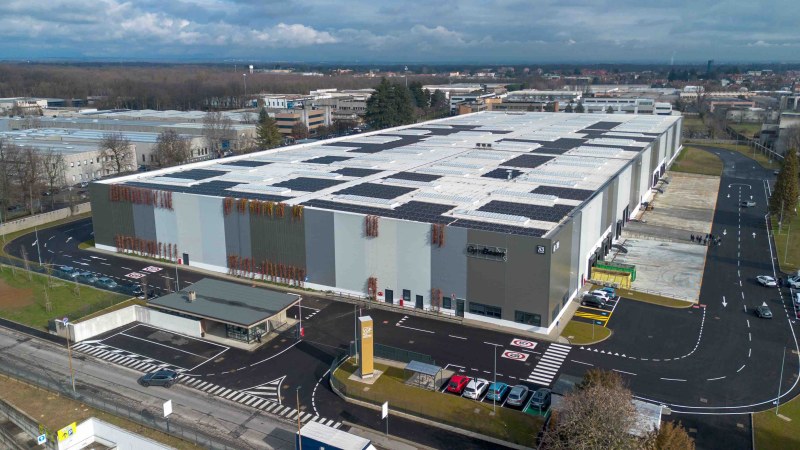
Mileway has signed a lease agreement for approximately 15,000 sqm at the Osmannoro logistics park, in the municipality of Sesto Fiorentino, with a leading international manufacturing company operating in the luxury segment. The deal concerns one of the two units currently under development and confirms the site’s appeal to global operators. The building is scheduled for delivery by the end of 2026 and forms part of a wider 50,000 sqm scheme comprising two independent buildings of around 15,500 sqm and 35,500 sqm. The new tenant will occupy the 15,500 sqm asset, including 14,200 sqm of warehouse space and 1,300 sqm of offices, with a clear internal height of 12 metres. Located in the Osmannoro industrial and logistics district, the park offers direct access to Florence, the A1 motorway and the main regional corridors, enabling coverage of Tuscany and Central Italy with a last-mile focus. Proximity to Florence, an international hub for fashion and luxury, strengthens integration with the local production supply chain and access to a skilled workforce. The park is designed to achieve Breeam Excellent certification and will feature rooftop photovoltaic systems, natural ventilation, zenithal lighting and rainwater harvesting and reuse systems. Developed on a previously underutilised site, the project also includes upgrades to public infrastructure and the creation of new green areas.
Intesa upgrades its Control Tower with AI
Geopolitical instability, market tensions and disruptions in logistics flows are increasing pressure on supply chains, forcing companies to rethink how they manage information. According to the Osservatorio Supply Chain Planning 2025 of the Politecnico di Milano (Supply Chain Planning Observatory 2025 of the Polytechnic University of Milan), only 10% of Italian companies adopt a preventive and structured approach to managing critical issues. The figure rises to 26% among large companies and falls to 5% among SMEs. Data fragmentation, limited system integration and the presence of unstructured documents are slowing decision-making processes along the supply chain. Against this backdrop, Intesa, a Kyndryl company, has upgraded its proprietary Control Tower platform for document and data exchange with artificial intelligence capabilities. The aim is to reduce the time between the emergence of a critical issue and corrective action, improving visibility and prevention capacity. The platform integrates flows from internal systems and logistics partners and analyses them using machine learning models, generating real-time alerts and predictive insights. A central element is Intelligent Document Management, which transforms delivery notes, contracts and attachments into operational information integrated into decision-making processes. Conversational assistants are also being introduced to enable users to query the supply chain in natural language and obtain immediate responses based on available data. In this perspective, EDI, the electronic exchange of documents, is evolving from a simple interconnection infrastructure into a supply chain governance tool, playing an active role in integrating information, documents and processes.
New cold chain hub in Mumbai
Cold Chain Technologies has inaugurated a new facility in Taloja, Navi Mumbai, strengthening its presence in India and the country’s cold chain infrastructure. The site forms part of the group’s strategic expansion plan and complements its global portfolio with local operational capacity, with the aim of providing temperature-controlled services for the pharmaceutical and life sciences sectors. The facility is located near Chhatrapati Shivaji Maharaj and Navi Mumbai International airports and serves pharmaceutical clusters including Ahmedabad, Pune, Goa, Aurangabad, Nagpur, Indore and Nashik, in addition to supporting existing facilities in Mumbai and Hyderabad. The plant operates under an integrated model that brings together manufacturing, research and development, and validation within a single site, delivering benefits in quality control, traceability and reduced lead times. The operational set-up improves efficiency along the flow between production and distribution, strengthening oversight of validation phases. The facility also aims to support India’s role in the global pharmaceutical supply chain by providing logistics infrastructure to underpin international distribution.
Geodis boosts intermodality in France
Geodis has launched a new multimodal logistics service for Naos, a company specialising in skincare products, introducing a rail-road combination on a domestic French route. Goods are collected in Neuville-en-Ferrain, in northern France, and transported by lorry for around 45 kilometres to the Dourges multimodal freight platform, from where they continue by rail to Avignon for final road delivery to Naos’ logistics warehouse in Port Saint Louis. The service covers nearly 300 full truckloads per year, previously handled entirely by road, delivering emission reductions through the intermodal solution. The objective is to support the transformation of Naos’ logistics plan in Europe and globally by developing operational solutions focused on efficiency and sustainability. The service uses sealed containers for the entire combined route and provides dedicated drivers for pick-up and delivery operations, ensuring confidentiality and operational control, which are key requirements in the cosmetics sector. The initiative forms part of a broader scope of activities managed by Geodis for Naos, including centralised maritime transport for the group’s brands, international warehouse management and customs support. In parallel, Geodis operates around 120 trains per week in France and across Europe, with domestic connections between Lille Dourges and Avignon and between Metz and Hendaye, each with five weekly rotations, as well as international services between Łódź and Baltic Sea ports, between Noisy-le-Sec and Novara on a daily basis, and between Łódź and Piacenza with several departures per week.