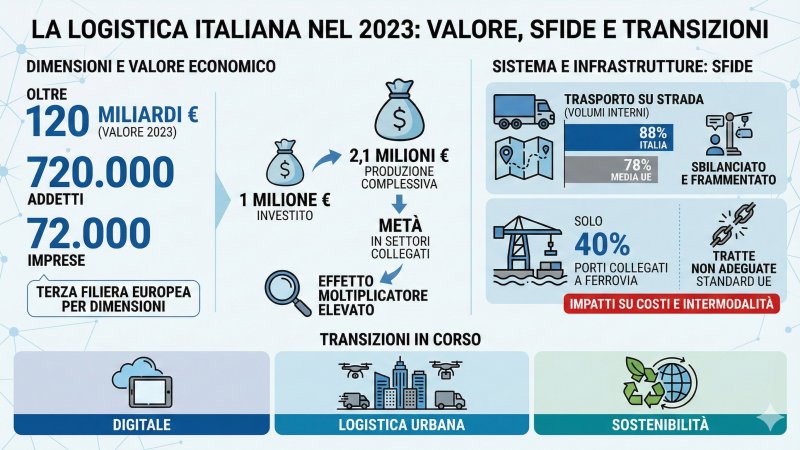








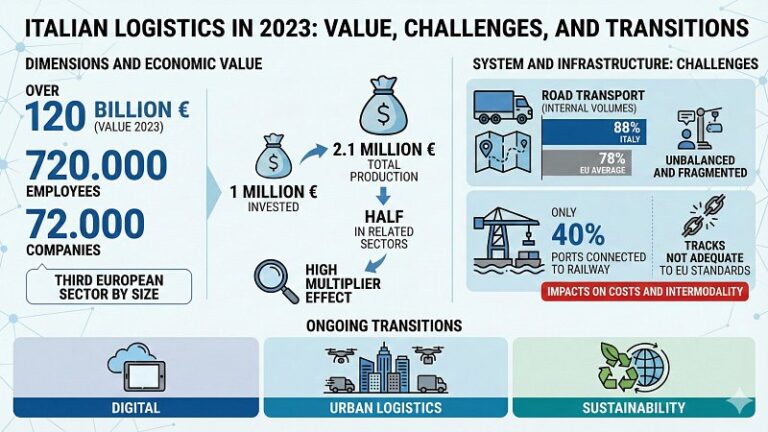
- Italian logistics was worth more than €120 billion in 2023 and employed 720,000 people across 72,000 companies. It is the third-largest supply chain in Europe by size, with a significant multiplier effect: every €1 million invested generates €2.1 million in total output, half of which accrues to related sectors.
- The system remains fragmented and heavily skewed towards road transport, which accounts for 88% of domestic freight volumes compared with an EU average of 78%. Only 40% of ports are directly connected to the rail network and many routes fail to meet European standards, affecting costs and intermodality.
- Digitalisation, urban logistics and sustainability are the three transitions currently under way. Just 2% of companies use artificial intelligence solutions, while the CSRD directive requires emissions reporting. ZES Unica and ZLS aim to attract €8.5 billion in investment and strengthen the role of southern Italy.
Italian logistics is a strategic function for the national economy, yet it faces structural imbalances that limit its full potential. This is the picture emerging from an analysis conducted in January 2026 by Cassa Depositi e Prestiti, updated to 2023 data, which sets out priorities for the 2025–2027 period. The document outlines who, when, where and why to intervene: a supply chain worth more than €120 billion in turnover in 2023, employing 720,000 people across 72,000 companies, the third largest in Europe after Germany and France, but still excessively fragmented and overly reliant on road transport.
The sector generates a substantial leverage effect: every €1 million invested activates €2.1 million in total production. Around half of this impact is indirect and involves sectors such as transport equipment manufacturing, energy and construction, confirming the enabling role of logistics within the wider production system. The Italian market nevertheless shows a marked size dualism. Alongside large integrated operators capable of offering end-to-end solutions and sustaining technology investment, there is a multitude of micro and small enterprises, often concentrated in third-party road haulage, with limited innovation capacity and narrow operating margins. A consolidation trend has emerged, however: over the past ten years more than 250 mergers and acquisitions have been recorded, driven by the need for vertical integration and supply chain control.
A structural issue concerns the widespread use of the Ex Works clause in exports: more than 50% of Italian exporters leave transport management to the foreign buyer. As a result, a significant share of logistics value added is transferred abroad, and Italian companies’ ability to control timing, costs and service quality along the international distribution chain is reduced.
From a modal perspective, Italy shows a more pronounced imbalance than the European average. Road transport accounts for 88% of domestic freight volumes, compared with the European Union average of 78%. Rail stands at 12–13%, a stable but limited share relative to the country’s potential, also considering its geographical position and manufacturing vocation. Comparison with other European countries shows that in Germany value-added logistics services carry greater weight, thanks to the presence of large integrated hubs and a more developed intermodal system. In Italy, as in France, primary transport still prevails over transformation, consolidation and advanced flow management activities.
Infrastructure shortcomings directly affect competitiveness. Only 40% of Italian ports are directly connected to the rail network. In addition, many routes do not meet European standards, particularly regarding train lengths of up to 740 metres and loading gauges suitable for carrying four-metre-high semi-trailers. According to the report, alignment with these standards could reduce the unit cost of rail transport by 25%, with consequences for modal split.
These constraints are compounded by bottlenecks linked to works under the Piano Nazionale di Ripresa e Resilienza (National Recovery and Resilience Plan) and temporary closures of some Alpine crossings, which have slowed the shift of traffic from road to rail. Strengthening last-mile rail connections to ports and inland terminals is identified as a priority to improve intermodality and cut emissions.
Alongside these structural weaknesses, the sector is undergoing three main transitions: digital, urban and sustainable. On the technology front, the adoption of advanced solutions remains limited. Only 2% of Italian logistics companies with at least three employees use artificial intelligence tools. The size gap is evident: uptake increases with company size, highlighting investment access challenges for smaller operators.
The potential benefits of new technologies are significant. For example, transport management systems can reduce waiting times by up to 30%, while warehouse management systems can increase productivity by up to 30%. Digitalisation of information flows also enables more accurate shipment tracking, improved load factors and reduced empty running, with positive effects on costs and environmental impact.
The growth of B2C e-commerce, up 5.5% between 2023 and 2024, is reshaping urban logistics. Commercial vehicles account for around 15% of total traffic in Italian cities. According to the report’s authors, this calls for a reorganisation of urban spaces and last-mile distribution, including the use of automated pick-up points and urban warehouses to bring stock closer to end consumers and reduce fragmented flows.
Sustainability has become a competitive factor, also in light of the CSRD directive, which requires companies to report emissions across the entire supply chain, including indirect ones. In Italy, transport generates 28.4% of total emissions. Fleet renewal, energy upgrading of logistics buildings and the development of reverse logistics for returns management and recycling are identified in the CDP report as priority areas for action.
At global geopolitical level, the document highlights a trend towards the regionalisation of production chains and shorter value chains. This scenario could benefit Italy, particularly southern Italy, given its position in the Mediterranean and its leading role in short-sea shipping. The reorganisation of global flows therefore opens opportunities to strengthen the role of Italian ports as gateways to European markets.
Industrial policy tools play a central role in this framework. ZES Unica, operational in southern Italy since 2024, has already activated €8.5 billion in investment. Tax incentives and administrative simplifications aim to attract global operators and consolidate production and logistics sites in port and hinterland areas. The Simplified Logistics Zones planned for central and northern Italy, as in the case of Genoa and Veneto, are designed to integrate ports and hinterland areas and strengthen connections with European corridors. For the ZLS Veneto, exports are expected to increase by 40% over ten years.
The 2025–2027 Strategic Plan identifies four priorities: Competitiveness, Cohesion, Security and Just Transition. Competitiveness hinges on completing the TEN-T corridors and strengthening last-mile rail links. Territorial cohesion requires the full integration of southern Italy into European networks. Security concerns the resilience of supply chains in an unstable geopolitical context, while Just Transition implies an environmental transition that does not undermine companies’ economic stability.
Overall, the analysis by Cassa Depositi e Prestiti portrays a large supply chain with a strong impact on the national economy, but one that must overcome fragmentation, modal imbalances and delays in technology adoption. The shift towards higher value-added services and greater control over international flows represents the key step to retaining value within the country and strengthening its competitive position in the European context.
P.R.