




On the morning of 11 June 2025, Pasqualino Monti, president of the Autorità di Sistema Portuale del Mare di Sicilia Occidentale (Western Sicily Port Authority), officially inaugurated the launch of the container terminal’s activities in the port of Termini Imerese, near Palermo. This development complements previous consolidation works, interventions on the breakwater and lee piers and on the rock armour, dredging operations, and investment in the northern area of the port, which is intended for use by citizens and tourists alike.
During the inauguration, Monti stated that a new chapter in infrastructure strategy was being written in Termini Imerese. With €180 million already invested, the port is undergoing a transformation in both function and ambition. He added that the relocation of the container terminal from Palermo is not merely a logistical decision, but a move that enhances the very concept of a port system. The terminal is operated by Portitalia, whose president, Giuseppe Todaro, explained that this represents an opportunity for operators, clients, and the territory as a whole.
For operators, it means working under improved conditions and with growth prospects that the city could no longer offer, due to limited space and inadequate infrastructure supporting the port area in Palermo. For clients, the relocation reduces distances and consequently cuts down on transit times, while creating new opportunities for cargo movement to and from central Sicily. Last but not least, shifting part of the activity to a port that is both logistically and geographically better suited, with a road and motorway network that facilitates smoother freight transport, leads to reduced impact on overall traffic.
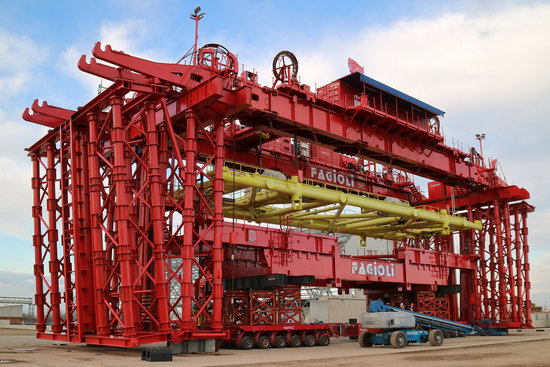
The new Sicilian container terminal stems from an integrated project supported by the National Recovery and Resilience Plan (Pnrr), the Western Sicily Special Economic Zone (Zes), and various regional and national funds. The facility spans an operational area of 40,000 square metres and is served by three main quays, with depths ranging from 8 to 12 metres. Dredging to depths of ten metres was completed in 2022, and consolidation of port infrastructure, including the installation of new mobile cranes supplied by Italgru, has reached the targeted level of progress. The project is backed by a complex financing package totalling €363.87 million, sourced from Pnrr/Zes projects, Pon Infrastrutture, port authority funds and regional resources, encompassing works already completed, ongoing and planned.
The terminal’s three main quays are: the Riva quay, which is 319 metres long with a depth of 12 metres and 8,450 square metres of yard space; the Trapezoidal pier, 433 metres long with a depth of 8 metres and 18,100 square metres of yard; and the San Veniero quay, which extends for 472 metres with the same depth and 22,400 square metres of yard space. The core equipment includes the Italgru mobile crane, supplied at a cost of €3.763 million and capable of handling loads of up to 120 tonnes on the hook. The crane operates within a range of 11 to 46 metres and can move at a speed of up to 4 km/h.
The project formally began in 2019 with the signing of the agreement for seabed dredging, financed with €35 million from the Pon Infrastrutture programme. Later, on 3 December 2021, the Western Sicily Zes Decree included the terminal among the investment projects of the Special Economic Zones, allocating €186.71 million for the strengthening of the container terminal. These interventions laid the groundwork for the creation of a facility capable of accommodating large vessels and supporting intermodal flows via both rail and road.
The terminal’s primary role is to ease congestion at the port of Palermo and redistribute freight traffic, ensuring smoother operations across the port hinterland infrastructure and internal corridors. Its integration into the Western Sicily Special Economic Zone offers operators tax benefits and administrative simplifications, encouraging new investments and the development of value-added services such as customs warehouses, logistics platforms and production facilities.
Looking ahead, container traffic is expected to gradually increase to 300,000 TEUs annually by 2028, thanks to the extension of maritime services and the enhancement of rail connections. The strengthening of the Ten-T network, particularly the completion of the Palermo-Catania-Messina corridor, will be key to consolidating Termini Imerese as a Mediterranean hub, promoting links with Northern Europe and the African continent. Furthermore, additional infrastructure developments, including the construction of a ro-ro terminal and specialised berths for dry bulk, could further expand the port’s offering and turn the area into a hub for complex logistics supply chains.