





The South Korean government has formalised an investment plan worth 4.5 trillion South Korean won, equivalent to around three billion euros, aimed at structurally strengthening the country’s logistics presence beyond its national borders by 2030. The initiative is coordinated by the Ministry of Oceans and Fisheries and involves port authorities, public financial instruments and major private transport and logistics operators. The programme is designed as a response to the disruptions experienced during recent supply chain crises and seeks to guarantee continuity for Korean trade flows in key international markets.
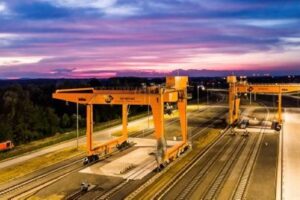
The investment is based on a strategy of vertical integration across logistics activities. South Korea is no longer limiting itself to control over maritime transport, a sector in which it already has a strong presence, but is also seeking to secure storage, distribution and port management functions in destination countries. According to documents from the Ministry of Oceans and Fisheries, the number of overseas logistics hubs will increase from the current nine to forty by 2030, while port terminals with Korean participation will rise from seven to ten. The planned facilities include advanced cold chain warehouses, automated systems and solutions dedicated to high-value industrial goods, particularly in the electronics, automotive and chemical sectors.
From a financial perspective, the plan is underpinned by a strengthening of public support instruments. The Korea Ocean Business Corporation acts as the financial backbone, with the expansion of the global supply chain fund from one to two trillion won and the creation of a dedicated container terminal fund worth one trillion won. These resources enable Korean port authorities to invest directly abroad and to attract the participation of private operators such as HMM, CJ Logistics, Samsung SDS and LX Pantos, reducing risk for companies while guaranteeing capacity and tariffs for small and medium-sized exporting firms.
The underlying rationale of the investment is resilience. Government analyses recall how, during the pandemic, many Korean companies faced delays and higher costs due to a lack of storage space in foreign ports, with direct consequences for competitiveness. Control over hubs and terminals provides stable footholds even during periods of congestion, reducing dependence on infrastructure managed by third-party operators and by competing countries. This dimension is complemented by a geopolitical consideration linked to the need to secure access to raw materials and strategic components along increasingly fragmented supply chains.
Europe represents one of the main areas of implementation of the plan and one of the most important markets for Korean exports. According to South Korean authorities, the continent sits at the heart of a strategy that combines hubs in northern, southern and eastern Europe in order to cover the main logistics and industrial corridors. In the Netherlands, a large logistics centre is already operational at the port of Rotterdam, in the Maasvlakte West area, developed by the Busan Port Authority and operated by Samsung SDS. The facility serves as an entry platform for northern Europe, enabling customs clearance and rapid distribution of Korean goods to Germany, the Benelux countries and Scandinavia.
In the Mediterranean, the most significant project is in Barcelona, where the joint venture B2B Logistics Busan Barcelona Hub has been established, owned 51 per cent by the port of Busan and 49 per cent by the port of Barcelona. Located in the logistics activity zone of the Catalan port, the platform is designed as a gateway to southern Europe, with direct connections to Spain, France and Italy. It is the first case of direct management of a European logistics platform by a South Korean public body and signals a strengthening of South Korea’s role in Mediterranean logistics networks.
The European impact also extends to eastern Europe, where new hubs are planned in countries such as Poland, Hungary and Croatia. These locations are closely linked to Korean industrial presence in the battery and automotive sectors, with manufacturing investments by groups such as LG Energy Solution and SK On. The availability of dedicated logistics infrastructure helps reduce procurement and distribution times across EU markets, reinforcing integration between manufacturing and logistics.
Overall, the South Korean plan introduces a new element of competition into the European logistics landscape. The entry of Asian public operators into the management of hubs and terminals may alter the balance between ports, favouring certain routes over others and increasing competitive pressure on local operators. At the same time, the investment brings additional infrastructure capacity, with potentially positive effects on traffic fluidity and on the attractiveness of certain areas for industrial activities linked to global value chains.
Pitero Rossoni