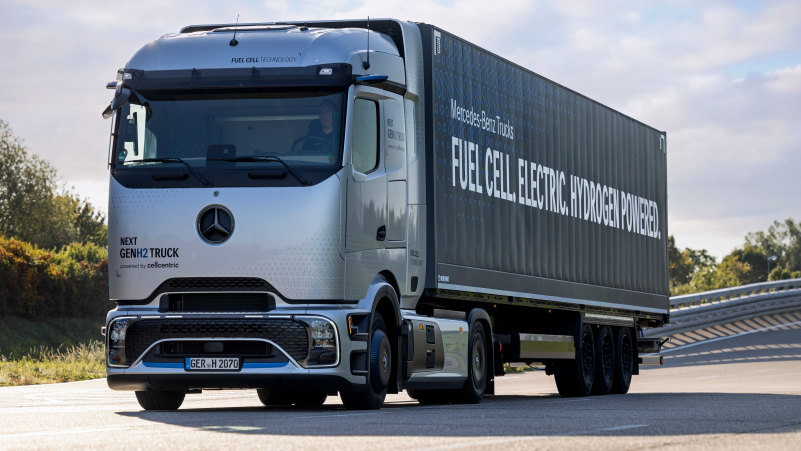








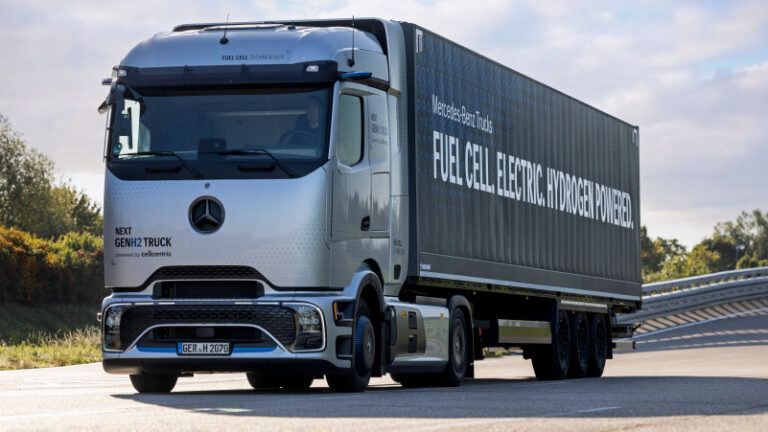
Daimler Truck has developed the Mercedes-Benz NextGenH2 Truck, a new generation of fuel-cell electric tractor that represents a further step in the development of hydrogen-powered long-haul road transport. The vehicle will be produced in a limited series of 100 units at the Mercedes-Benz plant in Wörth and will be deployed with selected customers from the end of 2026. The initiative follows the development and testing programme of the first-generation GenH2 prototypes and fits into the group’s strategy for the transition towards low-emission transport solutions.
According to the manufacturer, the NextGenH2 Truck retains the main strengths of the GenH2 while introducing technical solutions closer to series production. The new model continues to rely on liquid hydrogen, which Daimler Truck considers more suitable for heavy-duty transport than gaseous hydrogen. At a temperature of minus 253 degrees Celsius, liquid hydrogen offers higher energy density, with direct benefits in terms of range and payload. The total capacity of the two tanks has been increased compared with the first generation and now reaches up to 85 kilograms of hydrogen, enabling distances well beyond 1,000 kilometres on a single refuelling. Refuelling takes 10 to 15 minutes via the SLH2 standard developed by Daimler Truck and Linde, with operating procedures comparable to those of diesel vehicles.
The German manufacturer explains that transporting and storing liquid hydrogen involves lower complexity than high-pressure solutions, offering advantages in terms of tank weight and costs. These factors allow payload configurations comparable to those of diesel tractors currently in service. A concrete demonstration had already come at the end of 2023, when a Mercedes-Benz GenH2 covered 1,047 kilometres on a single load of liquid hydrogen, with a gross combination mass of around 40 tonnes.
At the heart of the drivetrain remains the BZA150 fuel cell from Cellcentric, the joint venture between Daimler Truck and Volvo Group. The NextGenH2 Truck is equipped with two units operating in a twin configuration, delivering a combined output of 300 kilowatts and integrated into the engine compartment beneath the cab. Data collected from road tests of the first generation indicate average consumption between 5.6 and 8 kilograms of hydrogen per 100 kilometres, with gross vehicle weights ranging from 16 to 34 tonnes.
The electrical energy produced by the reaction between hydrogen and oxygen powers the electric motors integrated into the electric axle, supported by a high-voltage buffer battery. The only by-product of the process is water vapour. In the NextGenH2 Truck, the battery has an installed capacity of 101 kilowatt-hours and is based on lithium iron phosphate chemistry. In addition to stabilising fuel-cell operation, the battery stores energy recovered during braking and downhill driving, helping to increase overall range.
One of the main innovations of the NextGenH2 Truck is the adoption of series-production components already used on the Mercedes-Benz eActros 600, the battery-electric model already on the market. These include the integrated electric axle with a four-speed transmission, the aerodynamically optimised ProCabin and the Multimedia Cockpit Interactive 2 system. The new cab delivers a 9% improvement in aerodynamic drag compared with the previous generation, with direct benefits for energy consumption.
The new hydrogen model offers output of up to 340 kilowatts in Economy mode and up to 370 kilowatts in Power mode, maintaining responsive performance even under heavy loads or on steep gradients. According to the manufacturer, the driving experience is aligned with that of battery-electric vehicles, with immediate torque, low noise levels and high comfort. Technical evolution also extends to the electronic architecture and safety systems. The NextGenH2 Truck integrates the latest generation of driver assistance systems, including Active Brake Assist 6, Front Guard Assist and Active Sideguard Assist 2, as well as compliance with current cybersecurity requirements.
The reorganisation of components within the so-called Tech Tower behind the cab, which houses the energy generation systems, has reduced overall bulk and shortened the wheelbase by 150 millimetres, bringing it to 4,000 millimetres. This intervention increases compatibility with different semi-trailer combinations and with a wide range of standard trailers, in compliance with European length regulations.
The Tech Tower also accommodates a new boil-off management system designed to meet regulatory requirements for hydrogen handling, including the ability to park the vehicle in enclosed spaces. An integrated cooling system ensures stable operating conditions even in high ambient temperatures or on demanding routes. A sensor system has also been introduced which, in the event of hydrogen leaks, still allows overnight stays in the cab, which is equipped with two standard beds, improving comfort for long-haul operations.
On the passive safety front, new side panels with impact-absorbing elements provide better protection for the liquid hydrogen tanks in the event of an accident, while also helping to reduce aerodynamic drag. Prototypes of the NextGenH2 Truck underwent intensive testing in extreme conditions in the Swiss Alps during 2025, both in winter and summer. The information gathered during these trials has been directly incorporated into the development of the limited-series vehicle.
The development, production and operational deployment of the 100 NextGenH2 Trucks planned from the end of 2026 are supported by total public funding of €226 million, provided by the German Federal Ministry for Digital and Transport and by the federal states of Rhineland-Palatinate and Baden-Württemberg. Daimler Truck confirms that the goal remains to start series production of fuel-cell trucks at the beginning of the next decade.