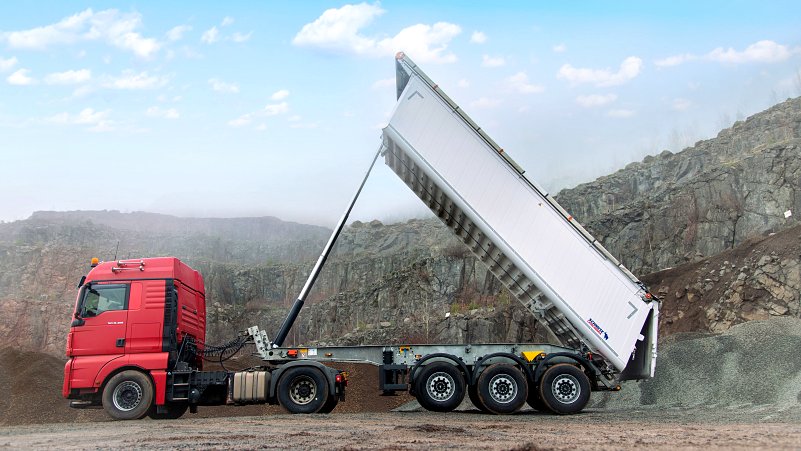





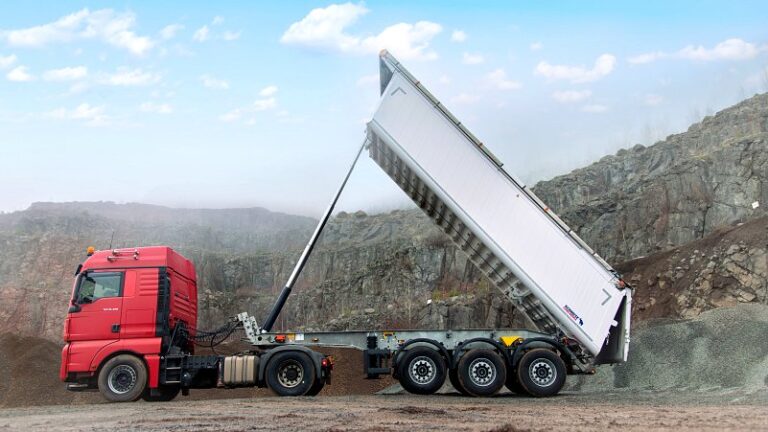
Schmitz Cargobull has introduced a new generation of lightweight alloy body for its S.Ki Ak Light tipper semi-trailer, a model designed primarily for construction, quarrying and agricultural applications. The new square aluminium body is produced at the Gotha plant and is intended to strengthen the company’s position in the low-weight tipper segment, where payload, structural durability and operational uptime directly affect vehicle profitability.
The upgrade retains one of aluminium’s key advantages, namely reduced vehicle weight, while introducing targeted modifications to reinforce the structure. Schmitz has redesigned the top rail and the contact surfaces of the sliding roof to improve stability during loading and unloading and to limit wear in the most stressed areas. In a sector where semi-trailers often operate in intensive cycles and harsh environments, component durability remains a key concern for operators.
A modular approach remains central to the industrial offering. Alongside standard versions, the manufacturer provides dedicated configurations and insulated solutions for specific applications. This reflects evolving demand in the tipper segment, where vehicles are increasingly required to adapt to different materials, routes and operating conditions without sacrificing a standardised technical base.
One of the most significant aspects of the redesign concerns the floor connection, which has been revised to provide greater resistance under heavy loads. The introduction of a top plate increases overall structural rigidity, while the rear section has been reinforced to withstand intensive use, such as in quarries and construction sites. These changes extend maintenance intervals and reduce the financial impact of downtime, two factors that are increasingly relevant in total cost of ownership calculations for fleets.
Schmitz has also focused on everyday usability. The smooth exterior of the body limits material build-up and reduces surfaces exposed to corrosion, while integrated anti-wear grooves in the floor act as visual indicators of body condition, helping operators determine when maintenance should be scheduled. The wider side profiles, with fewer joints, are designed to facilitate cleaning and reduce preparation times. The standardisation of sliding roof components across both steel and aluminium versions supports simpler spare parts management. For mixed fleets, reducing component variety can lead to more efficient stock control and faster replacement times, particularly in operations where trailer availability is critical.
Optional equipment includes pneumatic underrun protection, an electric sliding roof and the OnBoard weighing system, along with other assistance devices to improve vehicle control and safety during unloading. In this area too, the tipper market is moving towards solutions that help drivers and fleet operators reduce operational errors, load irregularities and unproductive time.
The revision of the S.Ki Ak Light confirms Schmitz Cargobull’s direction in a highly competitive segment, where manufacturers compete primarily on durability, tare weight, ease of maintenance and operating costs. In Italy, where the tipper market remains dominated by numerous specialist players, the German brand is seeking to differentiate itself with a proposition that combines industrial standardisation, increased robustness and close attention to the practical aspects of day-to-day vehicle management.
Massimiliano Barberis