



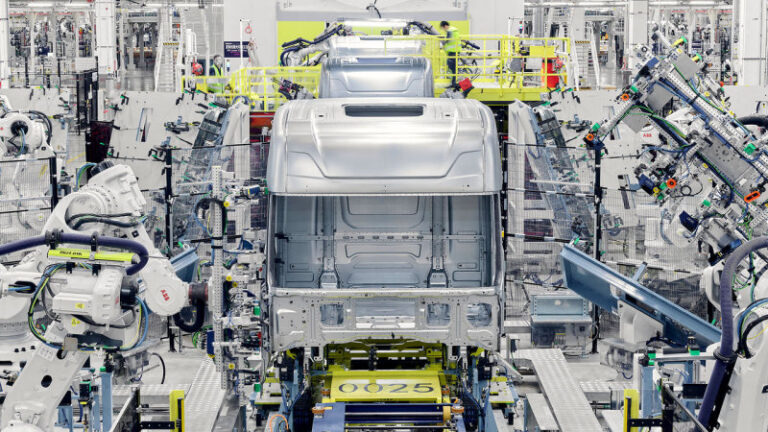
Scania Group has inaugurated its third global industrial hub in Rugao, Jiangsu province, marking a new phase in its strategy to expand and integrate production processes on a worldwide scale. The site, covering 800,000 square metres, has an authorised capacity of 50,000 vehicles per year and represents one of the company’s most significant investments, worth €2 billion. The plant will employ around 3,000 people and will serve both the Chinese market and selected Asian and non-Asian destinations.
In 2024, Scania delivered just over 102,000 vehicles worldwide, underlining the strategic importance of the new production capacity, which accounts for nearly half of the brand’s annual global output. The Rugao facility — Scania’s largest single investment to date — will enable the company to increase volumes in a market that alone represents the largest share of global truck demand.
Scania is also the first Western manufacturer in China to obtain full authorisation to produce wholly foreign-owned trucks, strengthening the Group’s presence in the world’s biggest truck market. The Rugao plant, which operates almost entirely on renewable energy — including locally sourced biogas and certified green electricity — also supports Scania’s decarbonisation targets for Scope 1 and Scope 2 emissions.
The new site is not limited to vehicle assembly but also serves as an integrated development centre, with research and design activities shared between Rugao and Shanghai. According to Ruthger de Vries, President of Scania Industrial Operations Asia, “sustainability is embedded in every process of the plant, from energy sourcing to waste management.” For the Swedish group, investment in China represents a strategic lever to strengthen global competitiveness and accelerate innovation. Christian Levin, CEO of Scania and the Traton Group, stressed that the local presence allows the company “to leverage the speed and creativity of China’s industrial ecosystem to accelerate the transition towards sustainable transport.”
The new facility comes at a time when several European manufacturers are re-evaluating their production footprint in China. Daimler Truck Holding, for instance, has reported profitability challenges in the local market and written down €120 million from its Chinese joint venture, while the domestic market remains dominated by state-owned producers such as Sinotruk, Dongfeng, Foton and Faw Group. In this competitive environment, Scania is pursuing a different path, focusing on a long-term model built on sustainable solutions, integrated services and closer customer relationships.
The Chinese plant is fully integrated into the Traton modular system, enabling the Group’s brands to tailor and develop their products according to individual market needs. Two product lines will be offered in China: Scania’s global range, customisable for demanding applications, and the new Next Era tractor line, designed for the long-haul, high-volume transport segment. The latter, developed in China and compatible with the local digital ecosystem, represents the first example of joint design combining the Group’s modular platform with the specific requirements of the Chinese market. Vehicle deliveries from Rugao are due to begin at the end of 2025, while the Next Era range will be launched in the first half of 2026.