





If there is one country that has benefited from the conflict between Russia and Ukraine, it is certainly Georgia. Located in the South Caucasus and overlooking the eastern shore of the Black Sea, it has set aside long-standing local conflicts such as the one involving Ossetia to quickly position itself along new alternative routes between China and the European Union. At the same time, Tbilisi has been quick to capitalise politically on the new international context. Russia’s invasion of Ukraine dates back to February 2022, and just one month later Georgia submitted its application to join the European Union, while also leaving open the possibility of involvement within NATO.
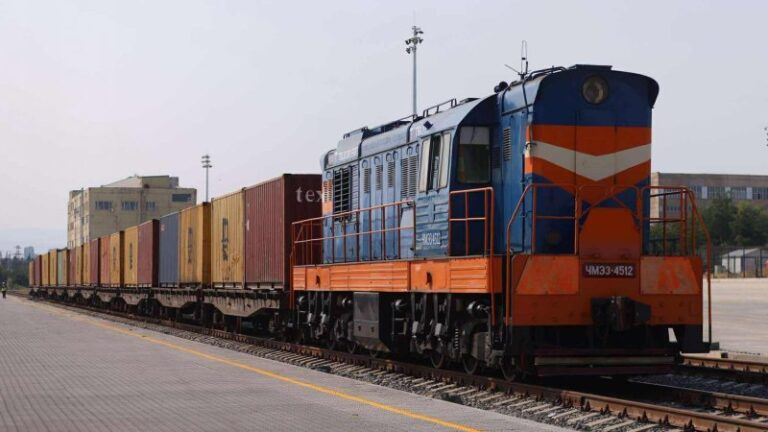
This political shift has been mirrored by a rapid revival in the transport sector. By the end of 2022, the volume of goods transported by rail had increased by more than 22%, while revenues rose by around 45%, largely driven by new transit flows. This clearly demonstrates how quickly trade routes can adapt to geopolitical changes. Although road transport remains by far the dominant mode, alongside maritime transport, railways are playing an increasingly significant role, accounting for around 30% of total freight volumes. This share is driven more by international flows than by domestic traffic.
On the infrastructure side, Georgian authorities have also moved swiftly. In 2024, work was completed to upgrade and modernise the Baku-Tbilisi-Kars line, also known as BTK, to international standards. This is the country’s most important rail corridor, linking with Azerbaijan on one side and Turkey on the other. While this route represents no more than 15% of Georgia’s total rail transport capacity, it handles around 30% of actual freight volumes in transit. Considering only the Georgian section, capacity was limited to one million tonnes per year before the upgrade works, but increased fivefold just one year after completion.
The Baku-Tbilisi-Kars line is part of the Middle Corridor, also known as the Trans-Caspian International Transport Route, although it is not the only option for connections between Asia and Europe in this region. From the first year of the Russia-Ukraine conflict, traffic volumes surged dramatically, with a reported increase of 116% according to local sources. In 2025, container transport tripled, mainly driven by the transit of full trainloads.
Georgia is also making the most of its potential thanks to its Black Sea ports, particularly Poti and Batumi, which have seen significant investment. In 2026, Georgian Railways launched a further investment plan worth more than €300 million, primarily aimed at acquiring modern rolling stock, an area where much remains to be done. However, the challenges do not end there.
New projects also involve Anaklia, a location previously known mainly for its tourism and seaside appeal, after having played a minor role in the past as a secondary base for the Soviet naval fleet. In 2026, construction began on a 17-kilometre electrified freight rail link that will directly connect the main railway line to the port, enhancing its commercial function. Although accession negotiations with the European Union have not made significant progress, Georgia is becoming increasingly integrated into the European framework through various intergovernmental organisations, including the European Bank for Reconstruction and Development (EBRD), a key driver in supporting the market economy, attracting investment and promoting infrastructure development.
Piermario Curti Sacchi