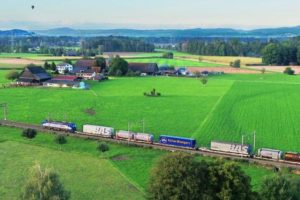





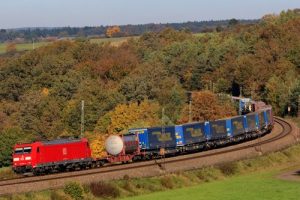
Germany’s railways present a mixed picture, with progress on some projects offset by closures elsewhere due to engineering works. Among the positive developments is the completion, at the end of March 2026, of works on a section of the Rhine Valley railway (Rheintalbahn). Two new tracks have been laid alongside the existing ones, bringing the total to four tracks along a six-kilometre stretch running from just north of Müllheim to south of the Auggen junction in Baden-Württemberg. After six years of construction, the additional tracks will increase capacity on one of the busiest sections of the German rail network. With this project completed, the four-track section between Karlsruhe and Basel now extends to 67 kilometres out of a total of 200 kilometres. Notably, the section south of Auggen connects with the Katzenberg Tunnel, a 9,385-metre diversion opened in December 2012 as part of the wider quadrupling scheme.
However, while one piece of the puzzle falls into place, Bavaria is facing significant disruption. A major programme to modernise the rail network is causing inevitable knock-on effects, including prolonged line closures, rerouting and cancellations, particularly for freight services. For five months, until summer 2026, upgrade and renewal works are affecting the line between Regensburg and Nürnberg. This approximately 100-kilometre stretch is a key section of the trans-European TEN-T Rhine–Danube corridor. Due to the lack of viable alternative routes, freight operators in Germany once again find themselves at a standstill, as highlighted by Die Güterbahnen, the association representing around 100 rail freight companies and long committed to the vision of a single European rail network.
The two main alternatives for freight trains are the Bavarian routes via Würzburg–Nürnberg–Treuchtlingen and via the Ansbach node. However, the latter has been affected by technical issues linked to the signalling control centre, putting this diversion at risk and exposing the system’s fragility. If Ansbach is disrupted, traffic diverted via Treuchtlingen risks becoming heavily congested, with knock-on effects for services towards Munich and the rest of Bavaria.
According to Die Güterbahnen, the alternative routes proposed by infrastructure manager DB InfraGo are too fragile and at the same time increase operating costs for companies and operators, without additional public support. More critically, the association argues that German railways suffer from serious shortcomings in construction planning. In anticipation of the long closure of the Regensburg–Nürnberg line, alternative routes should have been upgraded with passing loops to the European standard of 750 metres, which has not been done. This represents a further obstacle and an additional cost burden for operators, who must absorb the disruption without any real compensation, apart from the prospect of improved performance once the modernisation works are completed.
The memory is still fresh of the disruption caused by one of Germany’s major rail upgrade projects: the complete five-month closure in 2024 of the Frankfurt–Mannheim line, also known as the Riedbahn, one of the busiest rail corridors and a central axis of the Rhine–Alpine corridor. Further phases of work are continuing in 2026. DB InfraGo’s decision to concentrate upgrade works during planned closures avoids prolonged, piecemeal construction activity, but at the same time makes it difficult to manage alternative routes, particularly for freight, given the saturation of available lines.
Piermario Curti Sacchi