
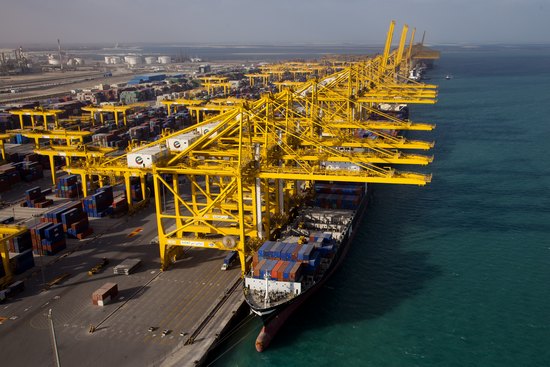





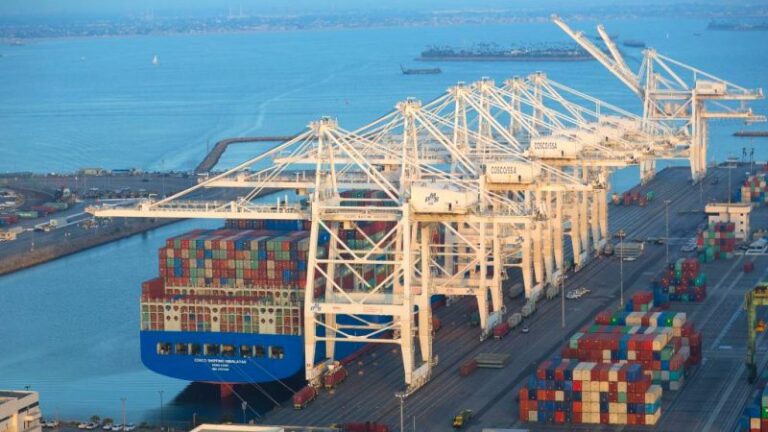
- In 2026, the main source of inefficiency in the supply chain is no longer the open sea, but the short stretch between port and warehouse. Containers declared available but not collected, missed appointments and saturated receiving capacity create widespread micro-costs — demurrage, detention and additional storage — eroding margins without appearing on high-level dashboards.
- Ultra-large container vessels of 20,000–24,000 TEU, volume volatility driven by tariffs and geopolitical instability, and a chronic shortage of short-haul port drivers are amplifying misalignments between terminals, trucks and warehouses. In Europe, Rotterdam, Antwerp and Hamburg are reporting vessel waiting times of more than two days and terminal utilisation close to 90%, with knock-on effects reaching inland logistics hubs in northern Italy.
- Countermeasures exist, including integrated vessel–drayage–warehouse planning, real-time visibility, port-centric logistics and gateway redesign. Their effectiveness, however, depends on the adoption of specific KPIs for the port–warehouse segment and on connecting systems that remain fragmented across different operators.
In 2026, a significant share of supply chain disruption no longer originates at sea, but within the few kilometres separating the port terminal from the destination warehouse. These are not headline-grabbing blockages or long vessel queues, but rather small disruptions that accumulate quietly: containers listed as available but not picked up, missed delivery slots, warehouses that are full or not ready to receive goods, and trucks and drivers not synchronised with vessel arrivals. An analysis by Source Logistics describes this dynamic as a "silent breakdown" of the logistics chain: invisible in executive dashboards, yet constantly generating recurring costs and eroding overall delivery reliability.
The issue has clearly identifiable operational roots. According to World Craft Logistics, three main bottlenecks define the port–warehouse segment. The first is the lack of coordination between containers and trucks: the container is available at the terminal, but the vehicle is not activated in time, drivers or trailers are missing, and dwell times increase as a result. The second is the warehouse constraint: facilities are not aligned with vessel discharge profiles, staffing levels do not match peak volumes, unloading bays are saturated and, when warehouses are full, trucks miss their receiving windows and containers remain at the port. The third is fragmented information systems: ports, drayage carriers and warehouses operate on separate platforms, with limited real-time visibility on vessel arrivals, container availability and receiving slots, and coordination still largely reliant on phone calls and emails.
These structural factors are exacerbated by broader trends. Container ships of 20,000–24,000 TEU discharge highly concentrated volumes within narrow time windows, exceeding quay and yard capacity. Port performance in many locations remains below pre-pandemic levels. The shortage of drivers for port drayage — short-haul transport between terminal and the first warehouse — is chronic and shows no sign of easing, as highlighted by S&P Global Market Intelligence.
In 2026, two additional factors are further aggravating the situation. Global Corporate Logistics notes that volume volatility driven by tariff decisions and instability in key regions such as the Red Sea and the Strait of Hormuz is creating "bunching" effects: highly concentrated arrivals in certain weeks followed by periods of low activity. Port systems and warehouses struggle to scale rapidly to handle these peaks. At the same time, Thyssenkrupp Supply Chain reports that financial pressure is pushing many companies to reduce inventories, increasing sensitivity to even minor delays. A small mismatch between vessel arrival and warehouse receiving slots now has a far more immediate economic impact than in the past.
The result is an accumulation of micro-costs spread across multiple categories, which Source Logistics describes as "invisible" to senior management but significant in day-to-day operations. Four main cost drivers stand out. The first is demurrage and detention: containers that remain at terminals beyond free time due to lack of equipment, slots or warehouse capacity generate charges that the Federal Maritime Commission identifies as a structural issue for freight forwarders, often for reasons beyond their direct control. The second is additional storage in or near the port: when goods cannot enter the destination warehouse, storage must be paid either at the terminal or in external facilities, increasing both costs and handling. The third includes transport and labour inefficiencies: driver waiting times, empty trips, re-deliveries and warehouse overtime to manage out-of-window arrivals — costs that, according to Global Corporate Logistics, are not always fully captured in logistics P&L accounts. The fourth relates to inventory and sales impact: Averitt notes that delays in stock positioning lead to stockouts and lost sales, or force companies to increase safety stock elsewhere in the network to compensate for uncertainty in actual delivery times.
In Europe, the phenomenon has specific characteristics linked to the structure of intermodal corridors and the sensitivity of port hubs to disruptive events. In major Northern European ports — Rotterdam, Antwerp-Bruges and Hamburg — the combination of rerouted services via the Cape of Good Hope, the gradual return of Suez services and winter weather has led to "vessel bunching": simultaneous arrivals of multiple ships beyond quay and crane capacity. Kuehne+Nagel reported in its March 2026 operational update that Hamburg was experiencing average vessel waiting times of more than two days and yard utilisation close to 90%, with extended import dwell times and restricted truck access. Container pick-up windows are communicated only two to three days before the estimated time of arrival, significantly limiting the ability to plan collections reliably. Delays then cascade to inland logistics centres across Germany, Benelux, France and northern Italy.
In the Mediterranean and Italy, the critical issue is not only quay productivity but also the fragility of the intermodal system. A recent coordinated strike across the Ligurian port system showed how slower gate operations can trigger queues of vehicles, dense yards and knock-on delays at alternative ports when cargo is rerouted at short notice. In the Adriatic — Trieste, Venice and Ravenna — the main weakness lies in missed rail slots and the failure to realign terminal operations with train loading plans, with effects lasting two to four days after normal operations resume. For Italian importers using rail corridors from Northern European ports or Adriatic gateways, the real risk is a decoupling between container arrival at the port, train availability and warehouse receiving capacity: containers remain idle at terminals or inland hubs because warehouse slots are not rescheduled in time.
Solutions are available and are beginning to emerge in leading operators’ practices. The first lever is integrated vessel–drayage–warehouse planning: linking estimated time of arrival, container availability, port slots, truck fleets and daily warehouse capacity into a single operational schedule, with clear prioritisation rules for time-sensitive goods. The second is the adoption of real-time visibility platforms with dynamic appointment systems, integrating data from terminals, carriers, drayage operators and warehouse management systems, and automatically updating plans in response to delays or early arrivals — a direction identified by Rhenus Group as a key trend for 2026.
The third is port-centric logistics and cross-docking: using warehouses adjacent to ports for rapid transloading and consolidation, reducing drayage distances and terminal dwell times while moving buffer capacity closer to the point of discharge. The fourth is network redesign through gateway diversification: spreading volumes across multiple ports to avoid a single congested hub disrupting the entire flow, and combining different modes — cabotage, rail and road — to bypass recurring bottlenecks. The fifth, often overlooked, is the adoption of dedicated KPIs for the port–warehouse segment: terminal dwell time, missed appointment rates, demurrage and detention costs per TEU, dock utilisation and actual port-to-warehouse transit time. Making these inefficiencies visible to decision-makers is, according to Global Corporate Logistics, a prerequisite for any structural intervention.
At European level, the new EU ports strategy is pushing for greater digitalisation, system interoperability and stronger TEN-T (Trans-European Transport Network) corridors, creating the conditions for solutions such as port single windows, standardised data exchange and extended end-to-end visibility. According to the European Commission, companies connected to these digital infrastructures will have greater scope to synchronise port, rail or road operations with warehouse activities. The short-term challenge is that widespread adoption requires investment, alignment among operators with differing interests and a data-sharing culture that remains underdeveloped across the sector.
Anna Maria Boidi