









The spot freight market for container shipping recorded a moderate recovery in the week ending 5 March 2026, following a period of decline. The World Container Index published by Drewry on 5 March rose to $1,958 per 40-foot container, an increase of 3% compared with $1,899 the previous week. Despite the weekly rebound, the index remains 23% lower than in the same period last year. The increase was driven mainly by transpacific routes, while the Asia–Europe corridor continues to show signs of weakness. The trend reflects the gradual recovery of industrial activity in Asia after the Chinese New Year and a rebalancing of shipping capacity by ocean carriers.
On routes between China and the European Union, performance remains mixed. Freight rates from Shanghai to Rotterdam fell by 2% to $2,052 per 40-foot container, representing a year-on-year decline of 22%. The Shanghai–Genoa route recorded a slight increase of 1% to $2,844, but remains 24% lower than a year ago. According to Drewry, rates on this corridor remain under pressure but could rise in the coming weeks. Traditionally, March marks the resumption of volumes following the reopening of Asian factories. Shipping lines are therefore planning to increase capacity: on Asia–Europe and Asia–Mediterranean routes, only four blank sailings have been announced over the next two weeks, a limited number compared with previous months.
The most significant increase has been recorded on routes between China and the United States. Freight rates from Shanghai to Los Angeles rose by 10% to reach $2,402 per 40-foot container, while the Shanghai–New York route increased by 7% to $2,977. Despite the weekly recovery, both routes remain below the levels recorded a year ago, with declines of 24% and 31% respectively. The strengthening of transpacific routes is also linked to capacity management. According to the Drewry Container Capacity Insight report, only four blank sailings are scheduled for next week on routes to the US east and west coasts, a significantly lower number than the previous week. The gradual recovery of industrial production in China after the Chinese New Year is therefore expected to support demand for maritime transport and contribute to further increases in freight rates.
A different trend is evident on transatlantic routes. The Rotterdam–New York service recorded a 2% decline to $1,570 per 40-foot container, marking a year-on-year contraction of 33%. In contrast, the New York–Rotterdam route rose by 1% to $964 and is one of the few corridors showing year-on-year growth, at 14%. Several return routes to Asia remained stable. The Rotterdam–Shanghai service was unchanged at $543 per 40-foot container, while the Los Angeles–Shanghai route remained steady at $724.
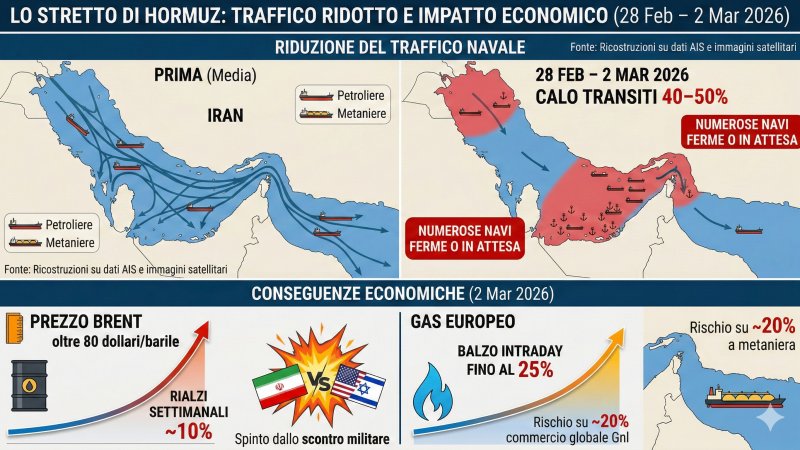
Beyond seasonal and operational factors, the freight market could also be influenced by geopolitical dynamics. US and Israeli attacks on Iranian targets have effectively frozen ship movements in the Strait of Hormuz, a passage through which around 20% of global oil supplies transit. According to Drewry, uncertainty over energy supply is pushing crude prices higher. If the situation persists, rising marine fuel costs, higher war risk insurance premiums and possible operational disruptions could translate into an increase in overall transport costs. In this scenario, shipping lines could pass part of the additional burden on to container freight rates, fuelling further upward pressure in the coming weeks.