








A technical advisory circulated by Boeing in 2011 has moved to the centre of the investigation into the crash that in November 2025 involved a UPS cargo aircraft at Muhammad Ali International Airport in Louisville, United States, killing 14 people, including the three crew members. According to Bloomberg, the National Transportation Safety Board (NTSB) is assessing whether and how those indications were incorporated into maintenance programmes and operational manuals by the manufacturer and the operator.
The notice dates back to February 2011, when Boeing sent a service letter to operators of the McDonnell Douglas MD-11 reporting four previous failures, on three different aircraft, of a component known as the spherical bearing race. This is a structural part of the engine mount, designed to absorb high loads and vibrations. The communication stated that inspection of the component would be included within checks of the structure that secures the engine to the fuselage.
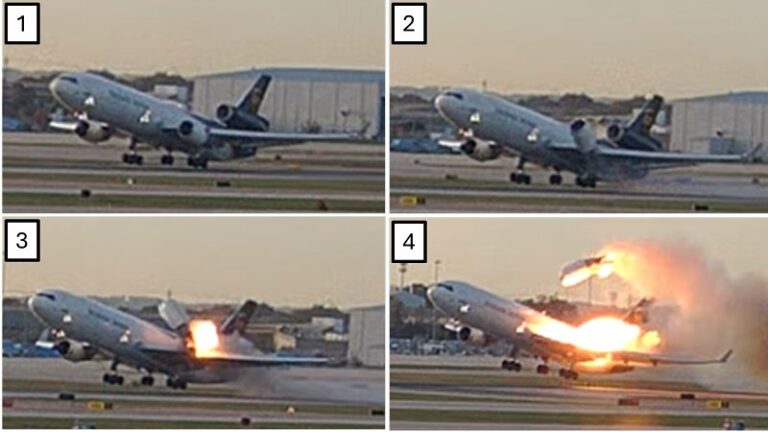
The aircraft involved in the Louisville accident, an MD-11F dedicated exclusively to cargo operations, lost its left engine during take-off from UPS’s main hub. According to the preliminary report, the aircraft did not exceed 30 feet in altitude before crashing. Images of the accident clearly show the engine and pylon separating and being thrown into the air in a fireball immediately after take-off.
The NTSB reported that it found fatigue cracks in several sections of the structure securing the turbine, an element that strengthens the link with the 2011 technical notice. In an interim update, released unusually between the preliminary and final reports, the agency said it is examining how the inspection instructions were integrated into Boeing’s maintenance documentation and how they were applied by UPS. Checks are also under way on the correspondence at the time between Boeing and the Federal Aviation Administration (FAA).
At the time of the notice, Boeing concluded that the issue “would not result in a flight safety condition”, and therefore did not represent an immediate risk to aircraft integrity. According to Bloomberg, the NTSB is now assessing whether that evaluation and the emphasis placed on the issue were appropriate. Jeff Guzzetti, former head of accident investigations at the FAA, said the agency is reviewing both UPS’s actions in response to the information received and the role of Boeing and the regulator in giving due weight to the evidence that emerged in 2011.
Following the accident, the Federal Aviation Administration ordered the grounding of all MD-11F pending inspections and corrective actions by operators. The directive was later extended to other aircraft with similar engine pylon configurations. Boeing and UPS, contacted by Bloomberg, confirmed their support for the NTSB investigation but declined to comment on the latest developments, stressing UPS’s formal role as a party to the inquiry. The MD-11 has long been out of production and is now used exclusively for cargo transport.