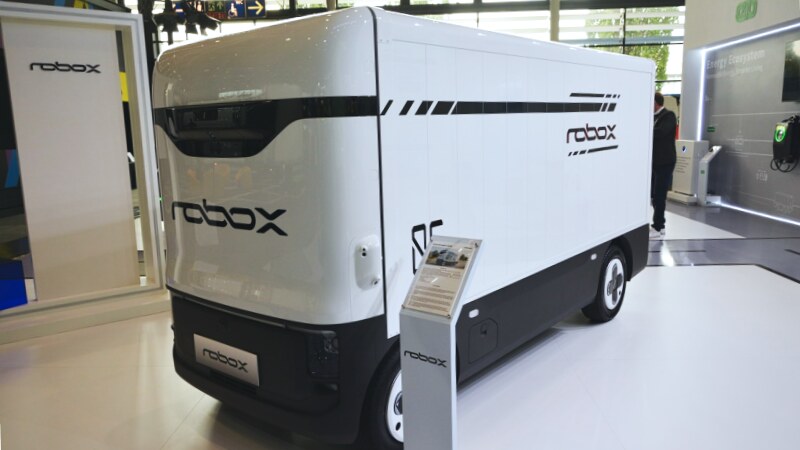





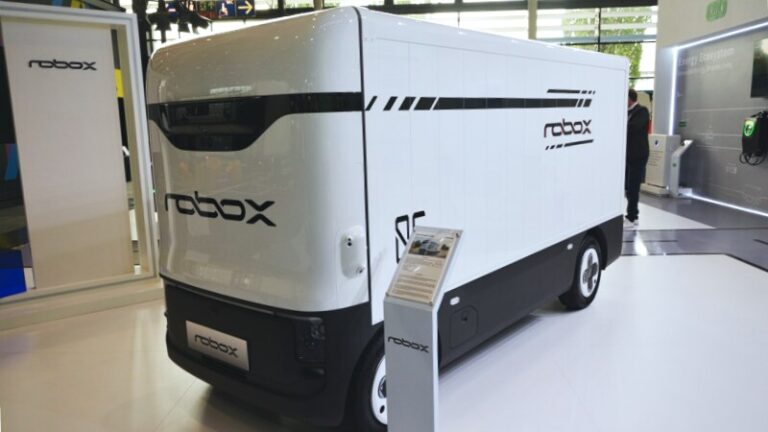
Chery Commercial Vehicle brought Robox to IAA Transportation 2026 in Hanover, an autonomous commercial vehicle designed with the ambition of changing the concept of goods distribution. Its name combines “robot” and “box”: it is a driverless transport platform in which the space normally occupied by the cab is used to maximise cargo capacity. Developed to achieve Level 4 autonomous driving, it features an automotive-grade chassis with a drive-by-wire architecture, designed so that electronic systems directly control the vehicle’s main functions. It uses a modular platform that can accommodate different body configurations. Its first application is last-mile logistics, although the manufacturer also identifies in-plant logistics and temperature-controlled transport as potential uses.
To perceive its surroundings, Robox combines lidar, millimetre-wave radar and cameras: the sensors gather complementary information about the surrounding environment, while data processing enables the vehicle to plan its route autonomously and handle different traffic conditions. The braking system is electromechanical (EMB), developed specifically for the autonomous architecture. This means there is no hydraulic circuit and each brake is actuated by electrical signals, with a response time that Chery claims is below 100 milliseconds. Safety is further supported by a deterministic backup system designed to maintain vehicle control even if faults occur in the primary systems.
Chery Commercial Vehicle presents Robox as an autonomous logistics platform, in which hardware, software and body structure are designed to work together, rather than simply as an electric vehicle without a cab. Once the driver is removed from the architecture, the commercial vehicle itself changes: there is no longer any need for a steering wheel, pedals or a conventional cab, and the priority becomes maximising usable space, integrating sensors and ensuring safe and predictable autonomous operation.
The project forms part of Chery Commercial Vehicle’s Zero-Carbon + AI strategy, presented at IAA as a complete ecosystem spanning vehicles, charging infrastructure, energy storage and intelligent fleet management, with Robox representing its most advanced component in artificial intelligence and automation. The same stand also featured Phoenix electric heavy-duty vehicles from the C&C Trucks brand: the Phoenix BEV, with an 860 kWh battery and a 400 kW electric axle providing a claimed range of around 600 km, and the Phoenix REEV, equipped with a range extender and promising up to 1,400 km of total range. Chery Energy also presented solutions based on bidirectional V2G charging, distributed energy storage and depot energy networks.