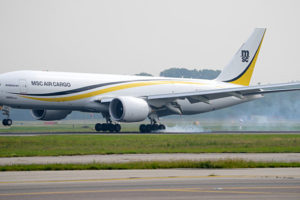





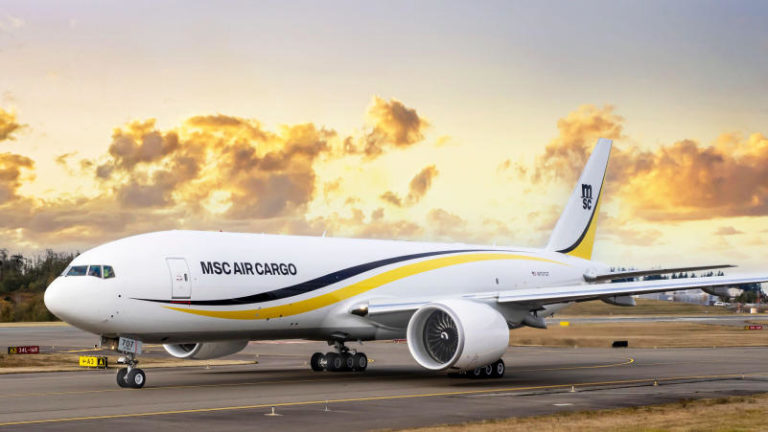
Msc Air Cargo has received a new Boeing 777F intended to strengthen the carrier’s intercontinental cargo operations and mark a new phase of development in Italy. The aircraft, registered I-Mscc and named “Castor”, was delivered on 11 March 2026 at the Boeing Everett Delivery Center in the United States and represents the third Boeing 777F registered in the Italian aircraft register for the Mediterranean Shipping Company group airline. With this delivery, the fleet rises to a total of seven Boeing 777F aircraft, including those operated directly and those used through agreements with other operators.
The entry into service of the new aircraft coincides with the expansion of the company’s Italian network. Alongside the already operational hub in Milan Malpensa, Msc Air Cargo is preparing to launch intercontinental cargo services from Rome Fiumicino. The Roman airport will be connected with some of Asia’s main cargo hubs, particularly Hong Kong International Airport, Shanghai Pudong International Airport and Ezhou Huahu Airport in China. The aim is to create a second Italian gateway, alongside Malpensa, for air freight traffic, capable of serving more directly the industrial and logistics base of central and southern Italy.
Since the launch of the project, the company has adopted a mixed operating model. Part of the fleet is deployed through agreements with third-party operators, while a growing share is managed directly under a European air operator certificate. This evolution allows the carrier to increase operational control, stabilise schedules and ensure greater continuity in the services offered to logistics and freight transport customers.
In the Italian context, Milan Malpensa has so far been the main operational reference point for Msc Air Cargo. From the Lombardy airport the carrier operates cargo services to several intercontinental destinations, including Hong Kong and Tokyo Narita, serving a logistics catchment area that includes northern Italy and part of central Europe. The development of dedicated cargo connections from Fiumicino also reflects the growing role of the Roman airport in logistics activities linked to freight traffic. The airport serves an area characterised by significant industrial and pharmaceutical production as well as export flows tied to agri-food products and perishables.