





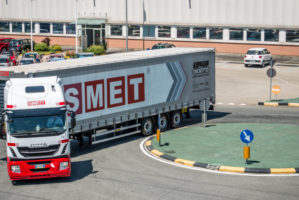

From October 2023 to September 2024, Maersk’s US subsidiary — Maersk Line, Limited (Mll) — is reported to have carried out at least 43 shipments of military material from the United States to Israel, transporting components for armoured vehicles produced by Oshkosh Defense and destined for the Israeli government. This emerges from an investigation published in February 2025 by Danish investigative outlet Danwatch, which obtained more than 2,000 shipping documents relating to US–Israel routes during that period. The documented shipments amount to thousands of tonnes of weapons parts transported under the Copenhagen-based group’s banner.
Maersk operates through Mll within the framework of the Maritime Security Program (Msp), a scheme under which the US federal government relies on private carriers to transport civilian and military materials to more than 180 countries. This dual role — commercial operator and logistics partner to the Pentagon — makes the case particularly complex from both a legal and reputational perspective.
At the centre of the dispute is the definition of “weapon”. The Danish group firmly denies having transported “weapons or ammunition” to Israel during the conflict, as stated by chief executive Vincent Clerc at the general meeting on 17 March 2025 and reiterated in an official note published on the company’s website the following day. At the same time, Maersk acknowledges having handled “military-related cargo” — materials connected to military use — maintaining that these shipments were carried out in full compliance with all applicable laws and with contracts signed with governments and institutions.
The Danwatch investigation, supported by reporting from Danish tabloid Ekstra Bladet (Billeder afslører: Mærsk sejler krigsudstyr til Israel), challenges this distinction. Shipping documents examined by the two outlets include descriptions such as “subcomponents for armoured vehicles” and “armoured combat vehicles”, institutional consignees such as the Israeli government, and commodity codes linked to weapons systems. International law experts cited by Danwatch argue that these materials are highly likely to have been used in military operations in Gaza, where the UN has documented the possible commission of war crimes and called for an arms embargo on Israel.
Maersk responds that, under the Maritime Security Program, it is prohibited from transporting classified or sensitive cargo — including weapons and ammunition — without submitting a specific transport plan approved by the US government. The company states that Mll has never submitted such a plan, concluding that it has never transported cargo of that nature to Israel under the Msp. According to critics, the company’s distinction between “weapons and ammunition” on one side and “military-related materials” on the other allows it to serve Israel’s war supply chain while formally remaining within its stated policies.
The case gained significant public attention in February 2025, when around 1,000 demonstrators blocked access to Maersk’s headquarters in Copenhagen for more than four hours, accusing the company of being the “backbone” of the flow of military materials from the United States to Israel and calling for an end to all cooperation with the Israeli Ministry of Defence. The protest took place just days after the publication of the Danwatch investigation and received wide international media coverage. In its March 2025 statement, Maersk described the organisers of these mobilisations as “radical groups” that “fabricate actions or opinions” attributed to the company to gain visibility, while acknowledging its operational responsibilities in conflict zones.
The dispute has also reached the shareholders’ meeting. The group Kritiske Aktionærer submitted a motion to prohibit Maersk from transporting weapons to Israel, while NGO Eko promoted a proposal to strengthen transparency in due diligence processes in high-risk areas, with a specific focus on military cargo. Both proposals were rejected. The outcome reflects the group’s ownership structure: Maersk Holding, the founding family’s holding company, controls around 41.5% of ordinary shares but holds 54.5% of voting rights, ensuring decisive influence over shareholder decisions.
Pressure on shipments of military materials to Israel has not been limited to Denmark. At the same time, in several European and Mediterranean countries, trade unions and port movements have blocked or called for the blocking of vessels from various companies suspected of carrying weapons or military components. Such incidents have been recorded in France, Spain, Italy and Morocco. A particularly well-documented case concerns a Spanish port that, in November 2024, denied entry to a Danish vessel accused of transporting weapons to Israel: in that instance as well, Maersk responded that the ship was not carrying “military weapons or ammunition”, repeating the defence used in other contexts.
From the perspective of international law, Danwatch and organisations that have followed up on its investigation — including Barcelona-based Centre Delàs (Centre Delàs for Peace Studies) in its 2025 report Collateral Profit — argue that by continuing to ship weapons parts to Israel after October 2023, Maersk would be failing to comply with the UN Guiding Principles on Business and Human Rights, which the company states it has incorporated into its 2023 Code of Conduct. Maersk explicitly refers to those same principles and to OECD guidelines on responsible business conduct, stating that it is “fully compliant” with current regulations.
The Maersk case highlights a divide running through the European debate on the supply of military materials to Israel: that between formal legality — in the absence of binding embargoes from Denmark and many EU partners — and legitimacy on ethical and political grounds. The Danish government has stated that companies must comply with international rules, but has clarified that it cannot impose constraints beyond legal requirements. In this context, Maersk is operating in a space where regulatory compliance and the expectations of a significant part of civil society, shareholders and public opinion are diverging ever more sharply.
M.L.