







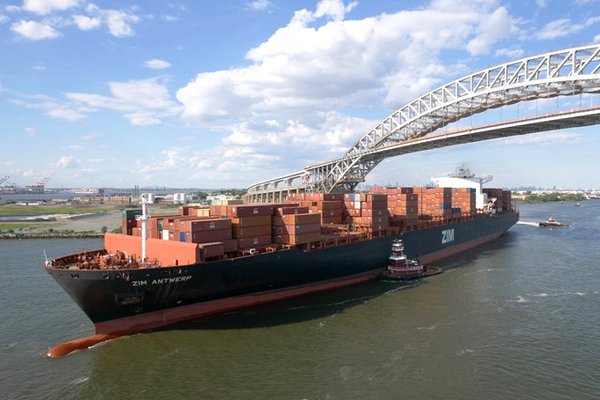
Hapag-Lloyd confirmed on 15 February 2026 that it is in advanced negotiations to acquire Zim Integrated Shipping Services, the Israeli carrier listed on the NYSE, in a deal valued by several financial and trade media sources at between more than $3.5 billion and $4.2 billion. In a statement published on its website, the German group clarified that no binding agreements have been signed and that discussions also include Fimi Opportunity Funds regarding obligations linked to the golden share held by the State of Israel. Israeli media reports, not yet officially confirmed, state that Zim’s board met in a lengthy evening session and approved the sale to Hapag-Lloyd and Fimi at a valuation of around $4.2 billion, more than $1.5 billion above the company’s market capitalisation of approximately $2.7 billion prior to the news.
According to press reports, the transaction would be structured in two parts. Hapag-Lloyd would acquire Zim’s international operations, including a fleet of more than 90 chartered vessels, the main trade lanes between Asia, the Mediterranean and North America, customer contracts and the Zim brand outside Israel. In parallel, Fimi would take over the strategic Israeli operations through a new entity, referred to as Zim Israel or New Zim, to which 16 owned vessels, domestic services to and from Israel, the Haifa headquarters, IT systems and the management of Israeli seafarers would be transferred, along with the rights and obligations linked to the golden share.
The golden share grants the State of Israel special powers over assets deemed strategic, including vessels, domestic services and headquarters, as well as veto rights over changes of control that could affect national security. According to media reports, the new Zim under Fimi would remain responsible for complying with these obligations, including the availability of vessels in the event of war or crisis and the maintenance of an operational presence in the country. The involvement of Fimi, Israel’s leading private equity fund led by Ishay Davidi, reflects the need to keep sensitive activities under national control.
The integration of Zim would enable Hapag-Lloyd to increase its global market share from around 7 per cent to nearly 9 per cent, strengthening its position among the world’s top five carriers by capacity. The Israeli company contributes a total fleet of 115 vessels, largely chartered, and a strong focus on Asia–US routes and value-added services to North America. The transaction would increase critical mass, improve load factors and reduce network overlaps, with expected effects also on bargaining power vis-à-vis ports, terminals and suppliers.
The market backdrop is shaped by the container freight rate cycle. After the peak in 2021–2022, the decline in rates during 2023–2024 affected carrier profitability and revived consolidation dynamics. Zim, listed on the NYSE since 2021 with an initial valuation of around $1.5 billion, reportedly holds approximately $2.8 billion in cash; part of this amount could be distributed as a dividend before the transaction closes, reducing the net value of the deal, an issue on which disagreements are said to have emerged within the board.
The sale process reportedly began in the second half of 2025 through a tender managed by Rothschild & Co. Other major operators are said to have expressed interest. The choice of Hapag-Lloyd would reflect both economic criteria and its willingness to accept a structure clearly separating international operations from those subject to the golden share.
The procedure remains complex. Hapag-Lloyd has made clear that completion requires approval from its corporate bodies, Zim’s shareholders’ meeting, the Israeli Government with regard to the transfer of special rights, and antitrust and supervisory authorities in the countries involved, including the European Union and the United States. Analysts cited by Reuters estimate that closing is unlikely before 2027, given regulatory reviews and geopolitical implications.
For the global container market, the transaction would mark a further step towards concentration. The integration of Zim into Hapag-Lloyd would reduce the number of independent mid-sized operators, strengthening the weight of major European carriers on east–west and transpacific routes and affecting competitive balances at several key ports. A comparison of the fleets highlights the scale of the deal. Hapag-Lloyd ranks as the world’s fifth-largest carrier by capacity and operates a significantly larger fleet in terms of both vessel numbers and total capacity than Zim, which ranks around tenth globally.