



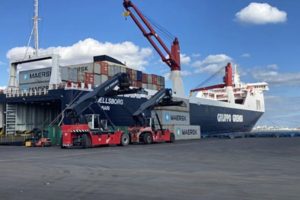

The port of Hamburg is taking a decisive step towards modernisation, with a total investment of over 1.8 billion euros aimed at upgrading the infrastructure of Waltershofer Hafen, the core of container operations at the German port. This is a strategic project designed to enhance nautical accessibility, increase operational capacity and promote the shift towards a more sustainable and technologically advanced port system.
Currently, around 90 per cent of the largest container ships arriving in Hamburg are handled in this area. To ensure safer and more efficient operations, the turning basin will be widened from its current 480 metres to 600 metres, offering vessels more room for rotational manoeuvres. This intervention will improve not only navigation along the river Elbe but also the resilience and fluidity of operations at the Buchardkai (CTB) and Container Terminal Hamburg (CTH), both key nodes in Germany’s logistics network.
The plan will be implemented by the Hamburg Port Authority and includes the creation of new yards and berths, allowing for the introduction of automated, electrically powered processes. It marks a concrete step towards the decarbonisation of port activities and the digital transformation of maritime logistics. The new operational areas will result from a significant reshaping of the existing land: soil will be dredged from the eastern bank north of the Petroleumhafen and along the Bubendey embankment, followed by the infill of the current basin, which will be properly isolated from the river by a dam.
According to initial estimates, the cost of public infrastructure will amount to approximately 1.1 billion euros, part of which will be funded by the state. For this reason, a state aid assessment procedure is under way with the European Commission, which may take several years. In the meantime, the HPA has opted to launch a voluntary ex-ante review to ensure full legal certainty regarding its procurement approach. Construction is expected to be completed by the mid-2030s.
In parallel with the public initiative, Eurogate has signed a preliminary lease agreement for the new areas and will invest at least 700 million euros to expand the existing terminal, with the aim of completing the works within two years of land handover. The project will adopt a fully automated operational model, with infrastructure, heavy equipment and IT systems developed to support an entirely electric container handling cycle. The site, which will be fully integrated into the road and rail network, will enable efficient and sustainable flow management, targeting climate neutrality by 2040.
For Hamburg’s authorities, this project is a strategic priority. According to Melanie Leonhard, senator and city minister for the economy, the planned works will ensure that the port can reliably and efficiently accommodate large vessels, strengthening Hamburg’s position on global shipping routes. Jens Meier, chief executive officer of the HPA, also stressed that the investment represents a crucial component for the port’s long-term competitiveness and a key element of the ecological transition.
Tom Eckelmann, managing director of Eurokai and chairman of the board of Eurogate, reiterated the urgency and importance of expanding the turning basin and modernising operational facilities, emphasising that these are fundamental decisions to secure a positive future for the port of Hamburg. The aim is to transform the site into a fully automated terminal aligned with strategic goals of productivity and environmental sustainability. The new operational areas will remain publicly owned and leased to Eurogate on market terms. The project has already received approval from the relevant authorities, and all legal appeals have been dismissed, paving the way for construction to begin.