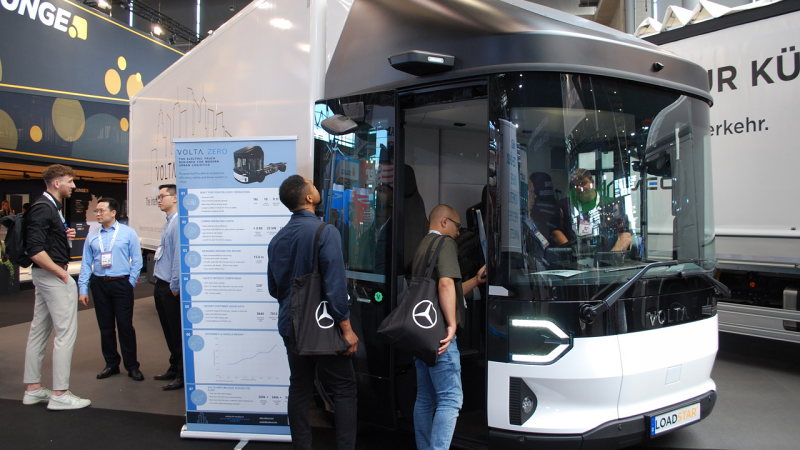






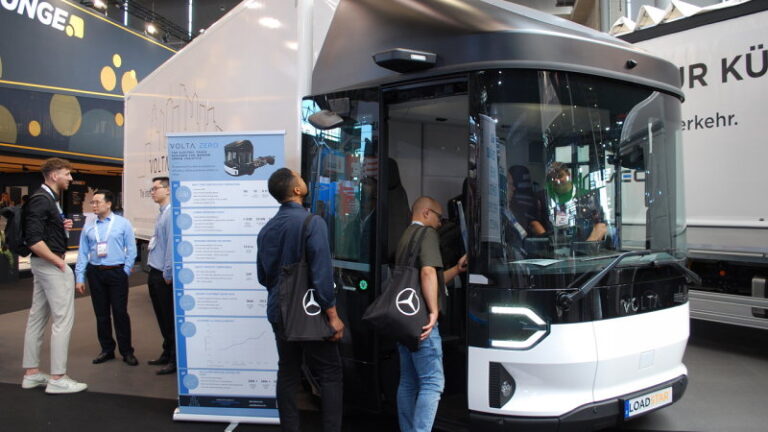
Driver seated in the centre and a highly glazed cab: the Volta Zero returned to IAA Transportation in Hanover, brought by Volta Commercial Vehicles. The battery-electric truck has a gross vehicle weight of 16 tonnes, two axles and rear-wheel drive, and was designed for urban distribution. Visitors to the German event could also drive it. However, it cannot yet be ordered, as only a limited number of the original vehicles are available for customer trials while a new generation is under development. The project is now several years old and was brought to a halt by the company’s financial crisis. It could have disappeared altogether, but following the administration of the parent company, some employees joined forces with component suppliers and majority investor LSL Technology to keep the vehicle alive and develop its successor.
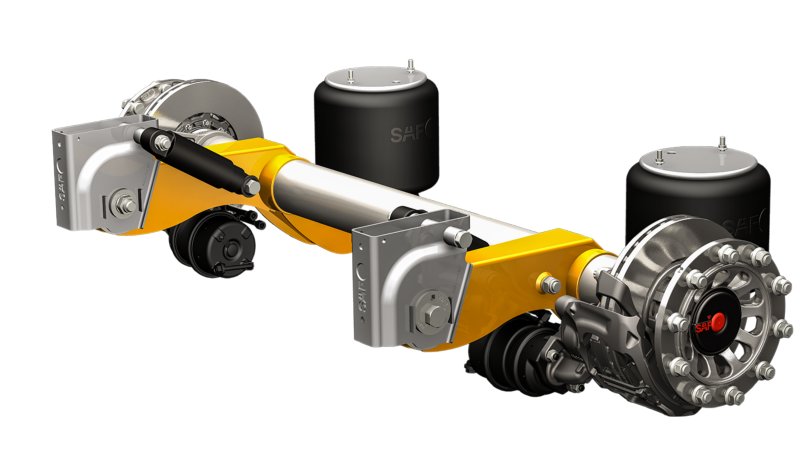
The Volta Zero is equipped with a 246 kWh gross, 224 kWh usable battery, made up of three 82 kWh packs using nickel-manganese-cobalt chemistry. This provides a manufacturer-claimed range of around 260 km. Charging is possible with alternating current at up to 22 kW or direct current through a CCS connector at up to 150 kW, allowing the battery to charge from zero to 80% in 90 minutes. The truck is driven by an electric axle fitted with a permanent-magnet synchronous motor, delivering 200 kW of nominal power and around 250 kW at peak, with nominal torque of 570 Nm and peak torque of 1,100 Nm. It is combined with a two-speed automatic transmission integrated into the motor. Energy consumption, based on data collected from customers, ranges between 80 and 86 kWh/100 km. Gross vehicle weight is 16 tonnes, while kerb weight is 9,160 kg including the Junge Loadstar 2.0 Eco body, which measures 7.32 metres externally. The Volta Zero has a kerb-to-kerb turning diameter of 15.8 metres.
The cab remains one of the most distinctive parts of the project. The driver sits in a central position with 220-degree direct visibility, which earned the truck five stars under Transport for London’s Direct Vision Standard, with a direct-vision score of 33 cubic metres. The cab is accessed via a 300 mm-high step, with electrically operated sliding doors on both sides, and there is space for two passengers alongside the driver. Visibility is supported by 360-degree cameras with rear-view screens, while the safety equipment also includes emergency braking with a front radar, lane-departure warning and front and rear parking sensors. The fleet of early vehicles has covered more than 506,000 km in total, including over 260,000 km in internal testing and more than 246,000 km in customer trials. According to the company, the next-generation Volta Zero will benefit from a more competitive global supply chain while retaining the project’s European footprint and European assembly.
The history of Volta Trucks remains inseparable from the difficulties encountered during its first industrial phase. Founded in Sweden in 2019, the company developed the vehicle in the United Kingdom and contracted its assembly to Steyr Automotive in Austria. In October 2023, however, it began insolvency proceedings in Sweden and entered administration in the United Kingdom after its battery supplier Proterra filed for Chapter 11 protection in the United States, disrupting production plans and making it harder to raise fresh capital. The UK business was subsequently acquired by the Luxor Capital fund through Volta Commercial Vehicles Limited, which in May 2025 itself entered insolvency together with its Austrian subsidiary. The latest stage has involved former employees and LSL Technology.
At Hanover 2026, therefore, Volta did not simply present an electric truck. It demonstrated the possibility of restarting from an unfinished project, building on technology that had already been developed and on the experience accumulated by the previous organisation. Volta Commercial Vehicles’ participation at IAA, where it was also listed among the manufacturers offering vehicle test drives, was in this sense a signal of its continued presence in the market. The next step for the company will be to turn the interest generated by the first vehicles into genuine industrial capability. The challenge is no longer simply to demonstrate that an electric urban-distribution truck can work: it is to build the supply chain, service network and commercial model around the Volta Zero that can make it competitive in the real market.
Massimiliano Barberis