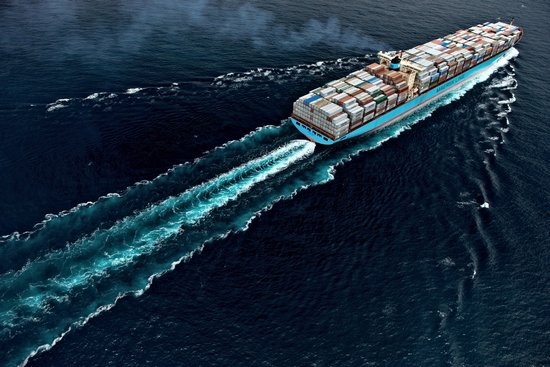






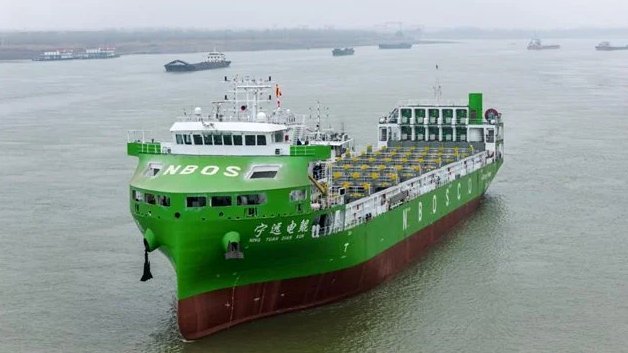
The Ningyuan Diankun, a new 10,000-tonne container ship powered entirely by electricity, began sea trials on 1 February 2026. The vessel was built by the Jiangxi Jiangxin Shipbuilding yard for Ningbo Ocean Shipping and departed from the Hukou shipyard in Jiangxi province after completing outfitting and mooring tests. The ship belongs to the feeder segment and is designed for short-sea container transport along China’s main coastal and river–sea routes.
The Ningyuan Diankun is 127.8 metres long, 21.6 metres wide and has a draught of 10.5 metres. It has a cargo capacity of 740 teu, with an open configuration that allows greater flexibility in loading and unloading operations. The sea trials are intended to verify the overall performance of the hull, the electric propulsion system and the reliability of the battery-based power supply, with a dedicated testing phase scheduled in the Shanghai area between 6 and 13 February.
The ship is powered exclusively by a modular battery system. Ten box-type energy storage modules are installed, designed to be both recharged via connection to the port electricity grid and rapidly replaced using dedicated cranes. This solution reduces vessel downtime and helps ensure operational continuity. The declared maximum speed is around 11.5 knots, consistent with feeder deployment and with the objective of minimising energy consumption.
Complementing the main system, the Ningyuan Diankun is also equipped with photovoltaic panels, intended to provide additional power for auxiliary systems and onboard operations. The combined use of high-capacity batteries and renewable energy generation makes it possible to eliminate direct emissions entirely, both during navigation and while berthed in port, including during cargo handling operations.
Another innovative element of the project is its intelligent navigation systems. The vessel integrates an advanced platform of sensors and software for control and navigational assistance. Its functions include real-time monitoring of the surrounding environment through artificial vision systems operating in different weather conditions, automated route planning and anti-collision systems. The ship can also operate in autonomous mode in open sea, with the potential to reduce or eliminate direct human intervention during specific phases of navigation.
The ongoing trials are also aimed at assessing the integration between the electric propulsion systems and the autonomous navigation functions, as well as the hull’s response under different operating conditions. The testing programme includes in-depth assessments of stability, energy management and the reliability of control systems, all considered critical factors for the regular commercial deployment of fully electric vessels.
The Ningyuan Diankun is the first of two sister ships ordered in May 2024. It was launched in September 2025, with entry into service expected after the completion of sea trials and certification. Once operational, the vessel will be deployed on feeder routes serving the port of Ningbo-Zhoushan, one of the world’s leading port hubs by throughput. If the trial results meet expectations, the model could be applied to other feeder and coastal routes, particularly where distances are short, port calls are frequent and recharging infrastructure is available.