






The results of Spirit-E, a research project on bidirectional charging for battery-electric commercial vehicles involving MAN Truck & Bus and Traton R&D, were presented on 30 October 2026. Over three years, from August 2023 to October 2026, the consortium demonstrated that an electric truck can store energy and feed it back into the grid, as well as draw power for charging. It also identified the conditions needed for logistics companies, grid operators and solution providers to use the technology commercially.
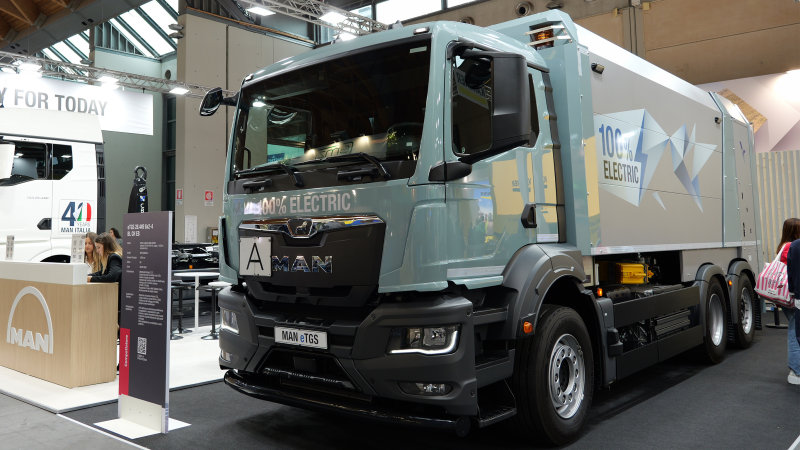
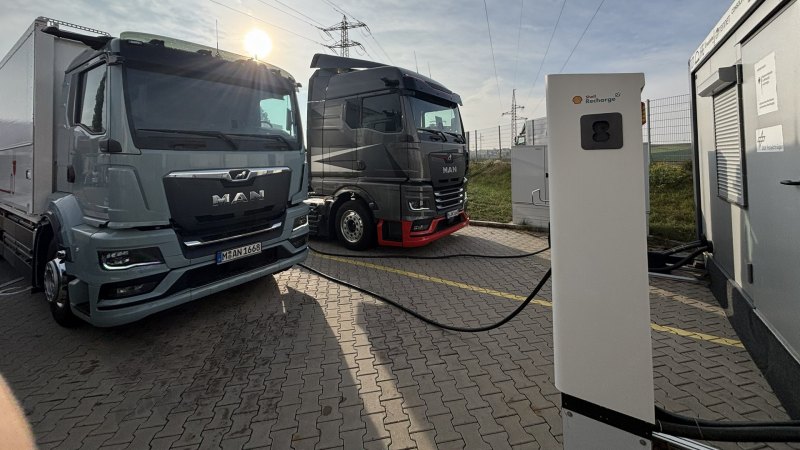
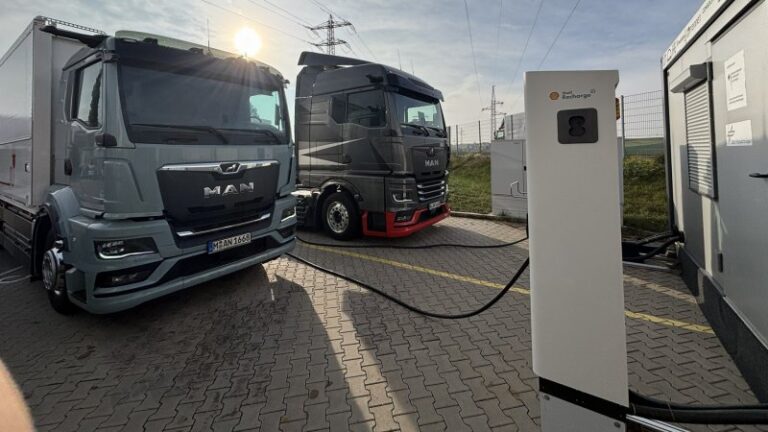
Testing under real-world conditions took place at Spedition Schmid’s depot in Regensburg, using the MAN eTGX and mobile and fixed charging systems supplied by project partner SBRS. The partners integrated the interfaces linking the vehicle, charging station, fleet operator’s software, depot energy management system, electricity market operator and grid operator. They also introduced a charging station booking system and software to schedule electric truck charging at the depot, implementing ISO 15118-20, which governs communication between vehicles and charging infrastructure during charging and discharging.
A MAN eTGX with 480 kWh of usable battery capacity fed electricity back at up to 350 kW through a bidirectional DC charging station. The energy was supplied both to the depot’s local network (Vehicle-to-Site) and to the public grid (Vehicle-to-Grid). The project also covered charging other vehicles directly from the truck’s battery (Vehicle-to-Vehicle). The manufacturer is now working to make the function available in series production and is developing an advisory service for customers.
During testing, a test environment provided by software company PowerBot was used to simulate scenarios in which an electric truck buys electricity when prices are low and sells it back when they rise. Through the European Equigy platform, the consortium also demonstrated how vehicles can help grid operators manage congestion. The Spirit-E project considers depot charging highly likely and, as electric fleets grow, it could contribute to grid stability.
The project’s calculations indicate average energy cost savings of around 10%, reaching 20% under optimal conditions. The financial benefits depend on operating patterns, annual mileage, dwell times, battery capacity and electricity prices, as well as grid charges, on-site generation, such as solar power, available grid connection capacity and opportunities to generate revenue from stored energy through electricity markets or grid services. Bidirectional charging is most attractive for electric trucks with regular depot stops and annual mileages below 100,000 kilometres. Vehicle-to-Site and Vehicle-to-Vehicle applications offer the greatest savings potential.
For commercial deployment, standards for flexible energy exchange still need to be simplified, and digital integration between logistics and energy systems needs to improve. Specific fleet management expertise is also required. The project partners were Consolinno Energy, Fraunhofer IEE, Hubject, the Research Center for Energy Economics, MAN Truck & Bus, Traton R&D, TenneT, SBRS and the Technical University of Munich, which coordinated the consortium. The project was funded by Germany’s Federal Ministry for Economic Affairs and Energy and coordinated by the DLR Project Management Agency.
P.R.