







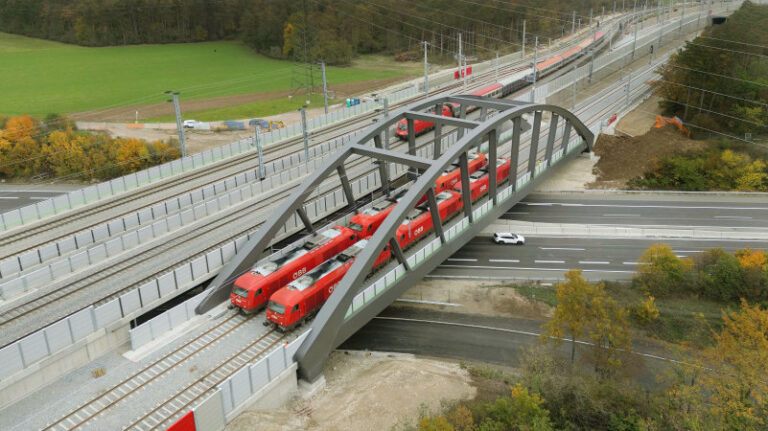
Austria is counting down to the completion and opening of the first section of the four-track upgrade of a key part of the Westbahn, the Western Railway, a major rail corridor extending just over 300 kilometres between Vienna, Linz and Salzburg. Although this route accounts for approximately 10% of Austria’s railway network by length, it carries more than 30% of all trains operating in the country.
Construction is currently under way along the 24-kilometre section between Linz and Wels. In December 2026, the approximately five-kilometre stretch between Wels and Marchtrenk is scheduled to be completed and opened to traffic. This section includes one of the main engineering structures in the four-tracking project: a 93-metre arch bridge over the A25 motorway, weighing 3,500 tonnes. The bridge underwent load testing in late October 2026 using six locomotives with a combined weight of almost 500 tonnes. The four-track upgrade of this western section of the Westbahn will remove a bottleneck that currently restricts line capacity, particularly affecting freight services. Separating traffic across four tracks will make it possible to accommodate additional demand, which is currently particularly strong.
The Westbahn has undergone major capacity upgrades in recent years. The route between Vienna and Linz is now entirely four-tracked, with some sections built alongside the original railway and others following new high-capacity alignments, much of them in tunnels. Work at major railway junctions is particularly complex, including the four-tracking of the entire route through Linz, where up to 450 trains pass every day. Austrian Federal Railways (ÖBB) has already upgraded the section beyond Wels towards Attnang-Puchheim, including several route improvements such as the Kalvarienberg Tunnel, which bypasses the bend at Lambach, and the Römerberg Tunnel, which eliminates a similar deviation between Breitenschützing and Schwanenstadt.
Further west, plans have been drawn up for another essential bypass to eliminate a particularly winding section between Köstendorf and the outskirts of Salzburg, the western terminus of the Westbahn. The proposed double-track railway, effectively providing two additional high-capacity tracks alongside the existing route, will include two separate single-track tunnel bores, each 16.2 kilometres long. As well as shortening journey times compared with the existing railway, the new alignment will increase capacity, improve operating conditions and eliminate loading-gauge restrictions.
The Linz–Wels area is Austria’s western hub on the European TEN-T Rhine–Danube Corridor. The central section of the Westbahn also accommodates the country's main logistics hubs, including Wels and Linz as well as the freight yards at Sankt Peter, Sankt Valentin and Amstetten. The Wels terminal, a key interchange between Austria, the German state of Bavaria and the Czech Republic, is one of the most important freight facilities on the Austrian railway network. Remarkably, it handles substantial traffic volumes with just four tracks, each less than 600 metres long. The infrastructure is now set for a significant upgrade, with major investments co-financed by the European Union under way to extend the tracks to 700 metres and provide a direct connection towards Linz and Vienna. This will reduce shunting costs while increasing capacity and operational efficiency.
Piermario Curti Sacchi