





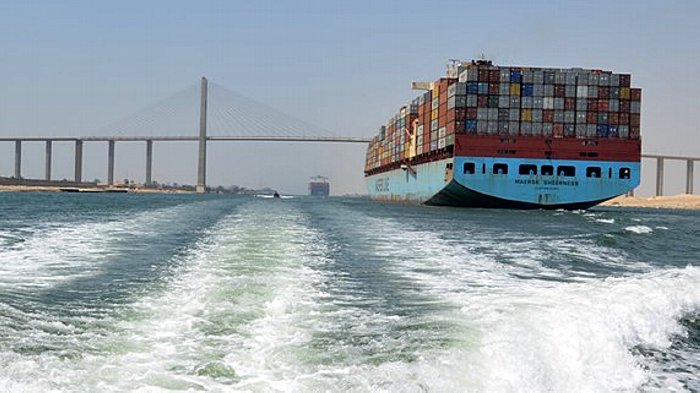
Maersk and Hapag-Lloyd have moved the AE19 service to the Suez Canal, designated SE4 by the German carrier, linking Asia, Saudi Arabia, the Mediterranean and Europe. The decision, announced on 10 August 2026, takes immediate effect: Berlin Maersk will inaugurate the new route with westbound voyage 628W and the subsequent eastbound voyage 637E. The two companies said the change followed a "careful assessment of the security situation" and described it as a step towards a gradual return to the trans-Suez corridor. The rotation includes calls at Xingang, Qingdao, Busan, Ningbo, Shanghai, Tanjung Pelepas and Jeddah, transit through the Suez Canal, Port Said, Tangier, Port Said again and the Suez Canal, followed by Jeddah, Singapore and the return to Xingang.
AE19/SE4 is the fourth service that Gemini Cooperation has brought back to Suez in less than eight months, and previous attempts have not all gone smoothly. The first, the MECL service between the Middle East and the US East Coast, began in mid-January and has continued without disruption. The second unfolded differently: the ME11 service, assigned to Albert Maersk in mid-February, was suspended almost immediately because of the conflict between the United States and Iran that broke out at the end of the month. The third attempt, AE15/SE3 between Asia, the Mediterranean and Turkey, set sail with Majestic Maersk on 24 July and remains active. The two companies have consistently stressed the gradual, phased nature of the process, without committing to a timetable for the entire AE12 network.
The new transit comes as security in the Red Sea is worsening rather than stabilising, particularly along the Saudi stretch crossed by AE19 with its Jeddah call. Since July, the Houthis have declared a maritime blockade against vessels linked to Saudi Arabia and have struck Saudi tankers in the region. On 9 and 10 August, on the same days as Maersk’s announcement, the Yemeni militants claimed an attack on the Aramco refinery in Jizan and on the port of Mokha, with local sources reporting 11 deaths. Some sources also report a missile attack against the Saudi tanker Ncc Wafa on 8 August. It remains unclear whether the security assessment cited in the statement mainly concerns the Israeli-Yemeni stretch of Bab el-Mandeb, or whether the two companies are taking a calculated commercial risk.
The decision is also influenced by Maersk’s economic position, following a difficult first quarter: profit fell year on year from $1.2bn, about €1.04bn, to $100m, about €87m, as freight rates declined. Returning to Suez reduces transit times and fuel consumption compared with sailing around the Cape of Good Hope: an efficiency recovery strategy ahead of the second-quarter results.
The competitive landscape remains divided on Suez. Hapag-Lloyd, despite being a joint operator of the service, has historically remained the more cautious carrier and requires at least three consecutive months of stability before reconsidering Suez. MSC, by contrast, is keeping all services on the Cape route, judging the security situation still insufficiently clear. CMA CGM has taken a different approach: in January it moved its FAL 1, FAL 3 and MEX services back around the Cape of Good Hope because of a "complex and uncertain international context", keeping only the INDAMEX service on Suez. Cosco, meanwhile, has offered weekly Red Sea transits since March 2026 and scheduled the first Bab el-Mandeb passage by its RES4 service in more than two years for late July.
M.L.