







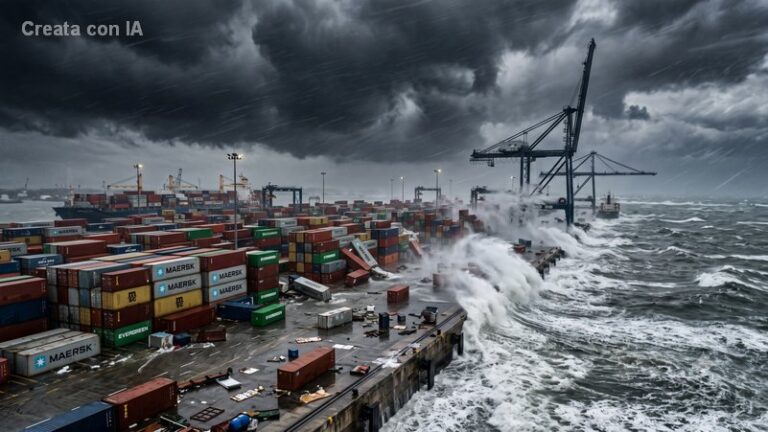
The Chinese container terminals of Yantian and Shekou, in the Shenzhen area, resumed operations on Monday, 27 July 2026, after Typhoon Noul crossed the Pearl River Delta. The reopening, however, has not restored normal operations. In an advisory issued on 28 July, Kuehne+Nagel reported that on the day operations resumed, gate appointment windows were already fully allocated at both ports, with the main constraint shifting from adverse weather to yard saturation. Disruptions linked to strong winds and heavy rain were concentrated between 24 and 27 July across the Shenzhen and Delta area. At Yantian, the operator reported severe road congestion and heavy pressure on yards, while traffic around the Shekou terminals remained regular, albeit with limited appointment availability. To contain the build-up, Yantian introduced a restriction on full export containers, which are being admitted at the gate only within seven days of the vessel’s estimated berthing date.
The restriction has shifted pressure onto off-dock container depots, where heavy backlogs have formed, resulting in additional storage costs and longer truck dwell times. Cargo risks missing vessels’ cut-off times, while factory production schedules and truck trip planning have to adjust to the seven-day rule. Kuehne+Nagel has advised customers to closely monitor vessels’ ETBs, book terminal appointments as early as possible and align factory loads with the windows granted by the ports.
Typhoon Noul made landfall at 3.50am on Sunday, 26 July, on the coast of Huidong county, in the municipality of Huizhou, Guangdong. China Daily described it as the most intense typhoon to hit China in 2026 and the strongest to affect areas east of the Pearl River estuary in the past decade. It was also the 12th tropical cyclone of the season and the third to reach the country in July alone. Preventive evacuations in Guangdong involved more than 800,000 people, after an initial estimate of 715,000 was released on the day of landfall. In Hong Kong, the Observatory issued storm signal No 8 overnight on Saturday, the third level on the local five-tier scale, with maximum sustained winds of 110 kilometres per hour near the centre of the cyclone. The Airport Authority cancelled around 350 flights and city authorities reported nine injuries. In Shenzhen, the airport cancelled 253 departing or arriving flights before 2pm, some metro lines began services several hours late, and controls on the Shenzhen-Zhongshan link were lifted at 10am.
The event hit a network already under strain. Typhoon Bavi made landfall on 12 July at Yuhuan, in Zhejiang, forcing the closure for around 48 hours of the ports of Shanghai, Ningbo-Zhoushan, Kaohsiung and Taipei, which together handle more than 30% of global container traffic. Nearly 2 million TEU of slot capacity remained blocked in North Asia, according to Linerlytica, with 54% of global port congestion concentrated in the area and clearance expected to take two weeks. In the days following Bavi, forwarder advisories had pointed to southern ports, Yantian and Shekou, as an alternative for urgent cargo. Two weeks later, Noul’s arrival also closed off that route, while ports in eastern China had not yet absorbed the mid-July backlog.
The season had been expected to be intense. For July, the National Climate Center of China (China’s national climate centre) had forecast the formation of four to six typhoons across the north-west Pacific and the South China Sea, compared with a historical average of 3.8, with two to three landfalls on the mainland against an average of 1.8 and stronger-than-normal intensity. On the freight rate front, the market had been easing before the event. Drewry’s World Container Index ended the week of 23 July down 4%, at $4,374 per FEU, after peaking at the start of the month on the Asia-Europe corridor. In its 9am update on 27 July, Seko Logistics classified the area as being in recovery and said the close accumulation of arriving vessels, berth congestion and the rescheduling of feeder services would continue to generate cascading delays in the following days.
Antonio Illariuzzi