








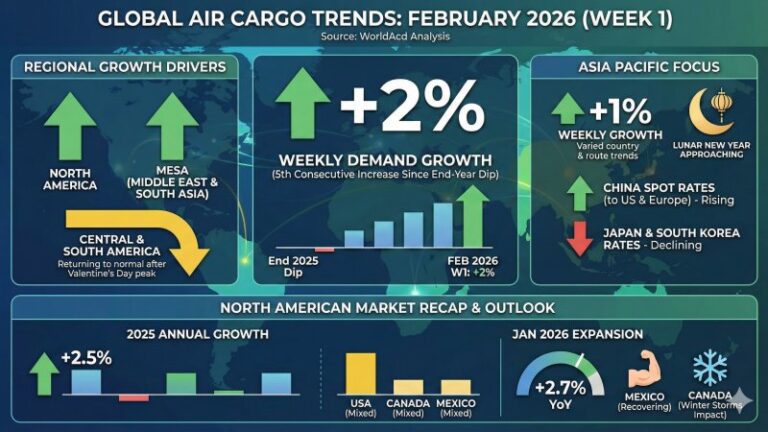
- Global air cargo demand continued to expand in the first week of February 2026, up 2% week on week, according to WorldAcd data. This marks the fifth consecutive increase following the year-end slowdown. North America and Mesa led the growth, while Central and South America eased back after the Valentine’s Day-driven peak.
- In Asia Pacific, volumes edged up 1% week on week, although trends varied by country and trade lane. Spot rates from China to the United States and Europe increased again, offsetting declines from Japan and South Korea, as the market adjusted ahead of the Lunar New Year.
- In 2025, the North American market closed with annual growth of 2.5%, though with significant differences between the United States, Canada and Mexico. January 2026 confirmed a 2.7% year-on-year expansion, with Mexico recovering and Canada affected by winter storms.
In week six of 2026, from 2 to 8 February, global air cargo demand rose by a further 2% compared with the previous week, marking the fifth consecutive increase after the customary year-end contraction. This is according to WorldAcd Market Data, based on more than 500,000 weekly transactions. The trend reflects a gradual normalisation of capacity, with freighter flights from Central and South America returning to standard levels after the seasonal flower peak ahead of Valentine’s Day on 14 February, and initial supply cuts by carriers in parts of Greater China ahead of the Lunar New Year on 17 February.
The most visible contribution to weekly growth came from North America, where tonnages rose 8% week on week. According to WorldAcd’s analysis, the rebound was linked to the restoration of capacity following the easing of winter storms that had led to service cuts across several parts of the continent in previous weeks. The Middle East and South Asia region, referred to as Mesa, also recorded strong growth of 7% compared with the previous week, after operational disruptions linked to tensions between the United States and Iran had affected flight regularity.
From Central and South America, volumes began to decline, falling 4% week on week after a 24% increase the previous week. The drop followed the end of the peak linked to flower shipments for Valentine’s Day, a logistics operation that each year mobilises hundreds of all-cargo flights and thousands of tonnes of freight from Colombia and Ecuador to Miami, Los Angeles and other North American hubs. The decline does not signal structural weakening in demand, but rather the conclusion of an especially intense seasonal phase.
From Asia Pacific, tonnages rose 1% compared with the previous week, although the picture varied by destination. Flows to the United States and Europe were broadly stable overall. To the United States, increases from Japan (+11%), Hong Kong (+6%) and China (+2%) were offset by declines from South Korea (-16%), Vietnam (-10%) and other parts of South-East Asia. On the pricing side, spot rates from China to the United States increased by 6% week on week to USD 4.69 per kilo, equivalent to around EUR 4.34 per kilo, while rates from Japan and South Korea fell by 10% and 14% respectively.
On the Asia Pacific–Europe lane, overall volumes were stable, but with marked differences between countries of origin. Shipments from Taiwan to Europe rose 6% week on week, marking the fifth consecutive weekly increase after the year-end slowdown, while Vietnam recorded a further 10% rise. Volumes from China were unchanged, while Japan and South Korea posted contractions. Average spot rates from Asia Pacific to Europe recorded a third consecutive weekly increase of 2%, supported mainly by a 6% rise from China to USD 4.09 per kilo, approximately EUR 3.78.
The Mesa–United States corridor was particularly dynamic, with volumes up 12% in week six. The figure reflects a 20% increase from Dubai to the United States, following a 26% drop the previous week linked to flight restrictions associated with geopolitical tensions, and a 14% rise from India after an 8% decline. Bangladesh posted a 17% increase, following a 10% rise the week before, confirming a recovery that began at the start of the year. Flows from Mesa to Europe also increased by 6%, although high volatility continues to make it difficult to identify a consolidated trend.
On an annual basis, the North American market analysis shows that 2025 was characterised by turbulence but closed with overall inbound and outbound volume growth of 2.5%. The United States, accounting for almost 90% of the regional total, recorded a 2.6% increase, Canada 8%, while Mexico saw a contraction of nearly 5%. Growth was balanced between inbound (+2.6%) and outbound (+2.3%) flows, with the United States at +2.8% and +2.2% respectively. Differences were more pronounced for Canada, with +9% inbound and +6% outbound, and for Mexico, with -6% inbound and -1% outbound. Compared with 2024, when North America recorded +9% inbound and +4% outbound, the figures point to a slowdown in the pace of expansion.
In January 2026, the region as a whole recorded a further year-on-year increase of 2.7%. However, winter storms affecting the United States and Canada may have weighed on results, particularly Canadian exports, which fell by almost 7% year on year during the month. Mexico showed the opposite trend: after a 5% contraction in 2025 overall, it recorded a 5% year-on-year increase in January, driven by a 14% rise in outbound flows and a more modest 1.5% increase in inbound traffic.
A.M.B.