






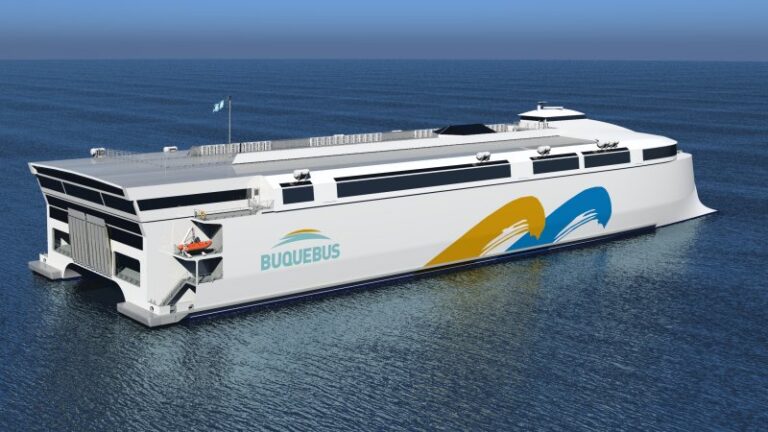
Between 17 and 19 January 2026, in the Derwent River at Hobart, Tasmania, Incat Tasmania completed the first sea trials of Hull 096, a fully electric catamaran ferry built for Buquebus and intended for services on the Río de la Plata between Argentina and Uruguay. The trials on the Derwent form part of a structured testing programme aimed at verifying the integration of the electrical system, hull manoeuvrability and the response of the control systems under operational conditions. Subsequent phases will include speed trials, exceeding 25 knots, with final delivery scheduled during 2026.
Hull 096, named China Zorrilla, is a 130-metre-long aluminium catamaran with a beam of 32 metres, capable of carrying up to 2,100 people, including passengers and crew, and 225 vehicles. The vessel is the ninth unit built by Incat for Buquebus, the Uruguayan operator active since 1982 on Río de la Plata routes. The project was originally conceived with LNG propulsion but was converted to full electric propulsion during construction.
A significant part of the innovation lies in the energy storage system and propulsion chain. The vessel features a distributed architecture across four battery rooms, with a total battery weight exceeding 250 tonnes. The system uses Corvus Blue Whale technology with lithium iron phosphate cells, which are cobalt-free. The configuration is modular, with remote battery management and design features tailored for maritime use, including cell-level thermal risk mitigation and controlled gas venting.
Wärtsilä designed the waterjet system and the permanent magnet electric motors across eight drive lines. Waterjets remain a consistent choice for high-speed ferries with frequent manoeuvring in ports and access channels, also offering advantages in terms of safety and reduced vibration and noise. Electrical power is supplemented by around 2,000 square metres of solar panels with a total output of 400 kW, primarily intended to cover part of the hotel loads and to make a marginal contribution to extending range.
The vessel is designed for short routes, with a declared autonomy of around 90 minutes, compatible with the Buenos Aires–Colonia del Sacramento crossing, estimated at approximately 58–60 kilometres. Fast direct-current recharging is expected to take about 40 minutes, making berth turnaround planning and the reliability of shore-side infrastructure critical. In terms of sustainability and electricity supply, Uruguay has a renewable share of over 90%, while on the Argentine side the energy mix includes a stronger presence of natural gas, alongside contributions from nuclear and renewable sources.