






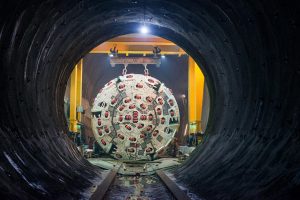
The most important of the four variants to the historic railway line—the direct access to the Brenner Base Tunnel—takes a significant operational step forward. On 20 June 2025, the engines of the tunnel boring machine at the Prader site, at the entrance to Funes in South Tyrol, will be switched on. Named “Kathrin”, following the tradition of giving female names to tunnel boring machines, it will advance into the mountain to create one of the main access points of this section.
The southern access variant to the Brenner Base Tunnel from Fortezza to Ponte Gardena runs almost entirely underground, consisting mainly of two tunnels and a railway viaduct that crosses the Isarco River with two tracks extending 250 metres. This viaduct is the only visible architectural structure of any significance. The first tunnel is the 15.4-kilometre-long Scaleres tunnel, followed closely by the 6.3-kilometre-long Gardena tunnel. Both are being excavated partly using traditional methods with explosives and pneumatic hammers, and partly with the aid of mechanical boring machines.
The launch of “Kathrin” is merely the latest step in a series of works that have been under way for some time. At the Forch access point, as of June 2025, over 1,000 metres have already been excavated with the tunnel boring machine out of a total of 1,300, with completion expected by July 2025. The machine will then be dismantled, and excavation will continue southward using traditional methods, both for the main tunnels and for the chambers from which the new tunnel boring machines will be launched. Progress is also being made at the Chiusa access point, where miners using explosives have reached 550 metres of excavation out of a total of 1,750.
The contract for the railway variant from Fortezza to Ponte Gardena was awarded by RFI in June 2021 to the Dolomiti Consortium, composed of Webuild as lead contractor and Implenia Construction as associate partner. The contract is worth more than 1.16 billion euros and includes a construction period of seven years, including the executive design phase. A key feature of this section is its maximum gradient of 12.5 per mille, which is favourable for the passage of heavy freight trains travelling through the base tunnel between Italy and Austria.
The new Fortezza–Ponte Gardena section avoids a steep stretch of the historic line, which features gradients of 22 per mille. For this reason, the variant is considered essential and prioritised over the other three already identified sections, which are either in the planning stage (Verona, Bolzano) or already under construction, such as the Trento freight bypass. Paradoxically, building a complex and costly structure like the base tunnel would make little sense if part of its advantages were lost due to access lines with major constraints—not in terms of profile, but of haulable mass.
Piermario Curti Sacchi